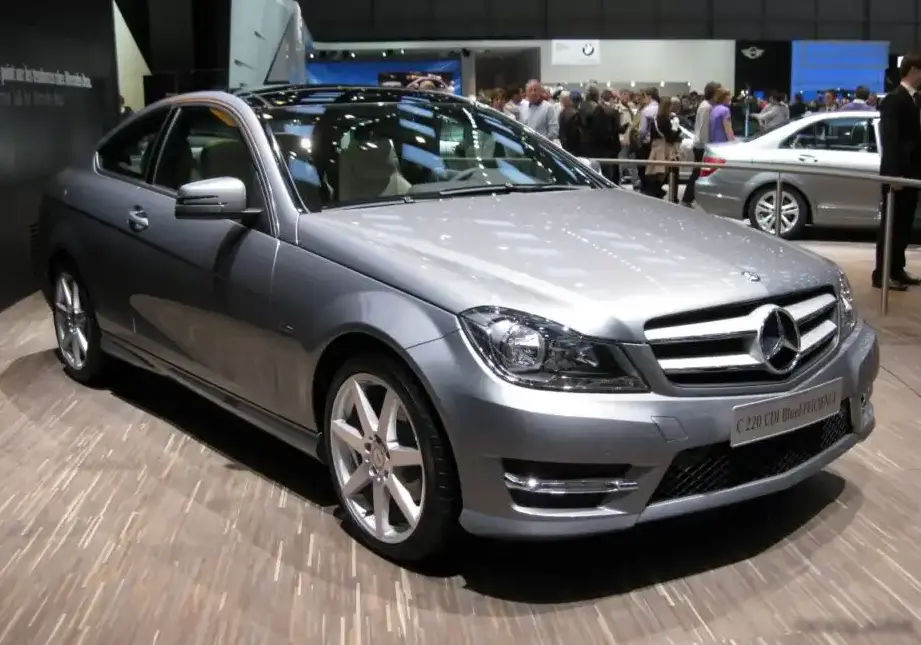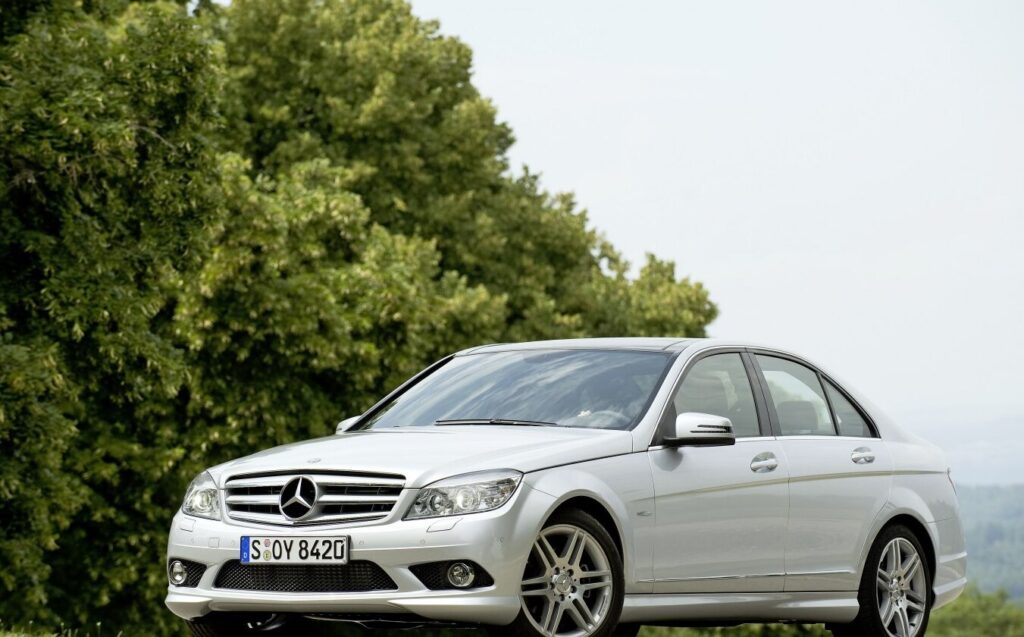
The Mercedes-Benz C-Class (W204) C 220 CDI BlueEFFICIENCY with the Start & Stop system was a diesel-powered variant of the popular C-Class, produced from 2010 to 2011. Positioned as a fuel-efficient and refined option within the W204 range, it aimed to balance performance with economy, appealing to buyers seeking a premium compact executive car. This model represented Mercedes-Benz’s efforts to improve fuel consumption and reduce emissions while maintaining the brand’s standards of luxury and driving comfort. It sat in the mid-range of the C-Class lineup, offering a step up from the base C 200 CDI but falling below the more powerful C 250 CDI and C 350 models.
Technical Specifications
| Brand | Mercedes-Benz |
| Model | C-class |
| Generation | C-class (W204) |
| Type (Engine) | C 220 CDI BlueEFFICIENCY (170 Hp) Start & Stop |
| Start of production | 2010 |
| End of production | 2011 |
| Powertrain Architecture | Internal Combustion engine |
| Body type | Sedan |
| Seats | 5 |
| Doors | 4 |
| Fuel consumption (urban) | 5.6-6.3 l/100 km (42 – 37.3 US mpg) |
| Fuel consumption (extra urban) | 3.7-4.3 l/100 km (63.6 – 54.7 US mpg) |
| Fuel consumption (combined) | 4.4-5.1 l/100 km (53.5 – 46.1 US mpg) |
| CO2 emissions | 117-133 g/km |
| Fuel Type | Diesel |
| Acceleration 0 – 100 km/h | 8.4 sec |
| Acceleration 0 – 62 mph | 8.4 sec |
| Acceleration 0 – 60 mph | 8 sec |
| Maximum speed | 232 km/h (144.16 mph) |
| Emission standard | Euro 5 |
| Weight-to-power ratio | 9.1 kg/Hp |
| Weight-to-torque ratio | 3.9 kg/Nm |
| Power | 170 Hp @ 3000-4200 rpm |
| Torque | 400 Nm @ 1400-2800 rpm (295.02 lb.-ft. @ 1400-2800 rpm) |
| Engine layout | Front, Longitudinal |
| Engine Model/Code | OM 651.911 |
| Engine displacement | 2143 cm3 (130.77 cu. in.) |
| Number of cylinders | 4 |
| Engine configuration | Inline |
| Cylinder Bore | 83 mm (3.27 in.) |
| Piston Stroke | 99 mm (3.9 in.) |
| Compression ratio | 16.2:1 |
| Number of valves per cylinder | 4 |
| Fuel injection system | Diesel Commonrail |
| Engine aspiration | Twin-Turbo, Intercooler |
| Valvetrain | DOHC |
| Engine oil capacity | 6.5 l (6.87 US qt | 5.72 UK qt) |
| Kerb Weight | 1540 kg (3395.12 lbs.) |
| Max. weight | 2120 kg (4673.8 lbs.) |
| Max load | 580 kg (1278.68 lbs.) |
| Trunk (boot) space | 475 l (16.77 cu. ft.) |
| Fuel tank capacity | 59 l (15.59 US gal | 12.98 UK gal) |
| Permitted trailer load (braked) | 1800 kg (3968.32 lbs.) |
| Permitted trailer load (unbraked) | 750 kg (1653.47 lbs.) |
| Length | 4581 mm (180.35 in.) |
| Width | 1770 mm (69.69 in.) |
| Width (with mirrors) | 2009 mm (79.09 in.) |
| Height | 1447 mm (56.97 in.) |
| Wheelbase | 2760 mm (108.66 in.) |
| Front track | 1549 mm (60.98 in.) |
| Rear track | 1552 mm (61.1 in.) |
| Front overhang | 765 mm (30.12 in.) |
| Rear overhang | 1056 mm (41.57 in.) |
| Drag coefficient (Cd) | 0.28 |
| Minimum turning circle | 10.84 m (35.56 ft.) |
| Drivetrain | Rear wheel drive |
| Number of gears | 6 |
| Gearbox type | Manual transmission |
| Front suspension | Independent type McPherson, Transverse stabilizer |
| Rear suspension | Independent multi-link suspension, Transverse stabilizer |
| Front brakes | Ventilated discs |
| Rear brakes | Disc |
| Assisting systems | ABS (Anti-lock braking system) |
| Steering type | Steering rack and pinion |
| Power steering | Hydraulic Steering |
| Tires size | 205/55 R16 |
| Wheel rims size | 7J x 16 |
INTRODUCTION
The W204 C-Class, launched in 2007, represented a significant step forward for Mercedes-Benz in terms of build quality and technology. The C 220 CDI BlueEFFICIENCY, introduced in 2010, was a key component of this generation, designed to appeal to European markets increasingly focused on fuel efficiency and lower emissions. The “BlueEFFICIENCY” designation signified a range of measures taken to reduce fuel consumption, including optimized aerodynamics, reduced rolling resistance tires, and the implementation of the Start & Stop system. This variant was primarily sold in Europe, where diesel engines held a much larger market share than in the United States.
Powertrain & Engine Architecture
At the heart of the C 220 CDI BlueEFFICIENCY lay the OM 651.911, a 2.1-liter inline-four cylinder diesel engine. This engine was a product of Mercedes-Benz’s advanced diesel technology, featuring common-rail direct injection and a sophisticated twin-turbocharger system. The twin-turbo setup, consisting of a small, low-pressure turbo and a larger, high-pressure turbo, provided both excellent low-end torque and strong top-end power. The engine utilized a 16.2:1 compression ratio, contributing to its thermal efficiency. The Start & Stop system automatically shut off the engine when the vehicle came to a standstill, such as at traffic lights, and restarted it instantly when the driver released the brake pedal. The engine was paired with a 6-speed manual transmission, delivering power to the rear wheels. While an automatic transmission was available as an option, the manual was often preferred by drivers seeking greater control and fuel economy.
Driving Characteristics
The C 220 CDI BlueEFFICIENCY offered a refined and comfortable driving experience. While not a sports car, the 170 horsepower and 400 Nm (295 lb-ft) of torque provided ample power for everyday driving and overtaking maneuvers. Acceleration from 0 to 100 km/h (0-62 mph) took approximately 8.4 seconds, and the car had a top speed of 232 km/h (144 mph). The manual transmission allowed for precise gear changes, and the engine’s strong low-end torque meant that frequent downshifting wasn’t necessary. Compared to the more powerful C 250 CDI, the C 220 CDI felt less urgent in its acceleration, but it offered a more relaxed and fuel-efficient driving experience. The suspension provided a good balance between comfort and handling, making it suitable for both city driving and longer journeys.
Equipment & Trim Levels
The C 220 CDI BlueEFFICIENCY came standard with a respectable level of equipment, including air conditioning, power windows, central locking, and an audio system. Higher trim levels offered options such as leather upholstery, a sunroof, navigation system, and parking sensors. The interior design was typical of Mercedes-Benz, with a focus on quality materials and a sophisticated layout. The dashboard featured analog gauges and a multi-function display. Safety features included ABS, ESP, and multiple airbags.
Chassis & Braking
The W204 C-Class featured a robust chassis with independent suspension at all four wheels. The front suspension utilized a McPherson strut design, while the rear suspension employed a multi-link setup. This configuration provided a comfortable ride and good handling characteristics. The C 220 CDI was equipped with ventilated disc brakes at the front and solid disc brakes at the rear. ABS (Anti-lock Braking System) was standard, enhancing braking performance and stability. The steering was a rack-and-pinion system with hydraulic power assistance, providing precise and responsive steering feel.
Market Reception & Comparison
The C 220 CDI BlueEFFICIENCY was well-received by automotive critics for its fuel efficiency, refined engine, and comfortable ride. It was often praised as a sensible and practical choice for buyers seeking a premium compact executive car. Compared to the C 250 CDI, the C 220 CDI offered lower running costs but less outright performance. The C 200 CDI, the entry-level diesel variant, provided even better fuel economy but lacked the C 220 CDI’s extra power. The C 220 CDI struck a good balance between these two extremes, making it a popular choice for many buyers.
Legacy
The OM 651 engine family, including the 2.1-liter unit found in the C 220 CDI, proved to be remarkably reliable. With proper maintenance, these engines can accumulate high mileage without major issues. The C 220 CDI BlueEFFICIENCY remains a relatively common sight on the used car market today, and well-maintained examples continue to offer a compelling combination of fuel efficiency, comfort, and reliability. The Start & Stop system, while initially met with some skepticism, has become a standard feature on many modern vehicles, demonstrating the effectiveness of Mercedes-Benz’s BlueEFFICIENCY technology.