
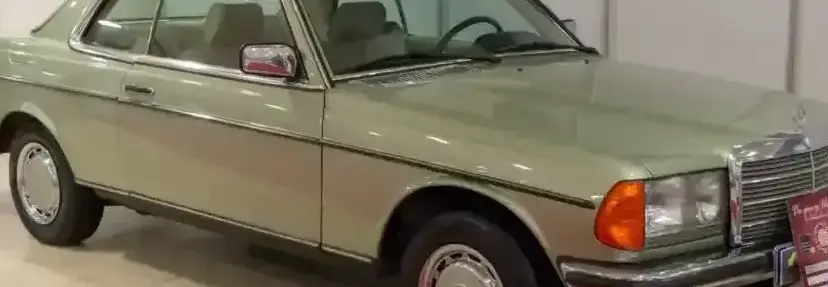
The Mercedes-Benz C123 230 CE, produced between February 1980 and August 1985, represents a significant iteration within the broader W123 series. Positioned as the coupe variant of the popular W123, the 230 CE offered a more sporting and stylish alternative to the sedan and wagon body styles. It was a key model in Mercedes-Benz’s strategy to offer a premium, yet relatively accessible, entry point into the coupe market, appealing to buyers who desired the Mercedes-Benz experience in a more compact and visually appealing package. The C123 chassis code specifically denotes the coupe version of the W123 platform.
Technical Specifications
| Brand | Mercedes-Benz |
| Model | W123 |
| Generation | C123 |
| Type (Engine) | 230 CE (136 Hp) |
| Start of production | February, 1980 |
| End of production | August, 1985 |
| Powertrain Architecture | Internal Combustion engine |
| Body type | Coupe |
| Seats | 4 |
| Doors | 2 |
| Fuel consumption (urban) | 13.1 l/100 km (18 US mpg, 21.6 UK mpg, 7.6 km/l) |
| Fuel consumption (extra urban) | 8.1 l/100 km (29 US mpg, 34.9 UK mpg, 12.3 km/l) |
| Fuel Type | Petrol (Gasoline) |
| Acceleration 0 – 100 km/h | 11.5 sec |
| Acceleration 0 – 62 mph | 11.5 sec |
| Acceleration 0 – 60 mph | 10.9 sec |
| Maximum speed | 180 km/h (111.85 mph) |
| Weight-to-power ratio | 10.1 kg/Hp, 98.6 Hp/tonne |
| Weight-to-torque ratio | 6.7 kg/Nm, 148.6 Nm/tonne |
| Power | 136 Hp @ 5100 rpm |
| Power per litre | 59.2 Hp/l |
| Torque | 205 Nm @ 3500 rpm (151.2 lb.-ft. @ 3500 rpm) |
| Engine layout | Front, Longitudinal |
| Engine Model/Code | M 102 E 23 / 102.980 |
| Engine displacement | 2299 cm3 (140.29 cu. in.) |
| Number of cylinders | 4 |
| Engine configuration | Inline |
| Cylinder Bore | 95.5 mm (3.76 in.) |
| Piston Stroke | 80.25 mm (3.16 in.) |
| Compression ratio | 9:1 |
| Number of valves per cylinder | 2 |
| Fuel injection system | Multi-port manifold injection |
| Engine aspiration | Naturally aspirated engine |
| Valvetrain | SOHC |
| Engine oil capacity | 5 l (5.28 US qt | 4.4 UK qt) |
| Coolant | 8.5 l (8.98 US qt | 7.48 UK qt) |
| Kerb Weight | 1380 kg (3042.38 lbs.) |
| Max. weight | 1900 kg (4188.78 lbs.) |
| Max load | 520 kg (1146.4 lbs.) |
| Fuel tank capacity | 65 l (17.17 US gal | 14.3 UK gal) |
| Length | 4640 mm (182.68 in.) |
| Width | 1786 mm (70.31 in.) |
| Height | 1395 mm (54.92 in.) |
| Wheelbase | 2710 mm (106.69 in.) |
| Front track | 1488 mm (58.58 in.) |
| Rear track | 1446 mm (56.93 in.) |
| Drivetrain Architecture | The Internal combustion engine (ICE) drives the rear wheels of the vehicle. |
| Drive wheel | Rear wheel drive |
| Number of gears | 4 gears, manual transmission |
| Front suspension | Double wishbone |
| Rear suspension | Trailing arm |
| Front brakes | Disc |
| Rear brakes | Disc |
| Steering type | Cone worm with recirculation balls |
| Power steering | Hydraulic Steering |
| Tires size | Front wheel tires: 195/70 R14Rear wheel tires: 195/70 R14 |
| Wheel rims size | Front wheel rims: 6J x 14Rear wheel rims: 6J x 14 |
Powertrain & Engine Architecture
The 230 CE was powered by the M102 E 23 engine, a 2.3-liter inline-four cylinder gasoline engine. This engine, designated with the code 102.980, was a mainstay of the Mercedes-Benz lineup during the 1980s. It featured a single overhead camshaft (SOHC) valvetrain operating two valves per cylinder. The engine utilized Bosch K-Jetronic multi-port fuel injection, a mechanical fuel injection system known for its reliability and precise fuel delivery. This system, while not as sophisticated as later electronic fuel injection systems, provided good performance and fuel economy for its time. The engine produced 136 horsepower at 5100 rpm and 205 Nm (151.2 lb-ft) of torque at 3500 rpm. The engine was mounted longitudinally in the front of the vehicle, driving the rear wheels. The standard transmission was a four-speed manual, though an optional four-speed automatic transmission was also available.
Driving Characteristics
The 230 CE with the manual transmission offered a reasonably engaging driving experience for its era. While not a sports car, the engine provided adequate power for comfortable cruising and overtaking. The four-speed manual gearbox allowed for precise control, though the gear ratios were spaced to prioritize fuel economy and smooth operation rather than outright acceleration. The automatic transmission, while offering convenience, noticeably dulled the car’s performance. Acceleration from 0 to 60 mph took approximately 10.9 seconds, and top speed was limited to 180 km/h (112 mph). Compared to the higher-performance 280 CE (with its inline-six engine), the 230 CE felt less powerful, but it offered a better balance of performance and fuel efficiency. The suspension, tuned for comfort, provided a smooth ride, but body roll was noticeable in corners.
Equipment & Trim Levels
The 230 CE was generally well-equipped for its price point. Standard features included power-assisted steering, disc brakes on all four wheels, and a comfortable interior with cloth upholstery. Optional extras included leather upholstery, air conditioning, a sunroof, and upgraded audio systems. The interior design was typical of Mercedes-Benz in the early 1980s – functional, well-built, and understated. The dashboard featured a woodgrain trim and clear, easy-to-read gauges. The 230 CE occupied a mid-range position in the C123 coupe lineup, offering a step up in refinement and performance compared to the base 200 CE, but falling short of the luxury and power of the 280 CE.
Chassis & Braking
The C123 chassis featured independent suspension all around. The front suspension utilized a double wishbone design, while the rear suspension employed a trailing arm setup. This configuration provided a comfortable ride and good handling characteristics. The braking system consisted of disc brakes on all four wheels, providing adequate stopping power. The steering was a recirculating ball system with hydraulic power assistance, offering a good balance of feel and ease of use. The car’s weight of approximately 1380 kg (3042 lbs) contributed to its stable handling, but also limited its acceleration.
Market Reception & Comparison
The Mercedes-Benz C123 230 CE was generally well-received by automotive critics. It was praised for its build quality, comfortable ride, and refined interior. However, some critics noted that the engine lacked the power of its larger counterparts. Compared to the 200 CE, the 230 CE offered a noticeable improvement in performance. Compared to the 280 CE, it was more affordable and fuel-efficient, but less powerful and luxurious. Fuel economy was respectable for the time, averaging around 13.1 l/100 km (18 US mpg) in urban driving and 8.1 l/100 km (29 US mpg) on the highway.
Legacy
The M102 engine, found in the 230 CE, is known for its durability and reliability. With proper maintenance, these engines can last for hundreds of thousands of miles. The C123 coupes, in general, have become increasingly collectible in recent years, particularly well-maintained examples. The 230 CE represents a sweet spot in the lineup, offering a good balance of performance, comfort, and affordability. While parts availability can be a challenge, a dedicated community of Mercedes-Benz enthusiasts ensures that parts and expertise are still available for these classic vehicles. Today, the 230 CE is appreciated for its timeless design, solid engineering, and enduring appeal.
