
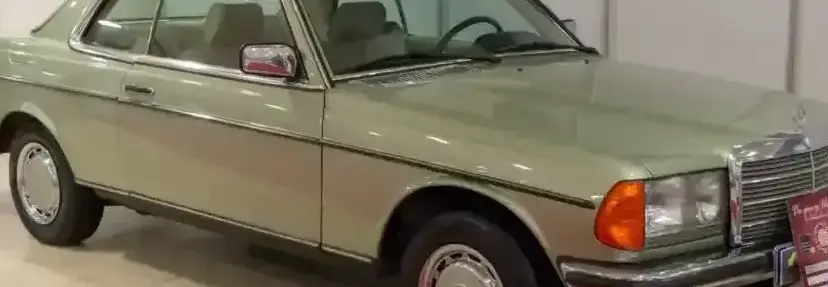
The Mercedes-Benz C123 280 CE, produced between April 1978 and August 1985, represents a significant iteration within the broader W123 series. Positioned as the coupe variant of the popular W123 sedan and estate, the 280 CE offered a more sporting and luxurious experience. It was a key model in Mercedes-Benz’s strategy to provide a premium, yet relatively accessible, grand touring vehicle for the European and North American markets. The C123 chassis code specifically denotes the coupe body style, distinguishing it from the other W123 body configurations. This model aimed to blend Mercedes-Benz’s renowned build quality and comfort with a more dynamic driving experience than its four-door sibling.
Technical Specifications
| Brand | Mercedes-Benz |
| Model | W123 |
| Generation | C123 |
| Type (Engine) | 280 CE (185 Hp) |
| Start of production | April, 1978 |
| End of production | August, 1985 |
| Powertrain Architecture | Internal Combustion engine |
| Body type | Coupe |
| Seats | 4 |
| Doors | 2 |
| Fuel consumption (urban) | 15 l/100 km (15.7 US mpg, 18.8 UK mpg, 6.7 km/l) |
| Fuel consumption (extra urban) | 9.3 l/100 km (25.3 US mpg, 30.4 UK mpg, 10.8 km/l) |
| Fuel Type | Petrol (Gasoline) |
| Acceleration 0 – 100 km/h | 9.9 sec |
| Acceleration 0 – 62 mph | 9.9 sec |
| Acceleration 0 – 60 mph | 9.4 sec |
| Maximum speed | 200 km/h (124.27 mph) |
| Weight-to-power ratio | 7.9 kg/Hp, 126.7 Hp/tonne |
| Weight-to-torque ratio | 6.1 kg/Nm, 164.4 Nm/tonne |
| Power | 185 Hp @ 5800 rpm |
| Power per litre | 67.4 Hp/l |
| Torque | 240 Nm @ 4500 rpm (177.01 lb.-ft. @ 4500 rpm) |
| Engine layout | Front, Longitudinal |
| Engine Model/Code | M 110 E 28 / 110.984 |
| Engine displacement | 2746 cm3 (167.57 cu. in.) |
| Number of cylinders | 6 |
| Engine configuration | Inline |
| Cylinder Bore | 86 mm (3.39 in.) |
| Piston Stroke | 78.8 mm (3.1 in.) |
| Compression ratio | 9:1 |
| Number of valves per cylinder | 2 |
| Fuel injection system | Multi-port manifold injection |
| Engine aspiration | Naturally aspirated engine |
| Valvetrain | DOHC |
| Engine oil capacity | 7 l (7.4 US qt | 6.16 UK qt) |
| Coolant | 10 l (10.57 US qt | 8.8 UK qt) |
| Kerb Weight | 1460 kg (3218.75 lbs.) |
| Max. weight | 1980 kg (4365.15 lbs.) |
| Max load | 520 kg (1146.4 lbs.) |
| Fuel tank capacity | 80 l (21.13 US gal | 17.6 UK gal) |
| Length | 4640 mm (182.68 in.) |
| Width | 1786 mm (70.31 in.) |
| Height | 1395 mm (54.92 in.) |
| Wheelbase | 2710 mm (106.69 in.) |
| Front track | 1488 mm (58.58 in.) |
| Rear track | 1446 mm (56.93 in.) |
| Drivetrain Architecture | The Internal combustion engine (ICE) drives the rear wheels of the vehicle. |
| Drive wheel | Rear wheel drive |
| Number of gears | 4 gears, manual transmission |
| Front suspension | Double wishbone |
| Rear suspension | Trailing arm |
| Front brakes | Disc |
| Rear brakes | Disc |
| Steering type | Cone worm with recirculation balls |
| Power steering | Hydraulic Steering |
| Tires size | Front wheel tires: 195/70 R14Rear wheel tires: 195/70 R14 |
| Wheel rims size | Front wheel rims: 6J x 14Rear wheel rims: 6J x 14 |
Powertrain & Engine Architecture
The heart of the 280 CE is the M110 E 28 inline-six engine, a 2.8-liter (2746 cc) naturally aspirated powerplant. This engine, a descendant of the long-running M110 family, featured a cast iron block and an aluminum cylinder head. It employed a dual overhead camshaft (DOHC) valvetrain, operating two valves per cylinder. Fuel delivery was handled by a Bosch K-Jetronic multi-port fuel injection system, a sophisticated system for its time that contributed to improved fuel efficiency and reduced emissions compared to carbureted engines. The engine produced 185 horsepower at 5800 rpm and 240 Nm (177 lb-ft) of torque at 4500 rpm. The engine’s longitudinal mounting and rear-wheel drive configuration were typical of Mercedes-Benz vehicles of this era. The standard transmission was a four-speed manual, though an optional four-speed automatic transmission was also available, and was a popular choice for buyers prioritizing comfort and ease of driving.
Driving Characteristics
The 280 CE, even with the 185 hp engine, wasn’t designed to be a high-performance sports car. Instead, it offered a refined and comfortable grand touring experience. The manual transmission provided a more engaging driving experience, allowing drivers to fully utilize the engine’s power band. However, the automatic transmission, while less sporty, offered smooth shifts and made the car more accessible for everyday driving. Acceleration from 0 to 60 mph took around 9.4 seconds, and top speed was approximately 124 mph. The car’s weight (around 3200 lbs) did impact its agility, but the well-tuned suspension – featuring double wishbones at the front and a trailing arm setup at the rear – provided a comfortable ride and predictable handling. Compared to the smaller, less powerful 230 CE, the 280 CE offered noticeably more performance, particularly in highway passing situations. It also provided a more relaxed cruising experience than the more performance-oriented, but less refined, models like the 280E sedan.
Equipment & Trim Levels
The 280 CE was positioned as a premium offering within the W123 coupe range. Standard equipment included power-assisted steering, disc brakes on all four wheels, and comfortable cloth upholstery. Leather upholstery, air conditioning, a sunroof, and upgraded audio systems were available as optional extras. Interior trim levels varied, with options for wood veneer accents and different color combinations. The dashboard layout was typical of Mercedes-Benz in the late 1970s and early 1980s, featuring a clean and functional design with clearly marked gauges. The coupe’s interior, while sharing many components with the sedan, felt more intimate and driver-focused.
Chassis & Braking
The C123 chassis was based on a reinforced version of the W123 sedan platform. The suspension system was designed to provide a balance between comfort and handling. The front suspension utilized double wishbones, coil springs, and anti-roll bar, while the rear suspension employed a trailing arm setup with coil springs. All four wheels were equipped with disc brakes, providing ample stopping power. The steering system was a cone worm with recirculation balls, offering precise and responsive steering feel. Tire size was typically 195/70 R14, providing a good compromise between ride comfort and grip.
Market Reception & Comparison
The C123 280 CE was generally well-received by automotive critics. It was praised for its build quality, comfortable ride, and refined engine. However, some critics noted that its performance was not as exhilarating as some of its competitors, such as the BMW 3 Series coupe. Fuel economy was reasonable for the time, averaging around 15.7 mpg in the city and 25.3 mpg on the highway. Compared to the 230 CE, the 280 CE offered a significant performance upgrade, but at a higher price point. The 280 CE also offered a more luxurious and refined experience than the more basic W123 models.
Legacy
The Mercedes-Benz C123 280 CE has become a sought-after classic car among enthusiasts. The M110 engine is known for its durability and reliability, and well-maintained examples can still provide years of trouble-free service. However, like all classic Mercedes-Benz vehicles, the 280 CE requires regular maintenance and attention to detail. Parts availability is generally good, but some components can be expensive. Today, the C123 280 CE represents a stylish and well-engineered grand tourer from a golden era of Mercedes-Benz design. Its blend of comfort, refinement, and durability has ensured its enduring appeal among collectors and enthusiasts alike.
