
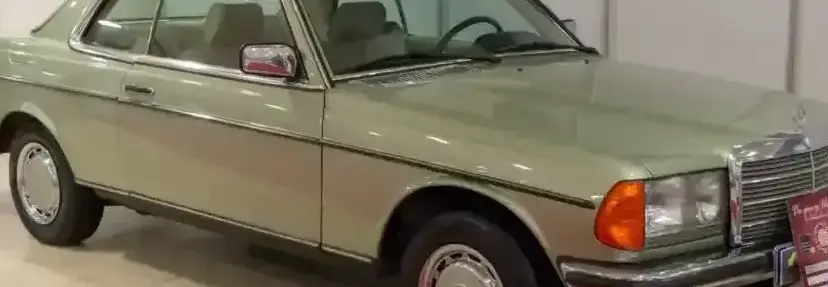
The Mercedes-Benz C123 280 CE, produced between April 1978 and August 1985, represents a sophisticated evolution of the iconic W123 series. This two-door coupe, positioned as the more sporting and luxurious variant within the W123 range, offered a blend of performance and comfort that appealed to a discerning clientele. The “CE” designation signified “Coupé with fuel injection,” highlighting a key feature of this model. It occupied a premium space in the lineup, above the more basic 230 CE and 200 CE models, and below the even more exclusive 300 CE. The 280 CE was a significant offering for Mercedes-Benz in Europe and increasingly in the North American market, where demand for luxury coupes was growing.
Technical Specifications
| Brand | Mercedes-Benz |
| Model | W123 |
| Generation | C123 |
| Type (Engine) | 280 CE (185 Hp) Automatic |
| Start of production | April, 1978 |
| End of production | August, 1985 |
| Powertrain Architecture | Internal Combustion engine |
| Body type | Coupe |
| Seats | 4 |
| Doors | 2 |
| Fuel consumption (urban) | 14.8 l/100 km (15.9 US mpg, 19.1 UK mpg, 6.8 km/l) |
| Fuel consumption (extra urban) | 9.8 l/100 km (24 US mpg, 28.8 UK mpg, 10.2 km/l) |
| Fuel Type | Petrol (Gasoline) |
| Acceleration 0 – 100 km/h | 10.8 sec |
| Acceleration 0 – 62 mph | 10.8 sec |
| Acceleration 0 – 60 mph | 10.3 sec |
| Maximum speed | 195 km/h (121.17 mph) |
| Weight-to-power ratio | 7.9 kg/Hp, 126.7 Hp/tonne |
| Weight-to-torque ratio | 6.1 kg/Nm, 164.4 Nm/tonne |
| Power | 185 Hp @ 5800 rpm |
| Power per litre | 67.4 Hp/l |
| Torque | 240 Nm @ 4500 rpm (177.01 lb.-ft. @ 4500 rpm) |
| Engine layout | Front, Longitudinal |
| Engine Model/Code | M 110 E 28 / 110.984 |
| Engine displacement | 2746 cm3 (167.57 cu. in.) |
| Number of cylinders | 6 |
| Engine configuration | Inline |
| Cylinder Bore | 86 mm (3.39 in.) |
| Piston Stroke | 78.8 mm (3.1 in.) |
| Compression ratio | 9:1 |
| Number of valves per cylinder | 2 |
| Fuel injection system | Multi-port manifold injection |
| Engine aspiration | Naturally aspirated engine |
| Valvetrain | DOHC |
| Engine oil capacity | 7 l (7.4 US qt | 6.16 UK qt) |
| Coolant | 10 l (10.57 US qt | 8.8 UK qt) |
| Kerb Weight | 1460 kg (3218.75 lbs.) |
| Max. weight | 1980 kg (4365.15 lbs.) |
| Max load | 520 kg (1146.4 lbs.) |
| Fuel tank capacity | 80 l (21.13 US gal | 17.6 UK gal) |
| Length | 4640 mm (182.68 in.) |
| Width | 1786 mm (70.31 in.) |
| Height | 1395 mm (54.92 in.) |
| Wheelbase | 2710 mm (106.69 in.) |
| Front track | 1488 mm (58.58 in.) |
| Rear track | 1446 mm (56.93 in.) |
| Drivetrain Architecture | Rear wheel drive |
| Number of gears | 4 |
| Gearbox type | Automatic transmission |
| Front suspension | Double wishbone |
| Rear suspension | Trailing arm |
| Front brakes | Disc |
| Rear brakes | Disc |
| Steering type | Cone worm with recirculation balls |
| Power steering | Hydraulic |
| Tires size | 195/70 R14 |
| Wheel rims size | 6J x 14 |
Powertrain & Engine Architecture
The heart of the 280 CE was the M110 E 28 inline-six engine, a 2.8-liter (2746 cc) naturally aspirated powerplant. This engine, a descendant of the long-running M110 family, featured a cast-iron block and aluminum cylinder head. It employed a dual overhead camshaft (DOHC) valvetrain operating two valves per cylinder. Bosch K-Jetronic fuel injection was standard, providing precise fuel delivery for improved efficiency and performance. The M110 was known for its smoothness and durability. The engine produced 185 horsepower at 5800 rpm and 240 Nm (177 lb-ft) of torque at 4500 rpm. This power was channeled through a four-speed automatic transmission, a common pairing for the 280 CE, designed for comfortable cruising rather than outright sportiness. The transmission was electronically controlled, offering smoother shifts compared to earlier hydraulic systems.
Driving Characteristics
The 280 CE Automatic offered a refined and comfortable driving experience. While not as overtly sporty as a manual transmission-equipped model, the automatic provided effortless acceleration and smooth gear changes. The 0-60 mph time of around 10.3 seconds was respectable for the era, and the car could achieve a top speed of 195 km/h (121 mph). The automatic transmission’s gear ratios were geared towards relaxed highway cruising, making it an excellent grand tourer. Compared to the 230 CE, the 280 CE offered noticeably more power and torque, resulting in stronger acceleration and more confident overtaking. However, it lacked the responsiveness of the manual gearbox and the fuel efficiency of the smaller-engined models.
Equipment & Trim Levels
The 280 CE came well-equipped as standard. Interior appointments typically included comfortable cloth or leather upholstery, wood trim on the dashboard and door panels, and power windows. Air conditioning was a common option, as were a sunroof and upgraded audio systems. The instrument cluster was typically a combination of analog gauges and warning lights, providing essential information to the driver. Optional extras included automatic climate control, heated seats, and a trip computer. The overall interior ambiance was one of understated luxury and quality craftsmanship, typical of Mercedes-Benz at the time.
Chassis & Braking
The C123 chassis featured independent suspension all around, with double wishbones at the front and a trailing arm setup at the rear. This configuration provided a comfortable ride and good handling characteristics. Disc brakes were fitted to all four wheels, offering ample stopping power. Power-assisted steering was standard, making the car easy to maneuver. The 280 CE’s weight of approximately 1460 kg (3218 lbs) was relatively high, but the suspension and brakes were well-matched to handle the car’s mass. Stabilizer bars were fitted front and rear to reduce body roll during cornering.
Market Reception & Comparison
The 280 CE was generally well-received by automotive critics. It was praised for its comfortable ride, refined engine, and luxurious interior. However, some critics noted that the automatic transmission dulled the driving experience compared to the manual gearbox. Fuel economy, at around 15.9 US mpg in the city and 24 US mpg on the highway, was typical for a car of its size and performance in the 1980s. Compared to the 230 CE, the 280 CE offered a significant performance upgrade but came at a higher price. The 300 CE, with its larger engine, offered even more power but was considerably more expensive.
Legacy
The Mercedes-Benz C123 280 CE remains a sought-after classic car today. The M110 engine is known for its reliability and longevity, provided it has been properly maintained. Parts availability is generally good, although some specific components can be difficult to find. The 280 CE’s combination of style, comfort, and performance has ensured its enduring appeal among Mercedes-Benz enthusiasts. Well-maintained examples command premium prices in the used car market, reflecting their status as a desirable and collectible classic.
