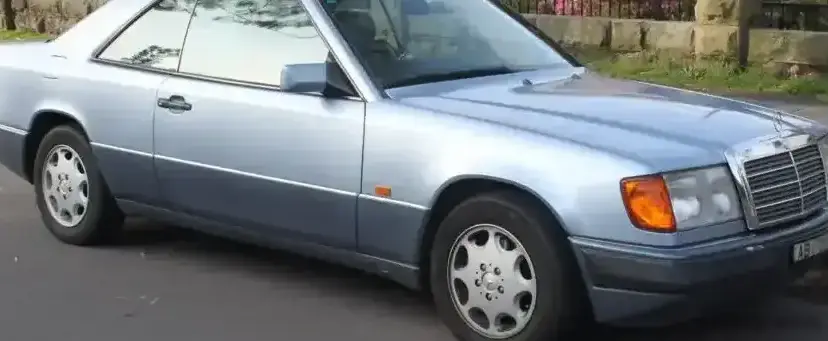
The Mercedes-Benz C124 200 CE CAT, produced from March 1990 to December 1992, represents a key variant within the W124 coupe range. Positioned as an entry-level offering in the C124 lineup, it provided a more accessible pathway into Mercedes-Benz coupe ownership compared to the higher-performance 230 CE or the flagship 320 CE models. This model, equipped with a 2.0-liter inline-four engine and a catalytic converter (“CAT” designation), was primarily aimed at buyers seeking a blend of Mercedes-Benz luxury, reliability, and reasonable running costs. The C124 itself was a significant model for Mercedes-Benz, representing a modern evolution of the earlier W114 and W123 coupes, and setting a new standard for safety and build quality in its segment.
Technical Specifications
| Brand | Mercedes-Benz |
| Model | W124 |
| Generation | C124 (facelift 1989) |
| Type (Engine) | 200 CE CAT (118 Hp) |
| Start of production | March, 1990 |
| End of production | December, 1992 |
| Powertrain Architecture | Internal Combustion engine |
| Body type | Coupe |
| Seats | 4 |
| Doors | 2 |
| Fuel consumption (urban) | 11.4 l/100 km (20.6 US mpg) |
| Fuel consumption (extra urban) | 6.3 l/100 km (37.3 US mpg) |
| Fuel Type | Petrol (Gasoline) |
| Acceleration 0 – 100 km/h | 12.5 sec |
| Acceleration 0 – 62 mph | 12.5 sec |
| Acceleration 0 – 60 mph | 11.9 sec |
| Maximum speed | 193 km/h (119.92 mph) |
| Weight-to-power ratio | 11.5 kg/Hp |
| Weight-to-torque ratio | 7.9 kg/Nm |
| Power | 118 Hp @ 5200 rpm |
| Torque | 172 Nm @ 3500 rpm (126.86 lb.-ft. @ 3500 rpm) |
| Engine layout | Front, Longitudinal |
| Engine Model/Code | M 102 E 20 / 102.963 |
| Engine displacement | 1996 cm3 (121.8 cu. in.) |
| Number of cylinders | 4 |
| Engine configuration | Inline |
| Cylinder Bore | 89 mm (3.5 in.) |
| Piston Stroke | 80.2 mm (3.16 in.) |
| Compression ratio | 9.1:1 |
| Number of valves per cylinder | 2 |
| Fuel injection system | Multi-port manifold injection |
| Engine aspiration | Naturally aspirated engine |
| Valvetrain | SOHC |
| Engine oil capacity | 5 l (5.28 US qt | 4.4 UK qt) |
| Coolant | 8.5 l (8.98 US qt | 7.48 UK qt) |
| Kerb Weight | 1360 kg (2998.29 lbs.) |
| Max. weight | 1850 kg (4078.55 lbs.) |
| Max load | 490 kg (1080.27 lbs.) |
| Fuel tank capacity | 70 l (18.49 US gal | 15.4 UK gal) |
| Length | 4655 mm (183.27 in.) |
| Width | 1740 mm (68.5 in.) |
| Height | 1394 mm (54.88 in.) |
| Wheelbase | 2715 mm (106.89 in.) |
| Front track | 1501 mm (59.09 in.) |
| Rear track | 1491 mm (58.7 in.) |
| Drivetrain Architecture | Rear wheel drive |
| Number of gears | 5 gears, manual transmission |
| Front suspension | Wishbone |
| Rear suspension | Independent multi-link suspension |
| Front brakes | Disc |
| Rear brakes | Disc |
| Assisting systems | ABS (Anti-lock braking system) |
| Steering type | Cone worm with recirculation balls |
| Power steering | Hydraulic Steering |
| Tires size | 195/65 R15 |
| Wheel rims size | 6.5J x 15 |
Powertrain & Engine Architecture
The 200 CE CAT was powered by the M102 E 20 engine, a 1996cc inline-four cylinder unit. This engine, a mainstay of Mercedes-Benz’s mid-size offerings for many years, featured a single overhead camshaft (SOHC) valvetrain operating two valves per cylinder. The engine utilized Bosch K-Jetronic fuel injection, a mechanical system known for its reliability and precise fuel delivery, though less sophisticated than later electronic systems. The “CAT” designation indicates the presence of a catalytic converter, mandated in many markets to reduce emissions. The engine produced 118 horsepower at 5200 rpm and 172 Nm (126.86 lb-ft) of torque at 3500 rpm. The five-speed manual transmission was standard, providing a relatively direct connection between the engine and the rear wheels.
Driving Characteristics
The 200 CE CAT offered a comfortable and refined driving experience, typical of Mercedes-Benz vehicles of the era. However, with only 118 hp propelling a curb weight of 1360 kg (approximately 2998 lbs), acceleration was not its strong suit. 0-60 mph took around 11.9 seconds, and top speed was around 119.92 mph. Compared to the 230 CE, which boasted significantly more power, the 200 CE felt noticeably slower, particularly when overtaking or climbing hills. The manual transmission, while providing more driver engagement than an automatic, required frequent shifting to maintain momentum. The gear ratios were tuned for fuel efficiency and cruising comfort rather than outright performance. The rear-wheel drive configuration provided balanced handling, but the relatively soft suspension setup prioritized ride quality over sporty handling.
Equipment & Trim Levels
The 200 CE CAT, as the entry-level C124 coupe, came reasonably well-equipped, reflecting Mercedes-Benz’s commitment to luxury even in its more affordable models. Standard features typically included power windows, central locking, a basic stereo system, and cloth upholstery. Leather upholstery, automatic climate control, a sunroof, and upgraded audio systems were available as optional extras. The interior design was classic Mercedes-Benz, characterized by high-quality materials and a functional, understated layout. The dashboard featured analog gauges and a straightforward control layout.
Chassis & Braking
The C124 chassis featured independent suspension all around, with a wishbone setup at the front and a multi-link arrangement at the rear. This provided a comfortable ride and good handling characteristics. The 200 CE CAT was equipped with disc brakes on all four wheels, offering adequate stopping power for its performance level. Anti-lock braking system (ABS) was standard, enhancing safety by preventing wheel lockup during hard braking. The steering was a recirculating ball system with hydraulic power assistance, providing a relatively light and precise feel.
Market Reception & Comparison
The 200 CE CAT was generally well-received by automotive critics as a sensible and well-built coupe. It was praised for its comfort, refinement, and reliability. However, its relatively modest performance was often noted. Compared to the 230 CE, the 200 CE offered a more affordable entry point into C124 ownership, but at the expense of performance. Fuel economy was a strong point, with the 200 CE achieving around 20.6 US mpg in the city and 37.3 US mpg on the highway. Reliability was also a key strength, with the M102 engine being known for its durability.
Legacy
The Mercedes-Benz C124 200 CE CAT has proven to be a remarkably durable and reliable vehicle. Many examples are still on the road today, a testament to the quality of engineering and construction. In the used car market, the 200 CE CAT is often sought after by enthusiasts who appreciate its classic styling, comfortable ride, and relatively simple mechanicals. While not a performance icon, it represents a solid and dependable entry point into classic Mercedes-Benz ownership. The M102 engine, while aging, remains relatively easy to maintain and repair, and parts availability is generally good. The C124 coupe, in all its variants, has become a beloved classic, and the 200 CE CAT holds a significant place in its history.