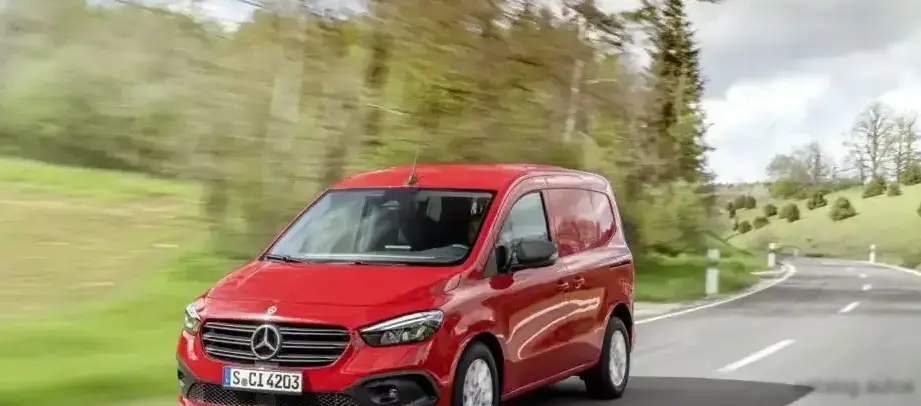
The Mercedes-Benz Citan II Panel Van 113, introduced in September 2021, represents the second generation of Mercedes-Benz’s compact van offering. Built in collaboration with Renault, the W420 Citan shares its platform with the Renault Kangoo, but receives distinct Mercedes-Benz styling and interior appointments. The “113” designation signifies the model’s engine and approximate power output – a 1.3-liter turbocharged gasoline engine producing 131 horsepower. This variant occupies a mid-range position within the Citan II lineup, offering a balance between affordability, fuel efficiency, and usability for commercial and private customers alike. It’s primarily aimed at businesses and individuals requiring a practical, yet relatively refined, small van for urban deliveries, tradespeople, or leisure activities.
Technical Specifications
| Brand | Mercedes-Benz |
| Model | Citan |
| Generation | Citan II Panel Van (W420) |
| Type (Engine) | 113 (131 Hp) |
| Start of production | September, 2021 |
| Powertrain Architecture | Internal Combustion engine |
| Body type | Minivan |
| Seats | 2-3 |
| Doors | 5 |
| Combined fuel consumption (WLTP) | 6.4-7.1 l/100 km (36.8 – 33.1 US mpg, 44.1 – 39.8 UK mpg, 15.6 – 14.1 km/l) |
| CO2 emissions (WLTP) | 146-161 g/km |
| Fuel Type | Petrol (Gasoline) |
| Acceleration 0 – 100 km/h | 12 sec |
| Acceleration 0 – 62 mph | 12 sec |
| Acceleration 0 – 60 mph | 11.4 sec |
| Maximum speed | 183 km/h (113.71 mph) |
| Emission standard | Euro 6d |
| Weight-to-power ratio | 10.5 kg/Hp, 94.9 Hp/tonne |
| Weight-to-torque ratio | 5.8 kg/Nm, 173.8 Nm/tonne |
| Power | 131 Hp @ 5000 rpm |
| Power per litre | 98.3 Hp/l |
| Torque | 240 Nm @ 1600 rpm (177.01 lb.-ft. @ 1600 rpm) |
| Engine layout | Front, Transverse |
| Engine Model/Code | M 200.731 |
| Engine displacement | 1332 cm3 (81.28 cu. in.) |
| Number of cylinders | 4 |
| Engine configuration | Inline |
| Compression ratio | 10.6:1 |
| Fuel injection system | Direct injection |
| Engine aspiration | Turbocharger, Intercooler |
| Engine oil capacity | 4.8 l (5.07 US qt | 4.22 UK qt) |
| Coolant | 7.2 l (7.61 US qt | 6.34 UK qt) |
| Kerb Weight | 1381-1628 kg (3044.58 – 3589.13 lbs.) |
| Max. weight | 2178 kg (4801.67 lbs.) |
| Max load | 550-797 kg (1212.54 – 1757.08 lbs.) |
| Trunk (boot) space – maximum | 2900 l (102.41 cu. ft.) |
| Fuel tank capacity | 54 l (14.27 US gal | 11.88 UK gal) |
| Max. roof load | 100 kg (220.46 lbs.) |
| Permitted trailer load with brakes (12%) | 1500 kg (3306.93 lbs.) |
| Permitted trailer load without brakes | 750 kg (1653.47 lbs.) |
| Length | 4498 mm (177.09 in.) |
| Width | 1859 mm (73.19 in.) |
| Height | 1832 mm (72.13 in.) |
| Wheelbase | 2716 mm (106.93 in.) |
| Front track | 1584 mm (62.36 in.) |
| Rear (Back) track | 1596 mm (62.83 in.) |
| Minimum turning circle (turning diameter) | 11.75 m (38.55 ft.) |
| Drivetrain Architecture | The Internal combustion engine (ICE) drives the front wheels of the vehicle. |
| Drive wheel | Front wheel drive |
| Number of gears and type of gearbox | 6 gears, manual transmission |
| Front suspension | Independent, type McPherson with coil spring and anti-roll bar |
| Rear suspension | Torsion |
| Front brakes | Ventilated discs |
| Rear brakes | Drum |
| Assisting systems | ABS (Anti-lock braking system) |
| Steering type | Steering rack and pinion |
| Power steering | Electric Steering |
| Tires size | 195/65 R15 95H; 205/60 R16 96H |
| Wheel rims size | 6J x 15 ET 35; 6J x 16 ET 38 |
Powertrain & Engine Architecture
The Citan 113 utilizes the M 200.731 engine, a 1.3-liter inline-four cylinder gasoline engine. This engine is part of Mercedes-Benz’s modular engine family and features direct fuel injection and a turbocharger with an intercooler. The direct injection system optimizes fuel delivery for improved efficiency and power output, while the turbocharger boosts performance by forcing more air into the cylinders. The engine produces 131 horsepower at 5000 rpm and 240 Nm (177 lb-ft) of torque at a low 1600 rpm, providing a good balance of power and responsiveness for everyday driving. The engine is paired with a six-speed manual transmission, delivering power to the front wheels. The engine incorporates a Start & Stop system to further enhance fuel economy and reduce emissions, and is equipped with a particulate filter to meet stringent Euro 6d emission standards.
Driving Characteristics
The Citan 113, with its 131 hp engine and manual transmission, offers adequate performance for urban and highway driving. Acceleration from 0 to 60 mph takes approximately 11.4 seconds, and the top speed is 183 km/h (113.71 mph). While not particularly sporty, the engine provides sufficient power for carrying loads and navigating traffic. The six-speed manual transmission allows for precise gear selection and helps to keep the engine in its optimal power band. Compared to higher-output versions of the Citan, the 113 feels less eager to accelerate, but it compensates with improved fuel economy. The gear ratios are tuned for practicality rather than performance, prioritizing fuel efficiency and ease of driving. Compared to diesel variants, the 113 offers a quieter and smoother driving experience, but lacks the low-end torque of the diesel engines.
Equipment & Trim Levels
The Citan 113 typically comes with a respectable level of standard equipment, focusing on functionality and practicality. Standard features include air conditioning, a basic audio system with Bluetooth connectivity, power windows, and central locking. Safety features such as ABS, electronic stability control, and driver and passenger airbags are also standard. Interior upholstery is typically durable fabric, and the dashboard features a functional, if somewhat basic, design. Optional extras include a touchscreen infotainment system with navigation, parking sensors, a rearview camera, and upgraded interior trim. Higher trim levels offer additional comfort and convenience features, such as cruise control and automatic climate control.
Chassis & Braking
The Citan II utilizes a front-wheel-drive layout with an independent McPherson strut suspension at the front and a torsion beam suspension at the rear. This setup provides a comfortable ride quality and predictable handling. The front brakes are ventilated discs, offering good stopping power, while the rear brakes are drums, a cost-saving measure common in this segment. The steering is electrically assisted, providing light and precise control. The chassis is designed to handle a substantial payload, with a maximum load capacity of up to 797 kg (1757.08 lbs). The suspension is tuned to prioritize ride comfort and stability when carrying loads.
Market Reception & Comparison
The Mercedes-Benz Citan II 113 has been generally well-received by critics as a practical and versatile small van. It’s praised for its fuel efficiency, comfortable ride, and relatively refined interior compared to some of its competitors. However, some reviewers have noted that the engine can feel underpowered when fully loaded. Compared to the diesel-powered Citan variants, the 113 offers lower running costs for those who primarily drive short distances, but lacks the diesel’s superior torque and fuel economy on longer journeys. Against competitors like the Volkswagen Caddy and the Citroën Berlingo, the Citan 113 holds its own in terms of practicality and features, benefiting from the Mercedes-Benz brand image.
Legacy
The M 200.731 engine, while relatively new, has demonstrated reasonable reliability in other Mercedes-Benz applications. The Citan II, as a whole, is expected to be a durable and long-lasting vehicle, benefiting from Mercedes-Benz’s reputation for build quality. On the used car market, the Citan 113 is likely to appeal to buyers seeking a practical and affordable small van with a premium badge. Its fuel efficiency and relatively low maintenance costs make it an attractive option for businesses and individuals alike. The combination of a gasoline engine and manual transmission may also appeal to buyers who prefer a more engaging driving experience.