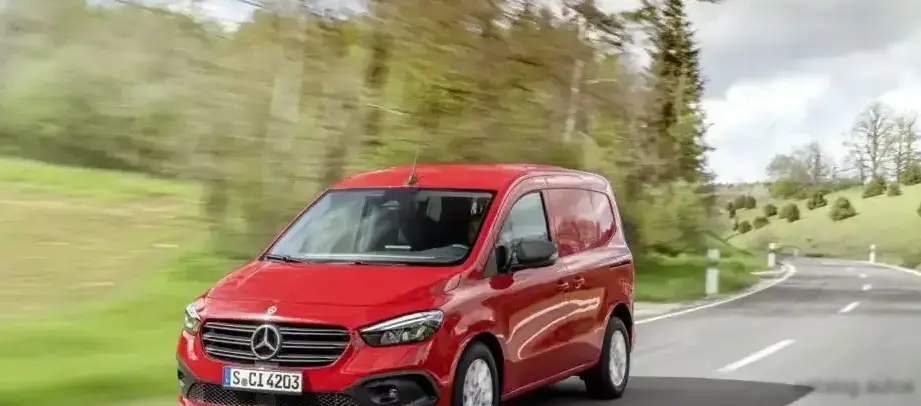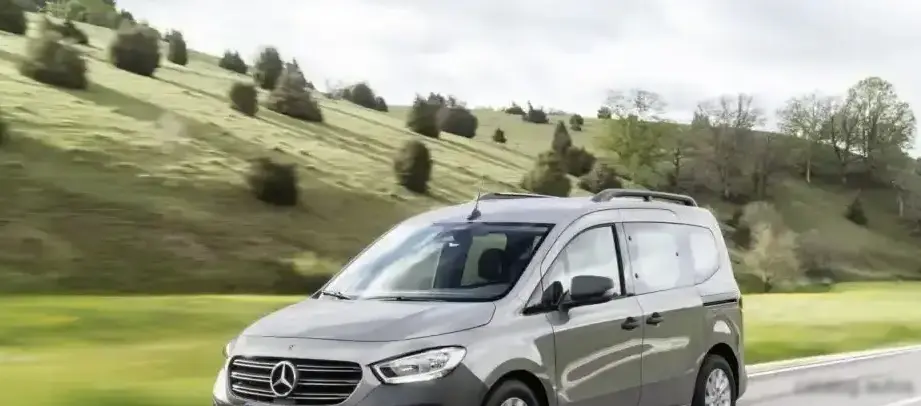
The Mercedes-Benz Citan II Tourer 110, produced from September 2021 onwards, represents an entry-level offering within the second generation (W420) of the Citan compact van. Positioned as a practical and economical choice, the 110 variant is characterized by its 1.3-liter turbocharged gasoline engine producing 102 horsepower. This model is primarily aimed at buyers prioritizing fuel efficiency and affordability over outright performance, serving as a versatile vehicle for both commercial and family use. The Citan II is a collaborative effort between Mercedes-Benz and Renault, sharing its platform and many components with the Renault Kangoo. This generation marked a significant upgrade over the first-generation Citan, offering improved refinement, safety features, and technology.
Technical Specifications
| Brand | Mercedes-Benz |
| Model | Citan |
| Generation | Citan II Tourer (W420) |
| Type (Engine) | 110 (102 Hp) |
| Start of production | September, 2021 |
| Powertrain Architecture | Internal Combustion engine |
| Body type | Minivan |
| Seats | 5 |
| Doors | 5 |
| Combined fuel consumption (WLTP) | 6.6-7.1 l/100 km (35.6 – 33.1 US mpg, 42.8 – 39.8 UK mpg, 15.2 – 14.1 km/l) |
| CO2 emissions (WLTP) | 151-161 g/km |
| Fuel consumption (economy) – combined (NEDC) | 6.3-6.4 l/100 km (37.3 – 36.8 US mpg, 44.8 – 44.1 UK mpg, 15.9 – 15.6 km/l) |
| CO2 emissions (NEDC) | 144-146 g/km |
| Fuel Type | Petrol (Gasoline) |
| Acceleration 0 – 100 km/h | 14.7 sec |
| Acceleration 0 – 62 mph | 14.7 sec |
| Acceleration 0 – 60 mph | 14 sec |
| Maximum speed | 168 km/h (104.39 mph) |
| Emission standard | Euro 6d |
| Weight-to-power ratio | 15.3 kg/Hp, 65.6 Hp/tonne |
| Weight-to-torque ratio | 7.8 kg/Nm, 128.5 Nm/tonne |
| Power | 102 Hp @ 4500 rpm |
| Power per litre | 76.6 Hp/l |
| Torque | 200 Nm @ 1500 rpm (147.51 lb.-ft. @ 1500 rpm) |
| Engine layout | Front, Transverse |
| Engine Model/Code | M 200.731 |
| Engine displacement | 1332 cm3 (81.28 cu. in.) |
| Number of cylinders | 4 |
| Engine configuration | Inline |
| Compression ratio | 10.6:1 |
| Fuel injection system | Direct injection |
| Engine aspiration | Turbocharger, Intercooler |
| Engine oil capacity | 4.8 l (5.07 US qt | 4.22 UK qt) |
| Coolant | 7.2 l (7.61 US qt | 6.34 UK qt) |
| Kerb Weight | 1556-1715 kg (3430.39 – 3780.93 lbs.) |
| Max. weight | 2095 kg (4618.68 lbs.) |
| Max load | 380-539 kg (837.76 – 1188.29 lbs.) |
| Trunk (boot) space – maximum | 520 l (18.36 cu. ft.) |
| Fuel tank capacity | 54 l (14.27 US gal | 11.88 UK gal) |
| Max. roof load | 100 kg (220.46 lbs.) |
| Permitted trailer load with brakes (12%) | 1500 kg (3306.93 lbs.) |
| Permitted trailer load without brakes | 750 kg (1653.47 lbs.) |
| Length | 4498 mm (177.09 in.) |
| Width | 1859 mm (73.19 in.) |
| Height | 1852 mm (72.91 in.) |
| Wheelbase | 2716 mm (106.93 in.) |
| Front track | 1584 mm (62.36 in.) |
| Rear (Back) track | 1596 mm (62.83 in.) |
| Minimum turning circle (turning diameter) | 11.75 m (38.55 ft.) |
| Drivetrain Architecture | Front wheel drive |
| Number of gears and type of gearbox | 6 gears, manual transmission |
| Front suspension | Independent, type McPherson with coil spring and anti-roll bar |
| Rear suspension | Torsion |
| Front brakes | Ventilated discs |
| Rear brakes | Disc |
| Assisting systems | ABS (Anti-lock braking system) |
| Steering type | Steering rack and pinion |
| Power steering | Electric Steering |
| Tires size | 195/65 R15 95H; 205/60 R16 96H |
| Wheel rims size | 6J x 15 ET 35; 6J x 16 ET 38 |
Powertrain & Engine Architecture
The Citan 110 utilizes the M 200.731 engine, a 1.3-liter inline-four cylinder gasoline engine. This engine is part of Mercedes-Benz’s modular engine family, developed in cooperation with Renault. It features direct fuel injection and a single turbocharger with an intercooler, contributing to a balance of efficiency and performance. The engine produces 102 horsepower at 4500 rpm and 200 Nm (147.51 lb-ft) of torque at 1500 rpm. The engine’s relatively low compression ratio of 10.6:1 aids in achieving optimal combustion with readily available fuel grades. The engine is paired with a six-speed manual transmission, delivering power to the front wheels. The engine also incorporates a Start & Stop system to further enhance fuel economy and reduce emissions, and is equipped with a particulate filter to meet stringent Euro 6d emission standards.
Driving Characteristics
The Citan 110, with its 102 horsepower and manual transmission, offers adequate performance for everyday driving. Acceleration from 0 to 100 km/h (0-62 mph) takes approximately 14.7 seconds, and the top speed is limited to 168 km/h (104.39 mph). Compared to higher-output versions of the Citan, such as the 130 variant, the 110 feels noticeably less responsive, particularly when fully loaded or climbing hills. The six-speed manual transmission is well-matched to the engine’s characteristics, providing reasonable gear spacing for both urban and highway driving. The gear ratios are tuned for fuel efficiency rather than outright acceleration. The 110’s focus is on providing a comfortable and economical driving experience, prioritizing usability over sporty handling.
Equipment & Trim Levels
The Citan 110 typically comes with a standard equipment list focused on practicality and functionality. This includes features such as air conditioning, a basic audio system with Bluetooth connectivity, power windows, and central locking. Interior upholstery is typically cloth, with a durable and easy-to-clean finish. Optional extras available for the 110 trim included features like a touchscreen infotainment system with navigation, parking sensors, a rearview camera, and upgraded interior trim materials. Safety features such as ABS, electronic stability control, and driver and passenger airbags are standard. The Citan II Tourer offers a flexible interior layout with multiple seating configurations and ample cargo space.
Chassis & Braking
The Citan II Tourer utilizes a front-wheel-drive platform with an independent McPherson strut suspension at the front and a torsion beam suspension at the rear. This setup provides a comfortable ride quality, although it’s not particularly sporty. The front brakes are ventilated discs, while the rear brakes are solid discs. ABS (Anti-lock Braking System) is standard, enhancing braking performance and stability. The suspension is tuned to prioritize ride comfort and load-carrying capacity, rather than dynamic handling. The steering is electrically assisted, providing light and easy steering feel.
Market Reception & Comparison
The Mercedes-Benz Citan II Tourer 110 was generally well-received as a practical and affordable compact van. Critics praised its fuel efficiency, spacious interior, and comfortable ride. However, some reviewers noted that the 102 horsepower engine felt underpowered, especially when the van was fully loaded. Compared to the more powerful Citan 130 variant, the 110 offered lower running costs but sacrificed performance. In terms of fuel economy, the 110 typically achieves between 6.6 and 7.1 liters per 100 kilometers (35.6 – 33.1 US mpg), making it one of the most economical options in its class. Reliability reports suggest that the M 200.731 engine is generally reliable, although regular maintenance is essential.
Legacy
The Citan II Tourer 110 represents a significant step forward for Mercedes-Benz in the compact van segment. Its combination of practicality, fuel efficiency, and affordability has made it a popular choice for both commercial and private buyers. The 1.3-liter turbocharged engine, while not the most powerful option, has proven to be relatively reliable and economical to operate. On the used car market, the Citan 110 offers good value for money, particularly for buyers seeking a versatile and low-cost-to-run vehicle. Its collaborative development with Renault has resulted in a well-engineered and durable van that is likely to remain a popular choice for years to come.