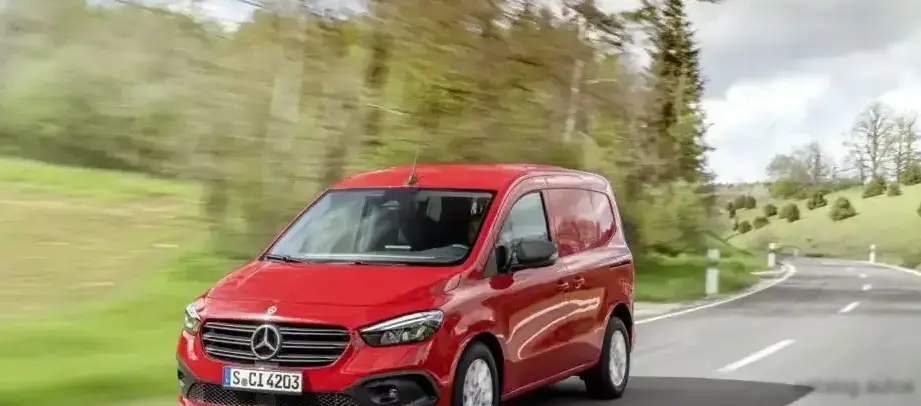
The Mercedes-Benz Citan II Tourer 110 CDI (95 hp) represents a key variant within the second generation (W420) of the Citan compact van, launched in September 2021. Positioned as an entry-level offering in the Tourer (passenger van) body style, this model aimed to provide a practical and fuel-efficient transportation solution for families and commercial users alike. The W420 Citan is a collaborative effort between Mercedes-Benz and Renault, sharing its platform and many components with the Renault Kangoo. This generation marked a significant step up in terms of refinement, technology, and safety features compared to its predecessor.
Technical Specifications
| Brand | Mercedes-Benz |
| Model | Citan |
| Generation | Citan II Tourer (W420) |
| Type (Engine) | 110 CDI (95 Hp) |
| Start of production | September, 2021 |
| Powertrain Architecture | Internal Combustion engine |
| Body type | Minivan |
| Seats | 5 |
| Doors | 5 |
| Combined fuel consumption (WLTP) | 5.2-5.6 l/100 km (45.2 – 42 US mpg, 54.3 – 50.4 UK mpg, 19.2 – 17.9 km/l) |
| CO2 emissions (WLTP) | 136-146 g/km |
| Fuel consumption (economy) – combined (NEDC) | 4.8-4.9 l/100 km (49 – 48 US mpg, 58.9 – 57.6 UK mpg, 20.8 – 20.4 km/l) |
| CO2 emissions (NEDC) | 125-128 g/km |
| Fuel Type | Diesel |
| Acceleration 0 – 100 km/h | 15.5 sec |
| Acceleration 0 – 62 mph | 15.5 sec |
| Acceleration 0 – 60 mph | 14.7 sec |
| Maximum speed | 164 km/h (101.9 mph) |
| Emission standard | Euro 6d |
| Weight-to-power ratio | 17.2 kg/Hp, 58.1 Hp/tonne |
| Weight-to-torque ratio | 6.3 kg/Nm, 158.9 Nm/tonne |
| Power | 95 Hp @ 3750 rpm |
| Power per litre | 65 Hp/l |
| Torque | 260 Nm @ 1750 rpm (191.77 lb.-ft. @ 1750 rpm) |
| Engine layout | Front, Transverse |
| Engine Model/Code | OM 608.915 |
| Engine displacement | 1461 cm3 (89.16 cu. in.) |
| Number of cylinders | 4 |
| Engine configuration | Inline |
| Compression ratio | 15.5:1 |
| Fuel injection system | Diesel Commonrail |
| Engine aspiration | Turbocharger, Intercooler |
| Engine oil capacity | 5.9 l (6.23 US qt | 5.19 UK qt) |
| Coolant | 10 l (10.57 US qt | 8.8 UK qt) |
| Kerb Weight | 1636-1794 kg (3606.76 – 3955.09 lbs.) |
| Max. weight | 2174 kg (4792.85 lbs.) |
| Max load | 380-538 kg (837.76 – 1186.09 lbs.) |
| Trunk (boot) space – maximum | 520 l (18.36 cu. ft.) |
| Fuel tank capacity | 54 l (14.27 US gal | 11.88 UK gal) |
| Max. roof load | 100 kg (220.46 lbs.) |
| Permitted trailer load with brakes (12%) | 1500 kg (3306.93 lbs.) |
| Permitted trailer load without brakes | 750 kg (1653.47 lbs.) |
| Length | 4498 mm (177.09 in.) |
| Width | 1859 mm (73.19 in.) |
| Height | 1852 mm (72.91 in.) |
| Wheelbase | 2716 mm (106.93 in.) |
| Front track | 1584 mm (62.36 in.) |
| Rear (Back) track | 1596 mm (62.83 in.) |
| Minimum turning circle (turning diameter) | 11.75 m (38.55 ft.) |
| Drivetrain Architecture | The Internal combustion engine (ICE) drives the front wheels of the vehicle. |
| Drive wheel | Front wheel drive |
| Number of gears and type of gearbox | 6 gears, manual transmission |
| Front suspension | Independent, type McPherson with coil spring and anti-roll bar |
| Rear suspension | Torsion |
| Front brakes | Ventilated discs |
| Rear brakes | Disc |
| Assisting systems | ABS (Anti-lock braking system) |
| Steering type | Steering rack and pinion |
| Power steering | Electric Steering |
| Tires size | 195/65 R15 95H; 205/60 R16 96H |
| Wheel rims size | 6J x 15 ET 35; 6J x 16 ET 38 |
Powertrain & Engine Architecture
The Citan 110 CDI is powered by the OM 608.915, a 1.5-liter inline-four cylinder diesel engine. This engine is part of Mercedes-Benz’s modular engine family and benefits from a turbocharger with an intercooler to enhance power and efficiency. The engine utilizes a diesel commonrail direct injection system, delivering fuel directly into the combustion chamber at high pressure for optimized combustion. The engine produces 95 horsepower at 3750 rpm and 260 Nm (191.77 lb-ft) of torque at 1750 rpm. The engine features a relatively high compression ratio of 15.5:1, typical for diesel engines, contributing to its thermal efficiency. The engine is paired with a six-speed manual transmission, sending power to the front wheels.
Driving Characteristics
The 110 CDI variant, with its 95 hp and manual transmission, offers a practical but not particularly sporty driving experience. Acceleration is modest, taking around 15.5 seconds to reach 62 mph (100 km/h). The focus is on fuel economy and usability rather than outright performance. The turbocharger helps to provide a reasonable amount of low-end torque, making it suitable for everyday driving and carrying loads. Compared to higher-output versions of the Citan, such as the 130 CDI, the 110 CDI feels noticeably slower, especially when fully loaded. The manual transmission provides drivers with more control, but the gear ratios are tuned for efficiency rather than spirited driving.
Equipment & Trim Levels
The Citan II Tourer 110 CDI typically came with a respectable level of standard equipment, including air conditioning, a basic audio system, electric front windows, and a height-adjustable driver’s seat. Safety features included ABS, ESP (Electronic Stability Program), and driver and passenger airbags. Optional extras included a touchscreen infotainment system with navigation, rear parking sensors, cruise control, and various comfort and convenience packages. Interior upholstery was typically cloth, with options for upgraded materials. The dashboard layout is functional and straightforward, prioritizing practicality over luxury.
Chassis & Braking
The Citan II Tourer utilizes a McPherson strut front suspension with a torsion beam rear suspension. This setup provides a comfortable ride quality, although it’s not particularly sporty. The front brakes are ventilated discs, while the rear brakes are solid discs. ABS (Anti-lock Braking System) is standard, providing enhanced braking performance and stability. The steering is electrically assisted, offering light and precise control. The suspension is tuned to prioritize ride comfort and load-carrying capacity, rather than dynamic handling.
Market Reception & Comparison
The Citan II Tourer 110 CDI was generally well-received by critics as a practical and fuel-efficient option in the compact van segment. Its strengths included its spacious interior, good fuel economy (around 5.2-5.6 l/100 km), and relatively low running costs. Compared to the more powerful 130 CDI variant, the 110 CDI offered a lower purchase price but sacrificed performance. It also competed with other compact vans such as the Renault Kangoo, Citroën Berlingo, and Peugeot Partner, offering a similar blend of practicality and affordability. The Citan’s Mercedes-Benz badge provided a degree of prestige that its rivals often lacked.
Legacy
The OM 608.915 engine, while not known for being exceptionally complex, has proven to be reasonably reliable in the Citan II Tourer. With regular maintenance, these engines can accumulate high mileage without major issues. On the used car market, the 110 CDI variant represents a good value proposition for buyers seeking a practical and economical van. Its lower purchase price and good fuel economy make it an attractive option for those who don’t require the extra performance of the higher-output models. However, potential buyers should be aware of the importance of regular servicing and maintenance to ensure long-term reliability.