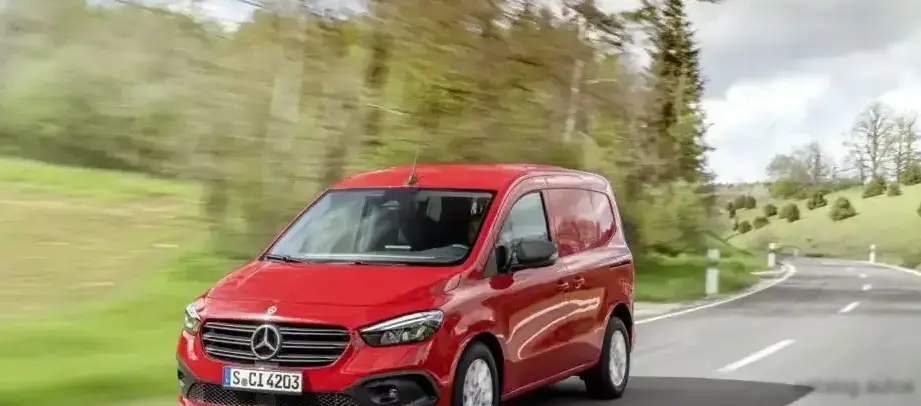
The Mercedes-Benz Citan Tourer Long (W415) 109 CDI BlueEFFICIENCY, produced from 2012 to 2015, represents a significant entry for Mercedes-Benz into the compact van segment. This long-wheelbase version of the Citan, co-developed with Renault, aimed to provide a practical and efficient commercial vehicle option for businesses and families alike. The 109 CDI variant, powered by a 1.5-liter diesel engine producing 90 horsepower, occupied the lower-mid range of the Citan lineup, prioritizing fuel economy and affordability over outright performance. It was positioned as a workhorse, ideal for urban delivery services and those needing a versatile, spacious vehicle.
Technical Specifications
| Brand | Mercedes-Benz |
| Model | Citan |
| Generation | Citan Tourer Long (W415) |
| Type (Engine) | 109 CDI (90 Hp) BlueEFFICIENCY |
| Start of production | 2012 |
| End of production | 2015 |
| Powertrain Architecture | Internal Combustion engine |
| Body type | Minivan |
| Seats | 5 |
| Doors | 5 |
| Fuel consumption (urban) | 4.7-5 l/100 km (50-47 US mpg) |
| Fuel consumption (extra urban) | 4.2-4.4 l/100 km (56-53.5 US mpg) |
| Fuel consumption (combined) | 4.3-4.6 l/100 km (54.7-51.1 US mpg) |
| CO2 emissions | 112-119 g/km |
| Fuel Type | Diesel |
| Emission standard | Euro 5 |
| Weight-to-power ratio | 15.3 kg/Hp |
| Weight-to-torque ratio | 6.9 kg/Nm |
| Power | 90 Hp @ 4000 rpm |
| Torque | 200 Nm @ 1750-3000 rpm (147.51 lb.-ft.) |
| Engine layout | Front, Transverse |
| Engine Model/Code | OM 607.951 |
| Engine displacement | 1461 cm3 (89.16 cu. in.) |
| Number of cylinders | 4 |
| Engine configuration | Inline |
| Cylinder Bore | 76 mm (2.99 in.) |
| Piston Stroke | 80.5 mm (3.17 in.) |
| Compression ratio | 15.5:1 |
| Number of valves per cylinder | 2 |
| Fuel injection system | Diesel Commonrail |
| Engine aspiration | Turbocharger, Intercooler |
| Valvetrain | SOHC |
| Engine oil capacity | 4.5 l (4.76 US qt | 3.96 UK qt) |
| Coolant capacity | 7.2 l (7.61 US qt | 6.34 UK qt) |
| Kerb Weight | 1380 kg (3042.38 lbs.) |
| Max. weight | 1950 kg (4299.01 lbs.) |
| Max load | 570 kg (1256.63 lbs.) |
| Trunk (boot) space (min) | 685 l (24.19 cu. ft.) |
| Trunk (boot) space (max) | 3000 l (105.94 cu. ft.) |
| Fuel tank capacity | 60 l (15.85 US gal | 13.2 UK gal) |
| Max. roof load | 100 kg (220.46 lbs.) |
| Permitted trailer load (braked) | 1050 kg (2314.85 lbs.) |
| Permitted trailer load (unbraked) | 690 kg (1521.19 lbs.) |
| Permitted towbar download | 75 kg (165.35 lbs.) |
| Length | 4321 mm (170.12 in.) |
| Width | 1829 mm (72.01 in.) |
| Width including mirrors | 2138 mm (84.17 in.) |
| Height | 1809 mm (71.22 in.) |
| Wheelbase | 2697 mm (106.18 in.) |
| Minimum turning circle | 11.2 m (36.75 ft.) |
| Drivetrain | Front wheel drive |
| Number of gears | 5 |
| Gearbox type | Manual transmission |
| Front suspension | Independent type McPherson |
| Rear suspension | Torsion |
| Front brakes | Ventilated discs |
| Rear brakes | Disc |
| Assisting systems | ABS (Anti-lock braking system) |
| Steering type | Steering rack and pinion |
| Power steering | Electric |
| Tires size | 195/65 R15 |
| Wheel rims size | 6.5J x 15 |
Powertrain & Engine Architecture
The heart of the Citan 109 CDI BlueEFFICIENCY is the OM 607.951, a 1.5-liter inline-four cylinder diesel engine. This engine is part of Mercedes-Benz’s compact diesel family, and shares significant components with Renault’s dCi engines due to the collaborative development of the Citan. The engine utilizes a turbocharger with an intercooler to boost power and efficiency. Fuel is delivered via a common rail direct injection system, allowing for precise fuel metering and optimized combustion. The engine features a single overhead camshaft (SOHC) valvetrain with two valves per cylinder. The 5-speed manual transmission was standard, chosen for its simplicity and contribution to fuel economy. The engine’s relatively low compression ratio of 15.5:1, combined with the turbocharging, aimed to balance performance with durability and reduced emissions.
Driving Characteristics
The 90 horsepower and 200 Nm (147.51 lb-ft) of torque produced by the 109 CDI engine translate to adequate, but not exhilarating, performance. Acceleration is best described as steady, with a 0-60 mph time estimated around 13-14 seconds. The engine’s torque peak, available from 1750-3000 rpm, provides sufficient pulling power for everyday driving and light commercial duties. The 5-speed manual gearbox is well-matched to the engine’s characteristics, with gear ratios optimized for fuel efficiency. Compared to higher-output versions of the Citan, such as the 112 CDI, the 109 CDI feels noticeably less responsive, particularly when fully loaded. However, the lower power output also contributes to improved fuel economy, making it a more economical choice for those prioritizing running costs.
Equipment & Trim Levels
The Citan 109 CDI BlueEFFICIENCY typically came equipped with a functional, rather than luxurious, interior. Standard features included air conditioning, a basic audio system, power windows, and central locking. Safety features such as ABS and driver/passenger airbags were also standard. The interior trim was typically utilitarian, with durable plastic materials and cloth upholstery. Optional extras included a trip computer, rear parking sensors, and upgraded audio systems. The “BlueEFFICIENCY” designation indicated the inclusion of fuel-saving technologies, such as start-stop functionality and optimized aerodynamics.
Chassis & Braking
The Citan Tourer Long utilizes a front-wheel-drive layout with an independent McPherson strut suspension at the front and a torsion beam suspension at the rear. This setup provides a reasonable balance between ride comfort and handling. The front brakes are ventilated discs, while the rear brakes are solid discs. The steering is rack and pinion with electric power assistance, offering light and precise steering feel. The suspension was tuned for practicality and load-carrying capacity, rather than sporty handling. Stabilizer bars were included to reduce body roll during cornering.
Market Reception & Comparison
The Citan 109 CDI BlueEFFICIENCY was generally well-received by critics as a practical and economical van. Its fuel economy was a major selling point, consistently achieving figures in the range of 50-55 mpg in real-world driving. Compared to other compact vans in its class, such as the Volkswagen Caddy and the Fiat Doblo, the Citan offered a competitive level of space, efficiency, and reliability. However, some critics noted that the interior was somewhat basic and lacked the refinement of some competitors. The 109 CDI variant was often seen as a sensible choice for businesses and individuals prioritizing low running costs over performance.
Legacy
The Mercedes-Benz Citan, and specifically the 109 CDI BlueEFFICIENCY variant, has proven to be a reliable and durable vehicle. The OM 607.951 engine, while not known for blistering performance, is generally considered to be robust and long-lasting, provided it receives regular maintenance. On the used car market, these Citans represent a good value proposition for those seeking a practical and economical van. Common issues are typically related to wear and tear on suspension components and the occasional failure of ancillary systems. The Citan helped establish Mercedes-Benz as a credible player in the compact van segment, and its legacy continues with the current generation Citan.