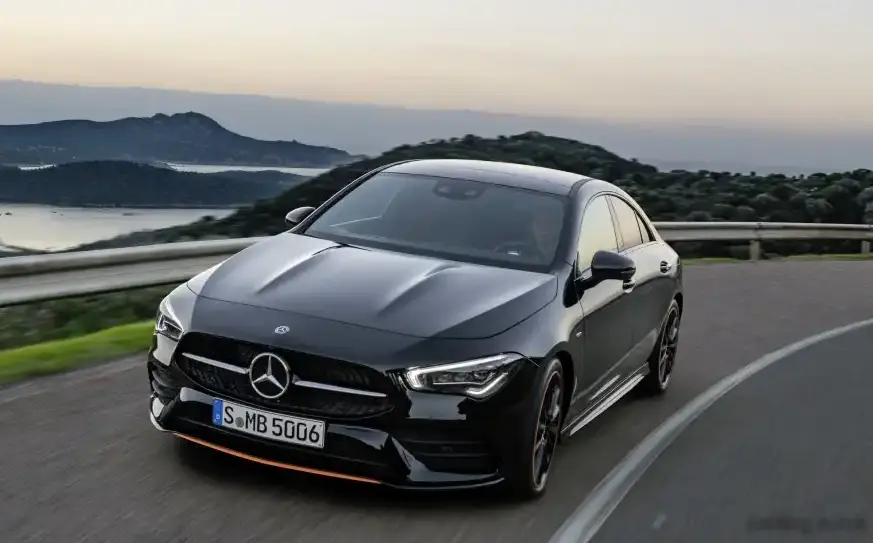
Technical Specifications
| Brand | Mercedes-Benz |
| Model | CLA |
| Generation | CLA Coupe (C118) |
| Type (Engine) | CLA 180d (116 Hp) 7G-DCT |
| Start of production | 2019 |
| End of production | January, 2023 |
| Powertrain Architecture | Internal Combustion engine |
| Body type | Coupe |
| Seats | 5 |
| Doors | 4 |
| Fuel consumption at Low speed (WLTP) | 4.4 l/100 km (53.5 US mpg, 64.2 UK mpg, 22.7 km/l) |
| Fuel consumption at very high speed (WLTP) | 5.2 l/100 km (45.2 US mpg, 54.3 UK mpg, 19.2 km/l) |
| CO2 emissions (WLTP) | 116-136 g/km |
| Fuel consumption (economy) – urban | 4.2-4.3 l/100 km (56 – 54.7 US mpg, 67.3 – 65.7 UK mpg, 23.8 – 23.3 km/l) |
| Fuel consumption (economy) – extra urban | 3.6-3.8 l/100 km (65.3 – 61.9 US mpg, 78.5 – 74.3 UK mpg, 27.8 – 26.3 km/l) |
| Fuel consumption (economy) – combined | 3.8-4.0 l/100 km (61.9 – 58.8 US mpg, 74.3 – 70.6 UK mpg, 26.3 – 25 km/l) |
| CO2 emissions | 100-105 g/km |
| Fuel Type | Diesel |
| Acceleration 0 – 100 km/h | 10.7 sec |
| Acceleration 0 – 62 mph | 10.7 sec |
| Acceleration 0 – 60 mph | 10.2 sec |
| Maximum speed | 205 km/h (127.38 mph) |
| Emission standard | Euro 6d-Temp |
| Weight-to-power ratio | 12.2 kg/Hp, 82 Hp/tonne |
| Weight-to-torque ratio | 5.4 kg/Nm, 183.7 Nm/tonne |
| Power | 116 Hp |
| Power per litre | 79.4 Hp/l |
| Torque | 260 Nm @ 1750-2500 rpm (191.77 lb.-ft. @ 1750-2500 rpm) |
| Engine layout | Front, Transverse |
| Engine Model/Code | OM 608 DE 15 SCR |
| Engine displacement | 1461 cm3 (89.16 cu. in.) |
| Number of cylinders | 4 |
| Engine configuration | Inline |
| Fuel injection system | Diesel Commonrail |
| Engine aspiration | Turbocharger, Intercooler |
| Engine oil capacity | 5.5 l (5.81 US qt, 4.84 UK qt) |
| Coolant | 12.1 l (12.79 US qt, 10.65 UK qt) |
| Kerb Weight | 1415 kg (3119.54 lbs.) |
| Max. weight | 2000 kg (4409.25 lbs.) |
| Max load | 585 kg (1289.7 lbs.) |
| Trunk (boot) space – minimum | 450 l (15.89 cu. ft.) |
| Fuel tank capacity | 43 l (11.36 US gal, 9.46 UK gal) |
| Permitted trailer load with brakes (12%) | 1400 kg (3086.47 lbs.) |
| Permitted trailer load without brakes | 745 kg (1642.44 lbs.) |
| Length | 4688 mm (184.57 in.) |
| Width | 1830 mm (72.05 in.) |
| Height | 1439 mm (56.65 in.) |
| Wheelbase | 2729 mm (107.44 in.) |
| Front track | 1612 mm (63.46 in.) |
| Rear (Back) track | 1612 mm (63.46 in.) |
| Front overhang | 927 mm (36.5 in.) |
| Rear overhang | 1032 mm (40.63 in.) |
| Ride height (ground clearance) | 104 mm (4.09 in.) |
| Approach angle | 13.4° |
| Departure angle | 14.3° |
| Ramp-over (brakeover) angle | 9.4° |
| Drivetrain Architecture | The Internal combustion engine (ICE) drives the front wheels of the vehicle. |
| Drive wheel | Front wheel drive |
| Number of gears and type of gearbox | 7 gears, automatic transmission G-DCT |
The Mercedes-Benz CLA 180d, equipped with the 7G-DCT dual-clutch transmission, represents the entry point into the C118 CLA Coupe range, produced from 2019 through January 2023. Positioned as a fuel-efficient and accessible option within the broader CLA lineup, this variant catered to buyers prioritizing economy and comfort over outright performance. It occupied the lower end of the spectrum, contrasting with more powerful gasoline variants like the CLA 250 and performance-oriented AMG models. The CLA 180d was primarily marketed in Europe and other regions where diesel engines maintain significant popularity, offering a blend of style, technology, and reasonable running costs.
Powertrain & Engine Architecture
The CLA 180d utilizes the OM 608 DE 15 SCR engine, a 1.5-liter inline-four cylinder diesel engine. This engine is part of Mercedes-Benz’s modular engine family, designed for efficiency and reduced emissions. It features a turbocharger with an intercooler to boost power output, and employs a diesel commonrail direct injection system for precise fuel delivery. The engine’s architecture incorporates advanced technologies like variable valve timing and a particulate filter to meet stringent Euro 6d-Temp emission standards. The 7G-DCT (7-speed Dual Clutch Transmission) is a key component, offering quick and smooth gear changes. This transmission is known for its efficiency and responsiveness, contributing to the car’s overall fuel economy. The DCT operates with two separate clutches, one for even and one for odd gears, allowing for pre-selection of the next gear and minimizing interruption in power delivery.
Driving Characteristics
The 116 horsepower and 260 Nm (191.77 lb-ft) of torque produced by the CLA 180d’s powertrain deliver adequate, though not exhilarating, performance. Acceleration from 0 to 100 km/h (0-62 mph) takes approximately 10.7 seconds. In real-world driving, the engine feels most comfortable in the mid-range, with readily available torque from 1750-2500 rpm. The 7G-DCT transmission contributes to a smooth driving experience, but can sometimes exhibit slight hesitation at lower speeds. Compared to the more powerful CLA 250, the 180d feels noticeably slower, particularly during overtaking maneuvers. The gear ratios are tuned for fuel efficiency rather than outright acceleration. The front-wheel-drive configuration provides predictable handling, but lacks the all-weather capability of the 4MATIC all-wheel-drive system available on other CLA variants.
Equipment & Trim Levels
The CLA 180d typically came equipped with a respectable level of standard features, including automatic climate control, a multimedia system with a touchscreen display, and a suite of safety features like automatic emergency braking and lane keeping assist. Interior upholstery was generally cloth, with options for leather upgrades. Standard dashboard configuration included analog gauges with a central display screen. Common optional extras included a panoramic sunroof, upgraded sound system, navigation system, and parking assist package. Trim levels varied slightly depending on the market, but generally offered progressive upgrades in terms of interior materials, exterior styling, and technology features.
Chassis & Braking
The CLA 180d utilizes a MacPherson strut front suspension and a multi-link rear suspension, providing a comfortable ride quality. The suspension is tuned for a balance between comfort and handling, prioritizing ride comfort over sporty dynamics. Braking systems typically consisted of disc brakes on the front wheels and drum brakes on the rear wheels, although some markets offered all-disc setups. Stabilizer bars were included on both axles to reduce body roll during cornering. The chassis is designed to be lightweight to maximize fuel efficiency, contributing to the car’s overall agility.
Market Reception & Comparison
The CLA 180d was generally well-received by critics as a practical and economical option within the CLA range. Its fuel efficiency was a major selling point, particularly in Europe where diesel fuel is often more affordable than gasoline. However, some reviewers criticized its lack of outright performance compared to higher-powered variants. Compared to the CLA 200d, the 180d offered a lower price point but sacrificed some power and refinement. Against competitors like the Audi A3 Sportback and BMW 1 Series, the CLA 180d offered a stylish alternative with a focus on fuel economy and technology.
Legacy
The OM 608 engine family, including the version used in the CLA 180d, has proven to be relatively reliable, although some owners have reported issues with the diesel particulate filter (DPF) requiring regeneration. The 7G-DCT transmission is generally robust, but requires regular maintenance to ensure smooth operation. In the used car market, the CLA 180d represents a relatively affordable entry point into the Mercedes-Benz brand. Its fuel efficiency and reasonable running costs make it an attractive option for buyers seeking a stylish and practical compact coupe. However, potential buyers should be aware of the potential for DPF issues and ensure the car has been properly maintained.