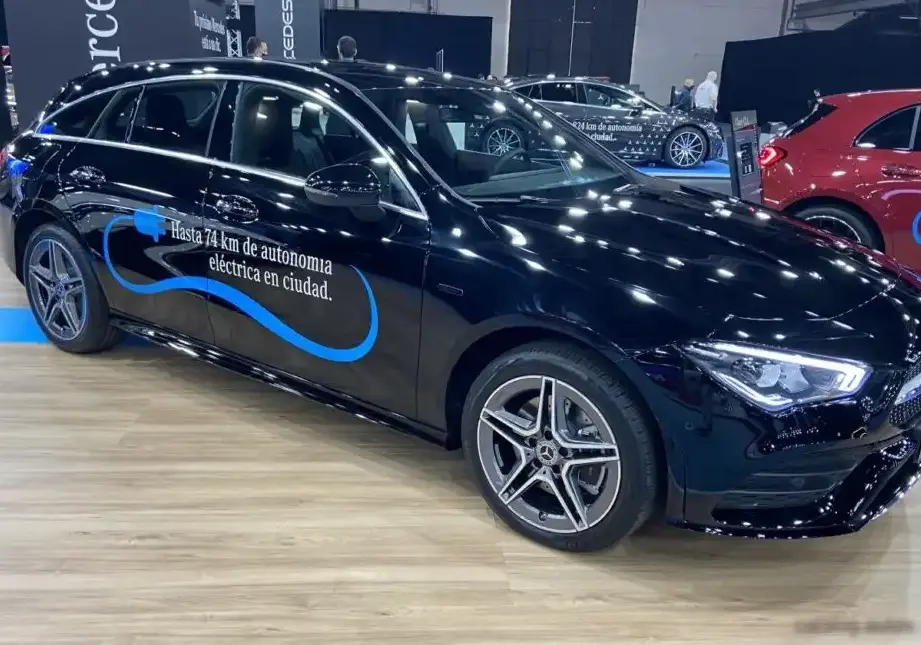
The Mercedes-Benz CLA 250e Shooting Brake (X118), produced from 2020 to January 2023, represents a compelling entry point into the world of plug-in hybrid (PHEV) compact estate cars. Positioned within the broader X118 CLA Shooting Brake generation, the 250e combines a 1.3-liter turbocharged gasoline engine with an electric motor, delivering a combined system output of 218 horsepower. This variant aimed to offer a balance of efficiency, performance, and practicality, appealing to buyers seeking a premium, eco-conscious vehicle. It was a key model in Mercedes-Benz’s strategy to expand its EQ Power range, offering a stepping stone towards full electrification.
Technical Specifications
| Brand | Mercedes-Benz |
| Model | CLA |
| Generation | CLA Shooting Brake (X118) |
| Type | CLA 250e (218 Hp) EQ Power 8G-DCT |
| Start of production | 2020 |
| End of production | January, 2023 |
| Powertrain Architecture | PHEV (Plug-in Hybrid Electric Vehicle) |
| Body type | Station wagon (estate) |
| Seats | 5 |
| Doors | 5 |
| Combined fuel consumption (WLTP) | 1-1.4 l/100 km (235.2 – 168 US mpg, 282.5 – 201.8 UK mpg, 100 – 71.4 km/l) |
| CO2 emissions (WLTP) | 23-32 g/km |
| Fuel consumption (NEDC) – combined | 1.4-1.6 l/100 km (168 – 147 US mpg, 201.8 – 176.6 UK mpg, 71.4 – 62.5 km/l) |
| CO2 emissions (NEDC) | 33-37 g/km |
| Fuel Type | Petrol / electricity |
| Acceleration 0 – 100 km/h | 6.9 sec |
| Acceleration 0 – 62 mph | 6.9 sec |
| Acceleration 0 – 60 mph | 6.6 sec |
| Maximum speed | 235 km/h (146.02 mph) |
| Emission standard | Euro 6d-ISC-FCM |
| Weight-to-power ratio | 7.7 kg/Hp, 130.1 Hp/tonne |
| Weight-to-torque ratio | 3.7 kg/Nm, 268.7 Nm/tonne |
| Gross battery capacity | 15.6 kWh |
| Net (usable) battery capacity | 10.9 kWh |
| Battery technology | Lithium-ion (Li-Ion) |
| Battery weight | 150 kg (330.69 lbs.) |
| Battery location | Under the rear seats |
| All-electric range (WLTP) | 61-71 km (37.9 – 44.12 mi) |
| All-electric range (NEDC) | 69-76 km (42.87 – 47.22 mi) |
| Average Energy consumption (WLTP) | 15.1-16.9 kWh/100 km (24.3 – 27.2 kWh/100 mi, 139 – 124 MPGe, 6.6 – 5.9 km/kWh, 4.1 – 3.7 mi/kWh) |
| Average Energy consumption (NEDC) | 14.8-15.4 kWh/100 km (23.82 – 24.78 kWh/100 mi, 141 – 136 MPGe, 6.8 – 6.5 km/kWh, 4.2 – 4 mi/kWh) |
| Max speed (electric) | 140 km/h (86.99 mph) |
| Electric motor power | 102 Hp |
| Electric motor Torque | 300 Nm (221.27 lb.-ft.) |
| Electric motor location | Between the combustion engine and the transmission |
| System power | 218 Hp |
| System torque | 450 Nm (331.9 lb.-ft.) |
| Power | 160 Hp @ 5500 rpm |
| Torque | 250 Nm @ 1620 rpm (184.39 lb.-ft. @ 1620 rpm) |
| Engine layout | Front, Transverse |
| Engine Model/Code | M 282 DE 14 AL |
| Engine displacement | 1332 cm3 (81.28 cu. in.) |
| Number of cylinders | 4 |
| Engine configuration | Inline |
| Cylinder Bore | 72.2 mm (2.84 in.) |
| Piston Stroke | 81.4 mm (3.2 in.) |
| Compression ratio | 10.6:1 |
| Number of valves per cylinder | 4 |
| Fuel injection system | Direct injection |
| Engine aspiration | Turbocharger, Intercooler |
| Valvetrain | DOHC |
| Engine oil capacity | 5.1 l (5.39 US qt | 4.49 UK qt) |
| Coolant | 6.8 l (7.19 US qt | 5.98 UK qt) |
| Kerb Weight | 1675 kg (3692.74 lbs.) |
| Max. weight | 2270 kg (5004.49 lbs.) |
| Max load | 595 kg (1311.75 lbs.) |
| Trunk (boot) space – minimum | 445 l (15.72 cu. ft.) |
| Trunk (boot) space – maximum | 1310 l (46.26 cu. ft.) |
| Fuel tank capacity | 35 l (9.25 US gal | 7.7 UK gal) |
| Max. roof load | 100 kg (220.46 lbs.) |
| Permitted trailer load with brakes (12%) | 1600 kg (3527.4 lbs.) |
| Permitted trailer load without brakes | 750 kg (1653.47 lbs.) |
| Permitted towbar download | 80 kg (176.37 lbs.) |
| Length | 4688 mm (184.57 in.) |
| Width | 1830 mm (72.05 in.) |
| Width including mirrors | 1999 mm (78.7 in.) |
| Height | 1453 mm (57.2 in.) |
| Wheelbase | 2729 mm (107.44 in.) |
| Front track | 1611 mm (63.43 in.) |
| Rear (Back) track | 1582 mm (62.28 in.) |
| Front overhang | 927 mm (36.5 in.) |
| Rear overhang | 1032 mm (40.63 in.) |
| Drag coefficient (Cd) | 0.27 |
| Minimum turning circle (turning diameter) | 11.1 m (36.42 ft.) |
| Front suspension | Independent type McPherson |
| Rear suspension | Independent multi-link suspension |
| Front brakes | Ventilated discs |
| Rear brakes | Disc |
| Number of gears and type of gearbox | 8 gears, automatic transmission G-DCT |
INTRODUCTION
The Mercedes-Benz CLA 250e Shooting Brake, launched in 2020 as part of the X118 series, represents a significant step in the brand’s commitment to electrified vehicles. Built on the 1HX0/A3 platform shared with other compact Mercedes-Benz models, the 250e aimed to provide a practical and efficient alternative to traditional gasoline-powered vehicles. The Shooting Brake body style, essentially a five-door wagon, offered increased cargo capacity compared to the CLA coupe, making it a more versatile option for families and those requiring additional space. The 250e was positioned as a mid-range offering within the CLA lineup, bridging the gap between the more affordable gasoline variants and the higher-performance AMG models.
Powertrain & Engine Architecture
At the heart of the CLA 250e lies a sophisticated plug-in hybrid powertrain. The internal combustion engine (ICE) is a 1.3-liter, four-cylinder unit designated the M 282 DE 14 AL. This engine utilizes direct fuel injection and is coupled with a turbocharger and intercooler to deliver 160 horsepower at 5500 rpm and 250 Nm (184.39 lb-ft) of torque at 1620 rpm. The engine’s relatively small displacement is compensated for by the turbocharging, providing a good balance of power and efficiency. The electric motor, producing 102 horsepower and 300 Nm (221.27 lb-ft) of torque, is integrated between the engine and the 8-speed dual-clutch transmission (8G-DCT). This configuration allows for both electric-only driving and a combined output of 218 horsepower and 450 Nm (331.9 lb-ft) of torque. The 15.6 kWh lithium-ion battery pack, located under the rear seats, provides an all-electric range of between 61-71 km (37.9 – 44.12 mi) under WLTP testing.
Driving Characteristics
The CLA 250e offers a distinct driving experience compared to its non-hybrid siblings. In electric mode, the vehicle provides near-silent acceleration and responsive performance for urban driving. The 8G-DCT transmission is well-tuned for smooth gear changes, and the electric motor’s instant torque contributes to brisk acceleration. When the battery is depleted or when more power is demanded, the gasoline engine seamlessly kicks in, providing a combined performance that allows for a 0-100 km/h (0-62 mph) time of 6.9 seconds. Compared to the CLA 250 with a traditional gasoline engine, the 250e feels slightly heavier due to the battery pack, but the added torque from the electric motor compensates for this. The gear ratios are optimized for both efficiency and performance, providing adequate power for highway cruising and overtaking maneuvers. The hybrid system’s regenerative braking also contributes to improved efficiency and reduces wear on the brake pads.
Equipment & Trim Levels
The CLA 250e Shooting Brake typically came well-equipped as standard. Interior features included comfortable seats upholstered in Artico leather, a multi-function steering wheel, and a 7-inch touchscreen infotainment system with Mercedes-Benz’s MBUX interface. Standard safety features included automatic emergency braking, lane keeping assist, and traffic sign recognition. Optional extras included a larger 10.25-inch touchscreen, a premium sound system, a panoramic sunroof, and adaptive cruise control. The trim level often dictated the availability of certain features, with higher trims offering more luxurious appointments and advanced technology. Exterior styling cues were generally consistent across the CLA range, with the 250e distinguished by subtle “EQ Power” badging.
Chassis & Braking
The CLA 250e utilizes a McPherson strut front suspension and a multi-link rear suspension, providing a comfortable and controlled ride. The suspension is tuned to balance handling and comfort, making it suitable for both city driving and longer journeys. The vehicle is equipped with ventilated disc brakes at the front and solid discs at the rear. ABS (Anti-lock Braking System) and electronic stability control are standard features, enhancing safety and stability. The steering is electrically assisted, providing precise and responsive handling. The weight distribution is slightly biased towards the front due to the placement of the engine and battery, but the chassis is well-balanced and provides confident handling characteristics.
Market Reception & Comparison
The CLA 250e Shooting Brake was generally well-received by automotive critics, who praised its fuel efficiency, comfortable ride, and stylish design. However, some reviewers noted that the all-electric range was relatively limited compared to some competitors. Compared to the CLA 200, the 250e offered significantly more power and torque, but at a higher price point. Compared to the CLA 250 with a traditional gasoline engine, the 250e provided the added benefit of electric-only driving and lower running costs, but with a slightly higher initial investment. The 250e also offered a more environmentally friendly alternative to the diesel-powered CLA 200d.
Legacy
The CLA 250e Shooting Brake represents an important step in Mercedes-Benz’s transition towards electrification. While production ended in January 2023, the model continues to be a popular choice in the used car market. The powertrain has proven to be relatively reliable, with few widespread issues reported. The combination of a fuel-efficient gasoline engine and an electric motor provides a practical and versatile solution for drivers seeking a premium, eco-conscious vehicle. The CLA 250e’s success paved the way for further development of Mercedes-Benz’s EQ Power range and contributed to the brand’s overall electrification strategy.