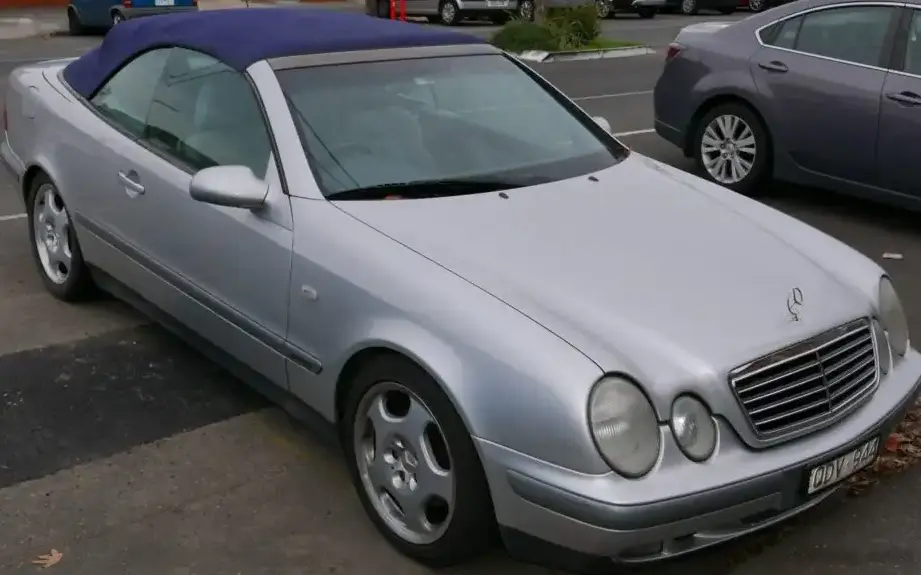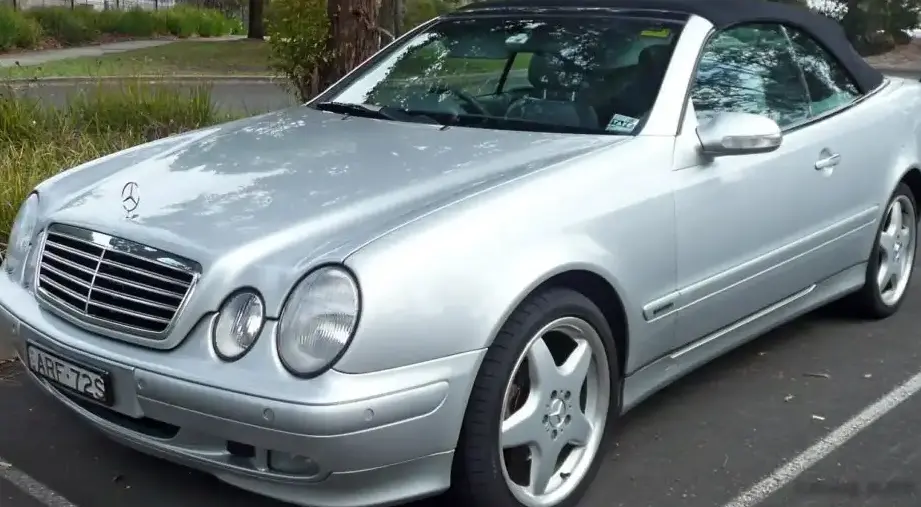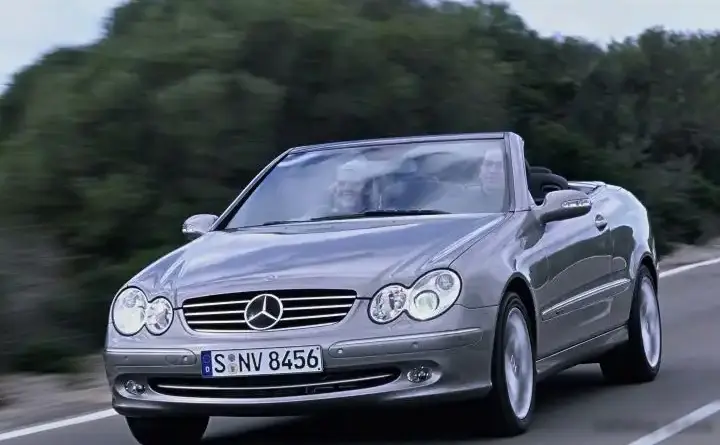
The Mercedes-Benz CLK 500, produced from April 2003 to May 2004, represented the high-performance variant of the A209 CLK generation. Positioned as the flagship model within the CLK lineup, it offered a luxurious grand touring experience. The A209 CLK series, launched as a replacement for the W208, aimed to blend the elegance of a coupe or convertible with the performance expected of a Mercedes-Benz. The CLK 500 specifically targeted buyers seeking a powerful and refined open-air driving experience, primarily in European and North American markets.
Technical Specifications
| Brand | Mercedes-Benz |
| Model | CLK |
| Generation | CLK (A209) |
| Type (Engine) | CLK 500 (306 Hp) 5G-TRONIC |
| Start of production | April, 2003 |
| End of production | May, 2004 |
| Powertrain Architecture | Internal Combustion engine |
| Body type | Cabriolet |
| Seats | 4 |
| Doors | 2 |
| Fuel consumption (economy) – urban (NEDC) | 17.2 l/100 km (13.7 US mpg, 16.4 UK mpg, 5.8 km/l) |
| Fuel consumption (economy) – extra urban (NEDC) | 8.6 l/100 km (27.4 US mpg, 32.8 UK mpg, 11.6 km/l) |
| Fuel consumption (economy) – combined (NEDC) | 11.6 l/100 km (20.3 US mpg, 24.4 UK mpg, 8.6 km/l) |
| CO2 emissions (NEDC) | 278 g/km |
| Fuel Type | Petrol (Gasoline) |
| Acceleration 0 – 100 km/h | 6.2 sec |
| Acceleration 0 – 62 mph | 6.2 sec |
| Acceleration 0 – 60 mph | 5.9 sec |
| Maximum speed | 250 km/h (155.34 mph), Electronically limited |
| Emission standard | Euro 4 |
| Weight-to-power ratio | 5.6 kg/Hp, 178.9 Hp/tonne |
| Weight-to-torque ratio | 3.7 kg/Nm, 269 Nm/tonne |
| Power | 306 Hp @ 5600 rpm |
| Power per litre | 61.6 Hp/l |
| Torque | 460 Nm @ 2700-4250 rpm (339.28 lb.-ft. @ 2700-4250 rpm) |
| Maximum engine speed | 6000 rpm |
| Engine layout | Front, Longitudinal |
| Engine Model/Code | M 113.968 |
| Engine displacement | 4966 cm3 (303.04 cu. in.) |
| Number of cylinders | 8 |
| Engine configuration | V-engine |
| Cylinder Bore | 97 mm (3.82 in.) |
| Piston Stroke | 84 mm (3.31 in.) |
| Compression ratio | 10:1 |
| Number of valves per cylinder | 3 |
| Fuel injection system | Multi-port manifold injection |
| Engine aspiration | Naturally aspirated engine |
| Valvetrain | SOHC |
| Engine oil capacity | 7.5 l (7.93 US qt | 6.6 UK qt) |
| Coolant | 11.5 l (12.15 US qt | 10.12 UK qt) |
| Kerb Weight | 1710 kg (3769.9 lbs.) |
| Max. weight | 2225 kg (4905.29 lbs.) |
| Max load | 515 kg (1135.38 lbs.) |
| Trunk (boot) space – minimum | 276 l (9.75 cu. ft.) |
| Trunk (boot) space – maximum | 390 l (13.77 cu. ft.) |
| Fuel tank capacity | 62 l (16.38 US gal | 13.64 UK gal) |
| Permitted trailer load with brakes (12%) | 1500 kg (3306.93 lbs.) |
| Permitted trailer load without brakes | 750 kg (1653.47 lbs.) |
| Length | 4638 mm (182.6 in.) |
| Width | 1740 mm (68.5 in.) |
| Width including mirrors | 1991 mm (78.39 in.) |
| Height | 1413 mm (55.63 in.) |
| Wheelbase | 2715 mm (106.89 in.) |
| Front track | 1497 mm (58.94 in.) |
| Rear (Back) track | 1478 mm (58.19 in.) |
| Front overhang | 840 mm (33.07 in.) |
| Rear overhang | 1083 mm (42.64 in.) |
| Drag coefficient (Cd) | 0.30 |
| Minimum turning circle (turning diameter) | 10.76 m (35.3 ft.) |
| Drivetrain Architecture | The Internal combustion engine (ICE) drives the rear wheels of the vehicle. |
| Drive wheel | Rear wheel drive |
| Number of gears and type of gearbox | 5 gears, automatic transmission G-TRONIC |
| Front suspension | Independent type McPherson, Transverse stabilizer |
| Rear suspension | Independent multi-link suspension, Transverse stabilizer |
| Front brakes | Ventilated discs, 345×30 mm |
| Rear brakes | Ventilated discs, 300×22 mm |
| Assisting systems | ABS (Anti-lock braking system) |
| Steering type | Steering rack and pinion |
| Power steering | Hydraulic Steering |
| Tires size | Front wheel tires: 225/45 R17 Rear wheel tires: 245/40 R17 |
| Wheel rims size | Front wheel rims: 7.5J x 17 Rear wheel rims: 8.5J x 17 |
Powertrain & Engine Architecture
The CLK 500 was powered by the M113.968 5.0-liter naturally aspirated V8 engine. This engine, a cornerstone of Mercedes-Benz’s performance offerings in the early 2000s, featured a three-valve-per-cylinder (two intake, one exhaust) SOHC design and multi-port fuel injection. The engine produced 306 horsepower at 5600 rpm and 460 Nm (339 lb-ft) of torque between 2700 and 4250 rpm. The engine’s architecture was a 90-degree V8, known for its smooth operation and inherent balance. The engine utilized a relatively high 10:1 compression ratio. The 5G-TRONIC automatic transmission, a five-speed unit, was the sole transmission option. This transmission was known for its smooth shifts and adaptive learning capabilities, adjusting shift points based on driving style.
Driving Characteristics
The CLK 500 offered a distinctly grand touring experience. The 5.0-liter V8 provided ample power for effortless cruising and brisk acceleration. The 0-60 mph sprint was achieved in approximately 5.9 seconds, and the car was electronically limited to a top speed of 250 km/h (155 mph). Compared to the CLK 320 or the later CLK 280, the 500 offered a significant performance advantage. While the lower-displacement models prioritized fuel efficiency and refinement, the CLK 500 focused on delivering a more visceral and engaging driving experience. The 5G-TRONIC transmission, while smooth, wasn’t as quick-shifting as some contemporary sports car transmissions, but it complemented the engine’s torque curve well, providing strong acceleration in most driving situations. The rear-wheel drive configuration contributed to a balanced feel, although it lacked the all-weather capability of all-wheel-drive systems offered on other Mercedes-Benz models.
Equipment & Trim Levels
The CLK 500 was generously equipped as standard. Interior features typically included leather upholstery, wood trim, automatic climate control, power-adjustable seats with memory function, and a premium sound system. Standard safety features included ABS, traction control, and multiple airbags. Optional extras included a panoramic sunroof, upgraded sound systems (such as Harman Kardon), and various cosmetic enhancements. The Cabriolet version featured a fully automatic retractable hardtop, providing open-air driving enjoyment with the security and refinement of a coupe when closed. Trim levels were relatively limited, with most customization occurring through the selection of optional packages and individual options.
Chassis & Braking
The CLK 500 utilized an independent suspension system at all four wheels. The front suspension employed a McPherson strut design with a transverse stabilizer bar, while the rear featured a multi-link setup, also with a stabilizer bar. This configuration aimed to provide a balance between ride comfort and handling precision. Braking duties were handled by ventilated disc brakes on all four wheels, providing ample stopping power. The front brakes measured 345x30mm, while the rear brakes were 300x22mm. ABS (Anti-lock Braking System) was standard, enhancing braking performance and stability.
Market Reception & Comparison
The CLK 500 was generally well-received by automotive critics. It was praised for its powerful engine, luxurious interior, and comfortable ride. However, some reviewers noted that its handling wasn’t as sharp as some of its competitors, such as the BMW 6 Series. Fuel economy was also a concern, with combined fuel consumption figures around 11.6 l/100 km (20.3 US mpg). Compared to the CLK 320, the 500 offered a substantial performance upgrade, but at a higher price point and with increased fuel consumption. The CLK 500 positioned itself as a more mature and refined alternative to sportier coupes, appealing to buyers who prioritized comfort and luxury alongside performance.
Legacy
The M113 V8 engine used in the CLK 500 is generally considered a robust and reliable powerplant, provided it receives regular maintenance. Common issues include occasional oil leaks and sensor failures, but these are typically not major concerns. The 5G-TRONIC transmission is also generally reliable, although fluid changes are crucial for longevity. Today, the CLK 500 represents an affordable entry point into the world of high-performance Mercedes-Benz vehicles. Well-maintained examples are sought after by enthusiasts who appreciate the combination of classic styling, powerful V8 engine, and luxurious features. The car’s relative rarity compared to other CLK models contributes to its collectibility.