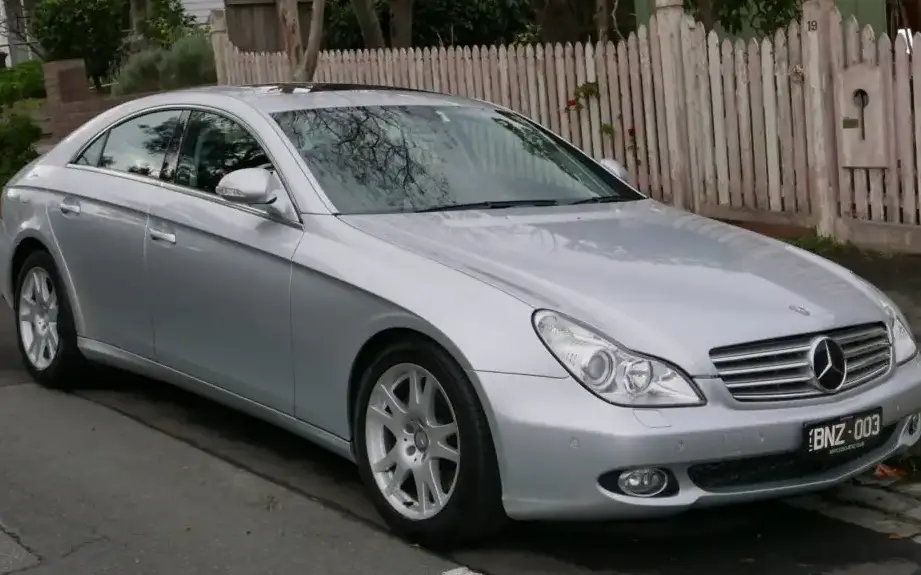
The Mercedes-Benz CLS 500, produced between September 2004 and June 2006, represents a pivotal model within the C219 generation of the CLS-Class “four-door coupe.” Positioned as a near-luxury offering within the lineup, it bridged the gap between the more accessible CLS 350 and the high-performance CLS 63 AMG. The C219 CLS was groundbreaking for its time, establishing a new segment blending the elegance of a coupe with the practicality of a sedan. It was built on the W211 E-Class platform, sharing many components but distinguished by its dramatically sloping roofline and unique styling. This variant, equipped with the M113 V8 engine and the 7G-TRONIC automatic transmission, aimed to deliver a refined and powerful driving experience.
Technical Specifications
| Brand | Mercedes-Benz |
| Model | CLS |
| Generation | CLS coupe (C219) |
| Type (Engine) | CLS 500 V8 (306 Hp) 7G-TRONIC |
| Start of production | September, 2004 |
| End of production | June, 2006 |
| Powertrain Architecture | Internal Combustion engine |
| Body type | Coupe |
| Seats | 4 |
| Doors | 4 |
| Fuel consumption (economy) – urban (NEDC) | 16.4-17.8 l/100 km (14.3 – 13.2 US mpg, 17.2 – 15.9 UK mpg, 6.1 – 5.6 km/l) |
| Fuel consumption (economy) – extra urban (NEDC) | 8.3-8.9 l/100 km (28.3 – 26.4 US mpg, 34 – 31.7 UK mpg, 12 – 11.2 km/l) |
| Fuel consumption (economy) – combined (NEDC) | 11.3-12.1 l/100 km (20.8 – 19.4 US mpg, 25 – 23.3 UK mpg, 8.8 – 8.3 km/l) |
| CO2 emissions (NEDC) | 268-290 g/km |
| Fuel Type | Petrol (Gasoline) |
| Acceleration 0 – 100 km/h | 6.1 sec |
| Acceleration 0 – 62 mph | 6.1 sec |
| Acceleration 0 – 60 mph | 5.8 sec |
| Maximum speed | 250 km/h (155.34 mph), Electronically limited |
| Emission standard | Euro 4 |
| Weight-to-power ratio | 5.7 kg/Hp, 176.4 Hp/tonne |
| Weight-to-torque ratio | 3.8 kg/Nm, 265.1 Nm/tonne |
| Power | 306 Hp @ 5600 rpm |
| Power per litre | 61.6 Hp/l |
| Torque | 460 Nm @ 2700-4250 rpm (339.28 lb.-ft. @ 2700-4250 rpm) |
| Maximum engine speed | 6300 rpm |
| Engine layout | Front, Longitudinal |
| Engine Model/Code | M 113.967 |
| Engine displacement | 4966 cm3 (303.04 cu. in.) |
| Number of cylinders | 8 |
| Engine configuration | V-engine |
| Cylinder Bore | 97 mm (3.82 in.) |
| Piston Stroke | 84 mm (3.31 in.) |
| Compression ratio | 10:1 |
| Number of valves per cylinder | 3 |
| Fuel injection system | Multi-port manifold injection |
| Engine aspiration | Naturally aspirated engine |
| Valvetrain | SOHC |
| Engine oil capacity | 7.5 l (7.93 US qt | 6.6 UK qt) |
| Coolant | 10.6 l (11.2 US qt | 9.33 UK qt) |
| Kerb Weight | 1735 kg (3825.02 lbs.) |
| Max. weight | 2275 kg (5015.52 lbs.) |
| Max load | 540 kg (1190.5 lbs.) |
| Trunk (boot) space – minimum | 495 l (17.48 cu. ft.) |
| Fuel tank capacity | 80 l (21.13 US gal | 17.6 UK gal) |
| Max. roof load | 100 kg (220.46 lbs.) |
| Length | 4913 mm (193.43 in.) |
| Width | 1873 mm (73.74 in.) |
| Width including mirrors | 2059 mm (81.06 in.) |
| Height | 1390 mm (54.72 in.) |
| Wheelbase | 2854 mm (112.36 in.) |
| Front track | 1593 mm (62.72 in.) |
| Rear (Back) track | 1603 mm (63.11 in.) |
| Front overhang | 894 mm (35.2 in.) |
| Rear overhang | 1165 mm (45.87 in.) |
| Ride height (ground clearance) | 144 mm (5.67 in.) |
| Drag coefficient (Cd) | 0.30 |
| Minimum turning circle (turning diameter) | 11.21 m (36.78 ft.) |
| Approach angle | 16.4° |
| Departure angle | 16.2° |
| Ramp-over (brakeover) angle | 12.2° |
| Drivetrain Architecture | The Internal combustion engine (ICE) drives the rear wheels of the vehicle. |
| Drive wheel | Rear wheel drive |
| Number of gears and type of gearbox | 7 gears, automatic transmission G-TRONIC |
| Front suspension | Independent multi-link suspension, Transverse stabilizer, Air suspension |
| Rear suspension | Independent multi-link suspension, Air suspension, Transverse stabilizer |
| Front brakes | Ventilated discs, 330 mm |
| Rear brakes | Ventilated discs, 300 mm |
| Assisting systems | ABS (Anti-lock braking system) |
| Steering type | Steering rack and pinion |
| Power steering | Hydraulic Steering |
| Tires size | Front wheel tires: 245/40 R18; 255/35 R19Rear wheel tires: 245/40 R18; 275/35 R18; 285/30 R19 |
| Wheel rims size | Front wheel rims: 8.5J x 18; 8.5J x 19Rear wheel rims: 8.5J x 18; 9.5J x 18; 9.5J x 19 |
Powertrain & Engine Architecture
The heart of the CLS 500 is the M113.967 4.966-liter (303.04 cu. in.) naturally aspirated V8 engine. This engine, a staple of Mercedes-Benz performance during the early 2000s, features a single overhead camshaft (SOHC) design per cylinder bank and three valves per cylinder (two intake, one exhaust). It utilizes multi-port fuel injection, delivering fuel directly into the intake ports. The M113 is renowned for its smooth power delivery and robust construction. The 7G-TRONIC automatic transmission, a seven-speed unit, was a significant advancement at the time, offering closer gear ratios for improved acceleration and fuel efficiency. This transmission featured a torque converter lock-up clutch to minimize slippage and enhance responsiveness. The engine produces 306 horsepower at 5600 rpm and 460 Nm (339.28 lb-ft) of torque between 2700 and 4250 rpm.
Driving Characteristics
The CLS 500’s 7G-TRONIC transmission is tuned for comfort and refinement rather than outright sportiness. While acceleration to 60 mph takes approximately 5.8 seconds, the focus is on providing a smooth and effortless driving experience. The automatic transmission’s programming prioritizes fuel economy and seamless gear changes, sometimes at the expense of immediate responsiveness. Compared to the CLS 350, the V8 offers significantly more power and torque, resulting in noticeably quicker acceleration and more confident passing maneuvers. However, it lacks the aggressive character of the CLS 63 AMG. The relatively high weight of the vehicle (1735 kg / 3825.02 lbs) does contribute to a feeling of substantial mass, but the air suspension helps to mitigate body roll and provide a comfortable ride.
Equipment & Trim Levels
The CLS 500 came standard with a generous array of features, reflecting its positioning as a near-luxury model. Standard equipment included leather upholstery, wood trim, automatic climate control, a premium sound system, and power-adjustable front seats with memory function. Optional extras included a panoramic sunroof, upgraded leather packages, a navigation system, and various driver-assistance features. The interior design emphasized elegance and sophistication, with a focus on high-quality materials and meticulous craftsmanship. Exterior features typically included 18-inch alloy wheels, although 19-inch wheels were available as an option.
Chassis & Braking
The C219 CLS utilized a sophisticated chassis design derived from the W211 E-Class. The front suspension featured an independent multi-link setup with a transverse stabilizer and air suspension, providing a comfortable and controlled ride. The rear suspension also employed an independent multi-link design with air suspension and a transverse stabilizer. Braking duties were handled by ventilated discs on all four wheels, with larger discs at the front (330mm) compared to the rear (300mm). Anti-lock braking system (ABS) was standard. The air suspension system allowed for adjustable ride height, further enhancing comfort and handling.
Market Reception & Comparison
The CLS 500 was generally well-received by automotive critics, who praised its elegant styling, comfortable ride, and powerful engine. However, some reviewers noted that the 7G-TRONIC transmission could feel hesitant at times, and the fuel economy was relatively poor (11.3-12.1 l/100 km). Compared to the CLS 350, the 500 offered a significant performance upgrade, but at a higher price point. The CLS 63 AMG, with its supercharged V8, provided a much more aggressive and performance-focused driving experience, but also came with a substantially higher price tag and increased running costs.
Legacy
The M113 V8 engine, found in the CLS 500, is known for its durability and reliability, provided it receives regular maintenance. The 7G-TRONIC transmission is also generally reliable, although some units may experience issues with the valve body or conductor plate over time. Today, the C219 CLS 500 represents an attractive entry point into the world of Mercedes-Benz luxury coupes. Well-maintained examples are becoming increasingly collectible, appealing to enthusiasts who appreciate the car’s unique styling and refined driving experience. While fuel economy is not a strong point, the CLS 500 offers a compelling combination of performance, comfort, and elegance that continues to resonate with drivers today.