Technical Specifications
| Brand | Mercedes-Benz |
| Model | E-Class |
| Generation | E-Class Cabrio (A207) |
| Type | E 250 BlueEFFICIENCY (204 Hp) 7G-TRONIC PLUS |
| Start of production | April, 2011 |
| End of production | March, 2013 |
| Powertrain Architecture | Internal Combustion engine |
| Body type | Cabriolet |
| Seats | 4 |
| Doors | 2 |
| Fuel consumption (urban) | 8.8-9 l/100 km (26.7 – 26.1 US mpg) |
| Fuel consumption (extra urban) | 5.5-5.8 l/100 km (42.8 – 40.6 US mpg) |
| Fuel consumption (combined) | 6.7-7 l/100 km (35.1 – 33.6 US mpg) |
| CO2 emissions | 157-164 g/km |
| Fuel Type | Petrol (Gasoline) |
| Acceleration 0 – 100 km/h | 7.8 sec |
| Acceleration 0 – 62 mph | 7.8 sec |
| Acceleration 0 – 60 mph | 7.4 sec |
| Maximum speed | 240 km/h (149.13 mph) |
| Emission standard | Euro 5 |
| Weight-to-power ratio | 8.1 kg/Hp |
| Weight-to-torque ratio | 5.3 kg/Nm |
| Power | 204 Hp @ 5500 rpm |
| Torque | 310 Nm @ 2000-4300 rpm (228.64 lb.-ft. @ 2000-4300 rpm) |
| Engine layout | Front, Longitudinal |
| Engine Model/Code | M 271.860 |
| Engine displacement | 1796 cm3 (109.6 cu. in.) |
| Number of cylinders | 4 |
| Engine configuration | Inline |
| Cylinder Bore | 82 mm (3.23 in.) |
| Piston Stroke | 85 mm (3.35 in.) |
| Compression ratio | 9.3:1 |
| Number of valves per cylinder | 4 |
| Fuel injection system | Direct injection |
| Engine aspiration | Turbocharger, Intercooler |
| Valvetrain | DOHC |
| Engine oil capacity | 5.5 l (5.81 US qt | 4.84 UK qt) |
| Coolant capacity | 7.2 l (7.61 US qt | 6.34 UK qt) |
| Kerb Weight | 1650 kg (3637.63 lbs.) |
| Max. weight | 2195 kg (4839.15 lbs.) |
| Max load | 545 kg (1201.52 lbs.) |
| Trunk (boot) space – minimum | 300 l (10.59 cu. ft.) |
| Trunk (boot) space – maximum | 390 l (13.77 cu. ft.) |
| Fuel tank capacity | 66 l (17.44 US gal | 14.52 UK gal) |
| Permitted trailer load with brakes (12%) | 1800 kg (3968.32 lbs.) |
| Permitted trailer load without brakes | 750 kg (1653.47 lbs.) |
| Permitted towbar download | 75 kg (165.35 lbs.) |
| Length | 4698 mm (184.96 in.) |
| Width | 1786 mm (70.31 in.) |
| Width including mirrors | 2015 mm (79.33 in.) |
| Height | 1398 mm (55.04 in.) |
| Wheelbase | 2760 mm (108.66 in.) |
| Front track | 1538 mm (60.55 in.) |
| Rear track | 1544 mm (60.79 in.) |
| Front overhang | 855 mm (33.66 in.) |
| Rear overhang | 1083 mm (42.64 in.) |
| Drag coefficient (Cd) | 0.28 |
| Minimum turning circle | 11 m (36.09 ft.) |
| Drivetrain Architecture | Rear wheel drive |
| Number of gears and type of gearbox | 7 gears, automatic transmission G-TRONIC PLUS |
| Front suspension | Coil spring, Independent multi-link suspension, Transverse stabilizer |
| Rear suspension | Independent multi-link spring suspension with stabilizer |
| Front brakes | Ventilated discs, 295 mm |
| Rear brakes | Disc, 300 mm |
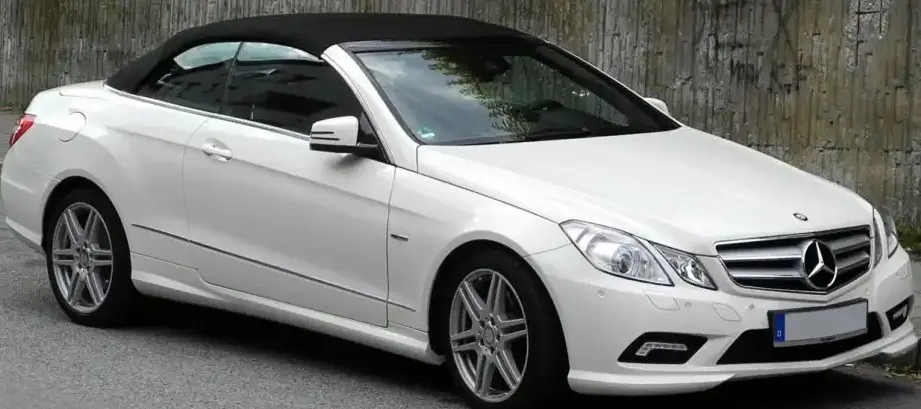
The Mercedes-Benz E-Class Cabriolet (A207) E 250 BlueEFFICIENCY, produced from April 2011 to March 2013, represented a compelling entry point into the luxurious world of open-top E-Class motoring. Positioned as a mid-range offering within the A207 generation, this variant combined a fuel-efficient turbocharged four-cylinder engine with the smooth shifting 7G-TRONIC PLUS automatic transmission. It aimed to deliver a balance of performance, comfort, and economy for buyers seeking a sophisticated convertible experience. The A207 E-Class Cabriolet itself was the convertible version of the W212 sedan, sharing its core platform and mechanical components but distinguished by its retractable soft top and focus on open-air driving pleasure.
Powertrain & Engine Architecture
The E 250 BlueEFFICIENCY Cabriolet was powered by the M 271.860 1.8-liter inline-four cylinder engine. This engine was a key component of Mercedes-Benz’s efforts to improve fuel efficiency without sacrificing performance. It featured direct fuel injection and a turbocharger with an intercooler, allowing it to produce 204 horsepower at 5500 rpm and 310 Nm (228.64 lb.-ft.) of torque between 2000 and 4300 rpm. The engine utilized a double overhead camshaft (DOHC) valvetrain with four valves per cylinder. The 7G-TRONIC PLUS automatic transmission, a seven-speed unit, was standard. This transmission was known for its smooth and responsive shifts, contributing to both driving comfort and fuel economy. The transmission’s gear ratios were optimized to provide good acceleration while maintaining low engine speeds during cruising.
Driving Characteristics
The E 250 BlueEFFICIENCY Cabriolet offered a comfortable and refined driving experience. While not as overtly sporty as some of its higher-powered E-Class siblings, the 1.8-liter turbo engine provided adequate performance for everyday driving and relaxed cruising. Acceleration from 0 to 60 mph took approximately 7.4 seconds, and the car had a top speed of 149.13 mph. The 7G-TRONIC PLUS transmission contributed to smooth gear changes, and the engine’s torque delivery made it easy to maintain speed on highways. Compared to the E 350 Cabriolet, the E 250 offered less outright power, but it also delivered better fuel economy and a slightly lighter feel. The automatic transmission, while convenient, didn’t offer the same level of driver engagement as a manual gearbox.
Equipment & Trim Levels
The E 250 BlueEFFICIENCY Cabriolet came standard with a generous array of features, reflecting its position as a premium vehicle. Standard equipment typically included leather upholstery, automatic climate control, a multi-function steering wheel, and a high-quality audio system. Optional extras included features such as a premium sound system, navigation system, heated seats, and various driver assistance systems like parking assist and lane keeping assist. Interior trim options allowed buyers to personalize the cabin to their tastes. The dashboard layout was typical of the W212 E-Class, with a focus on elegance and functionality.
Chassis & Braking
The A207 E-Class Cabriolet utilized a robust chassis designed to provide a comfortable ride and good handling. The front suspension featured coil springs and an independent multi-link setup with a transverse stabilizer bar. The rear suspension also employed an independent multi-link design with a stabilizer bar. The braking system consisted of ventilated discs at the front and solid discs at the rear. Anti-lock braking system (ABS) was standard. The suspension tuning was geared towards comfort, providing a smooth ride over various road surfaces. The steering was a hydraulic power-assisted rack and pinion system, offering precise and responsive control.
Market Reception & Comparison
The E 250 BlueEFFICIENCY Cabriolet was generally well-received by critics, who praised its fuel efficiency, comfortable ride, and refined interior. It was seen as a sensible choice for buyers who wanted a luxurious convertible without the higher running costs of the more powerful models. Compared to the E 350 Cabriolet, the E 250 offered a more affordable entry point into the E-Class Cabriolet range, but it did come with a trade-off in terms of performance. Fuel economy figures of 35.1 – 33.6 US mpg combined were competitive for its class. Reliability was generally good, although like any complex vehicle, it was susceptible to age-related issues.
Legacy
The M 271.860 engine, while not known for being exceptionally durable, proved to be reasonably reliable in the E 250 BlueEFFICIENCY. Common issues included occasional turbocharger problems and oil leaks. Today, the A207 E 250 BlueEFFICIENCY Cabriolet represents a relatively affordable way to experience Mercedes-Benz open-top luxury. Well-maintained examples are still sought after by enthusiasts who appreciate the car’s blend of style, comfort, and efficiency. The 7G-TRONIC PLUS transmission has proven to be a durable unit, and parts availability remains good. The car’s continued presence in the used car market is a testament to its enduring appeal.