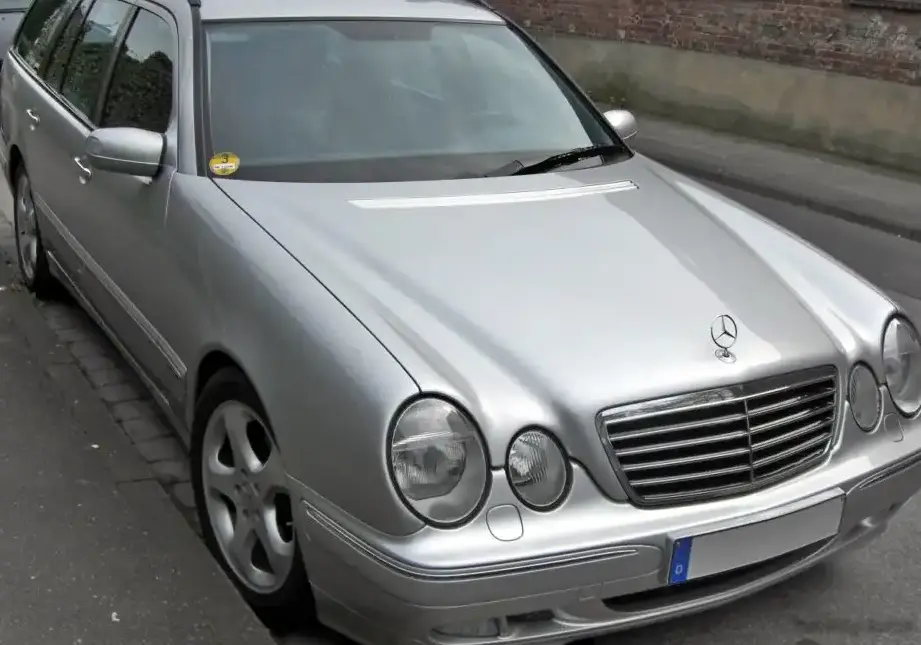
The Mercedes-Benz E 200 Kompressor T-modell, part of the S210 series facelift introduced in December 1999 and produced through December 2000, represented a compelling blend of practicality and performance within the E-Class range. Positioned as a mid-range offering in the wagon (estate) body style, it catered to buyers seeking a versatile vehicle with a degree of sporting character. This variant utilized a supercharged 2.0-liter inline-four engine, delivering 163 horsepower, and was typically paired with a 5-speed automatic transmission, though a 6-speed manual was also available. The S210 facelift brought revised styling, improved interior appointments, and refinements to the chassis and engine management systems compared to the pre-facelift models.
Technical Specifications
| Brand | Mercedes-Benz |
| Model | E-class |
| Generation | E-class T-modell (S210, facelift 1999) |
| Type (Engine) | E 200 Kompressor (163 Hp) |
| Start of production | December, 1999 |
| End of production | December, 2000 |
| Powertrain Architecture | Internal Combustion engine |
| Body type | Station wagon (estate) |
| Seats | 5 |
| Doors | 5 |
| Fuel consumption (urban) | 12.9 l/100 km (18.2 US mpg, 21.9 UK mpg) |
| Fuel consumption (extra urban) | 7.1 l/100 km (33.1 US mpg, 39.8 UK mpg) |
| Fuel consumption (combined) | 9.3 l/100 km (25.3 US mpg, 30.4 UK mpg) |
| Fuel Type | Petrol (Gasoline) |
| Acceleration 0 – 100 km/h | 10.1 sec |
| Acceleration 0 – 62 mph | 10.1 sec |
| Acceleration 0 – 60 mph | 9.6 sec |
| Maximum speed | 212 km/h (131.73 mph) |
| Weight-to-power ratio | 10.1 kg/Hp, 99.4 Hp/tonne |
| Weight-to-torque ratio | 7.1 kg/Nm, 140.2 Nm/tonne |
| Power | 163 Hp @ 5300 rpm |
| Power per litre | 81.6 Hp/l |
| Torque | 230 Nm @ 2500-4800 rpm (169.64 lb.-ft. @ 2500-4800 rpm) |
| Engine layout | Front, Longitudinal |
| Engine Model/Code | 111 E 20 ML EVO / 111.957 |
| Engine displacement | 1998 cm3 (121.93 cu. in.) |
| Number of cylinders | 4 |
| Engine configuration | Inline |
| Cylinder Bore | 89.9 mm (3.54 in.) |
| Piston Stroke | 78.7 mm (3.1 in.) |
| Compression ratio | 10.4:1 |
| Number of valves per cylinder | 4 |
| Fuel injection system | Multi-port manifold injection |
| Engine aspiration | Supercharger, Intercooler |
| Valvetrain | DOHC |
| Engine oil capacity | 5.5 l (5.81 US qt | 4.84 UK qt) |
| Coolant | 8.5 l (8.98 US qt | 7.48 UK qt) |
| Kerb Weight | 1640 kg (3615.58 lbs.) |
| Max. weight | 2220 kg (4894.26 lbs.) |
| Max load | 580 kg (1278.68 lbs.) |
| Trunk (boot) space – minimum | 600 l (21.19 cu. ft.) |
| Trunk (boot) space – maximum | 1920 l (67.8 cu. ft.) |
| Fuel tank capacity | 70 l (18.49 US gal | 15.4 UK gal) |
| Length | 4839 mm (190.51 in.) |
| Width | 1799 mm (70.83 in.) |
| Height | 1505 mm (59.25 in.) |
| Wheelbase | 2833 mm (111.54 in.) |
| Front track | 1542 mm (60.71 in.) |
| Rear (Back) track | 1546 mm (60.87 in.) |
| Drivetrain Architecture | Rear wheel drive |
| Drive wheel | Rear wheel drive |
| Number of gears and type of gearbox | 6 gears, manual transmission |
| Front suspension | Double wishbone |
| Rear suspension | Hydro-pneumatic element, Independent multi-link suspension |
| Front brakes | Ventilated discs |
| Rear brakes | Disc |
| Assisting systems | ABS (Anti-lock braking system) |
| Steering type | Steering rack and pinion |
| Power steering | Hydraulic Steering |
| Tires size | 205/65 R15 |
| Wheel rims size | 7J x 15 |
Powertrain & Engine Architecture
The heart of the E 200 Kompressor T-modell was the 111.957 engine, a 1998cc inline-four cylinder powerplant. This engine was a member of Mercedes-Benz’s M111 family, known for its robust construction and relatively simple design. The “Kompressor” designation indicated the presence of a mechanically driven supercharger, providing a boost in power and torque compared to naturally aspirated versions. This supercharger, an Eaton V-type unit, was integrated with an intercooler to reduce intake air temperature and further enhance performance. Fuel delivery was handled by a multi-port fuel injection system, precisely metering fuel into the intake ports. The engine featured a double overhead camshaft (DOHC) valvetrain with four valves per cylinder, optimizing gas flow for improved efficiency and power output. The 5-speed automatic transmission (typically a 722.6 unit) was chosen for its smooth operation and suitability for everyday driving. The manual transmission option, a 6-speed, offered more driver engagement.
Driving Characteristics
The E 200 Kompressor T-modell offered a comfortable and refined driving experience. The supercharger provided a noticeable boost in acceleration, particularly at lower engine speeds, making it feel more responsive than its displacement might suggest. While not a sports car, the 163 horsepower and 230 Nm of torque were sufficient for confident overtaking and highway cruising. The automatic transmission shifted smoothly, although it could sometimes feel hesitant during quick downshifts. Compared to the more powerful E 280 or E 320 models, the E 200 Kompressor offered a more economical driving experience, but at the expense of outright performance. The manual transmission version provided a more engaging driving experience, allowing for greater control over the engine’s power band.
Equipment & Trim Levels
The E 200 Kompressor T-modell came standard with a respectable level of equipment, including automatic climate control, power windows and mirrors, central locking, and an audio system. Upholstery was typically cloth, but leather was available as an option. Common optional extras included a sunroof, upgraded audio systems, parking sensors, and heated seats. The interior design was typical of Mercedes-Benz at the time – functional, well-built, and focused on comfort. The wagon body style offered a generous amount of cargo space, making it ideal for families or those needing to transport large items.
Chassis & Braking
The S210 E-Class featured a sophisticated chassis design. The front suspension utilized a double wishbone setup, while the rear employed an independent multi-link suspension, often with a hydro-pneumatic leveling system. This combination provided a comfortable ride and good handling characteristics. Braking duties were handled by ventilated discs at the front and solid discs at the rear, with ABS (Anti-lock Braking System) as standard. The steering was rack and pinion, providing precise and responsive control.
Market Reception & Comparison
The E 200 Kompressor T-modell was generally well-received by critics as a practical and well-rounded wagon. It offered a good balance of performance, fuel economy, and comfort. Compared to the larger-engined E-Class models, it was more affordable and fuel-efficient, making it an attractive option for buyers who didn’t require the ultimate in performance. However, some critics noted that the automatic transmission could be slow to respond at times. Fuel economy figures of around 25 mpg combined were respectable for the time. Reliability was generally good, although the supercharger could require maintenance over the long term.
Legacy
The Mercedes-Benz E 200 Kompressor T-modell (S210) has proven to be a relatively durable and reliable vehicle. The M111 engine is known for its longevity, and many examples are still on the road today. On the used car market, these wagons are appreciated for their practicality, comfort, and relatively affordable price point. While not as sought-after as some of the higher-performance E-Class variants, the E 200 Kompressor T-modell remains a popular choice for those seeking a well-built and versatile wagon with a touch of Mercedes-Benz luxury.