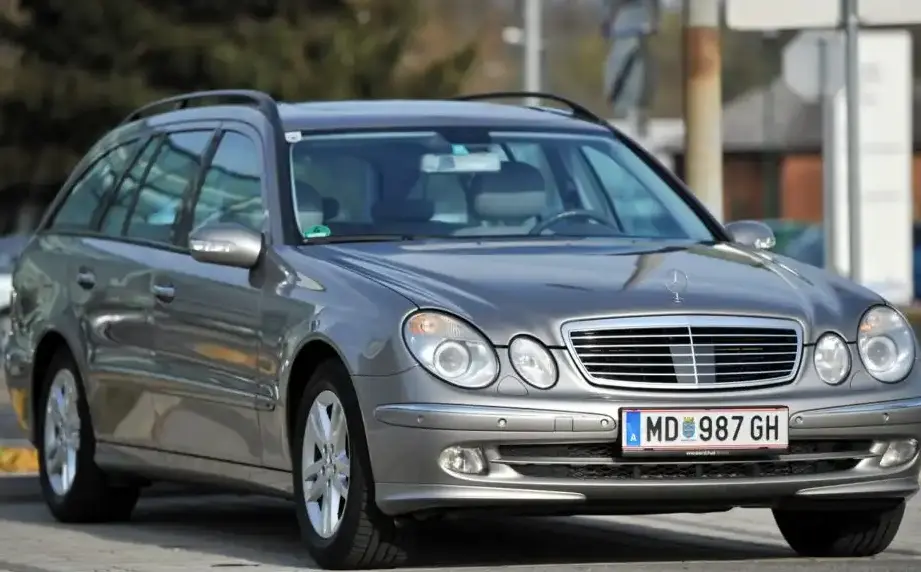
The Mercedes-Benz E-Class T-modell (S211) E 200 Kompressor, produced from 2003 to 2006, represented a compelling entry point into the premium wagon segment. Positioned within the broader S211 E-Class range – the third generation of E-Class wagons – the E 200 Kompressor offered a balance of practicality, comfort, and performance, appealing to buyers seeking a versatile vehicle with the Mercedes-Benz badge. It served as a more accessible alternative to the higher-performance E 320 and E 55 AMG variants, and a more engaging option than the diesel-powered E 220 CDI.
Technical Specifications
| Brand | Mercedes-Benz |
| Model | E-Class |
| Generation | E-Class T-modell (S211) |
| Type (Engine) | E 200 Kompressor (163 Hp) |
| Start of production | 2003 |
| End of production | 2006 |
| Powertrain Architecture | Internal Combustion engine |
| Body type | Station wagon (estate) |
| Seats | 5 |
| Doors | 5 |
| Fuel consumption (urban) | 12.9 l/100 km (18.2 US mpg, 21.9 UK mpg) |
| Fuel consumption (extra urban) | 6.9 l/100 km (34.1 US mpg, 40.9 UK mpg) |
| Fuel consumption (combined) | 9.1 l/100 km (25.8 US mpg, 31 UK mpg) |
| Fuel Type | Petrol (Gasoline) |
| Acceleration 0 – 100 km/h | 10.1 sec |
| Acceleration 0 – 62 mph | 10.1 sec |
| Acceleration 0 – 60 mph | 9.6 sec |
| Maximum speed | 220 km/h (136.7 mph) |
| Weight-to-power ratio | 10.6 kg/Hp |
| Weight-to-torque ratio | 7.2 kg/Nm |
| Power | 163 Hp @ 5500 rpm |
| Power per litre | 90.8 Hp/l |
| Torque | 240 Nm @ 3000 rpm (177.01 lb.-ft. @ 3000 rpm) |
| Engine layout | Front, Longitudinal |
| Engine Model/Code | M 271.941 |
| Engine displacement | 1796 cm3 (109.6 cu. in.) |
| Number of cylinders | 4 |
| Engine configuration | Inline |
| Cylinder Bore | 82 mm (3.23 in.) |
| Piston Stroke | 85 mm (3.35 in.) |
| Compression ratio | 9.5:1 |
| Number of valves per cylinder | 4 |
| Fuel injection system | Multi-port manifold injection |
| Engine aspiration | Supercharger, Intercooler |
| Engine oil capacity | 5.5 l (5.81 US qt | 4.84 UK qt) |
| Coolant capacity | 9.2 l (9.72 US qt | 8.09 UK qt) |
| Kerb Weight | 1720 kg (3791.95 lbs.) |
| Max. weight | 2295 kg (5059.61 lbs.) |
| Max load | 575 kg (1267.66 lbs.) |
| Trunk (boot) space – minimum | 690 l (24.37 cu. ft.) |
| Trunk (boot) space – maximum | 1950 l (68.86 cu. ft.) |
| Fuel tank capacity | 70 l (18.49 US gal | 15.4 UK gal) |
| Length | 4850 mm (190.94 in.) |
| Width | 1822 mm (71.73 in.) |
| Height | 1496 mm (58.9 in.) |
| Wheelbase | 2854 mm (112.36 in.) |
| Front track | 1559 mm (61.38 in.) |
| Rear track | 1552 mm (61.1 in.) |
| Drag coefficient (Cd) | 0.31 |
| Drivetrain Architecture | Rear wheel drive |
| Number of gears | 6 |
| Gearbox type | Manual transmission |
| Front suspension | Coil spring |
| Rear suspension | Coil spring |
| Front brakes | Ventilated discs |
| Rear brakes | Disc |
| Assisting systems | ABS (Anti-lock braking system) |
| Steering type | Steering rack and pinion |
| Power steering | Hydraulic Steering |
| Tires size | 255/55 R16 |
| Wheel rims size | 7.5J X 16 |
Powertrain & Engine Architecture
The heart of the E 200 Kompressor is the M271.941 1.8-liter inline-four engine. This engine is notable for its supercharger, a mechanical device driven by the engine’s crankshaft via a belt. The supercharger provides instant boost, mitigating the typical turbo lag associated with turbocharged engines. This results in strong low-end torque, making the car feel responsive in everyday driving situations. The engine utilizes multi-port fuel injection and features four valves per cylinder, contributing to its efficiency and power output. The engine code ‘271’ designates it as part of Mercedes-Benz’s modular engine family. The six-speed manual transmission was standard, offering precise shifts and allowing drivers to fully utilize the engine’s power band. While an automatic transmission was available, the manual was favored by enthusiasts for its more engaging driving experience.
Driving Characteristics
The E 200 Kompressor, with its 163 horsepower and 177 lb-ft of torque, delivered respectable performance for its class. Acceleration from 0-60 mph took around 9.6 seconds, and it reached a top speed of 136.7 mph. While not a sports car, the supercharged engine provided ample power for overtaking and highway cruising. The manual transmission’s gear ratios were well-matched to the engine’s characteristics, providing good acceleration in each gear. Compared to the more powerful E 320, the E 200 Kompressor felt less effortless at higher speeds, but its lighter weight and responsive engine made it more nimble in city driving. The automatic transmission option, while offering convenience, slightly dulled the driving experience and impacted fuel economy.
Equipment & Trim Levels
The E 200 Kompressor typically came standard with features expected of a premium vehicle, including automatic climate control, power windows and mirrors, a multi-function steering wheel, and a high-quality audio system. Interior upholstery was typically cloth, with leather options available as an upgrade. Optional extras included a sunroof, navigation system, heated seats, and parking sensors. The trim level was generally considered a mid-range offering, bridging the gap between the base models and the more luxurious trims. The wagon body style itself added a level of practicality with its generous cargo space, making it ideal for families or those needing to transport larger items.
Chassis & Braking
The S211 E-Class featured a robust chassis with coil spring suspension at all four corners. The front suspension utilized MacPherson struts, while the rear employed a multi-link setup, providing a comfortable ride and good handling characteristics. The E 200 Kompressor was equipped with ventilated disc brakes at the front and solid disc brakes at the rear, providing adequate stopping power. Anti-lock braking system (ABS) was standard, enhancing safety. The suspension was tuned to prioritize comfort, but still offered a reasonably controlled driving experience. Stabilizer bars were fitted front and rear to reduce body roll during cornering.
Market Reception & Comparison
The E 200 Kompressor was generally well-received by automotive critics as a sensible and practical option within the E-Class range. It was praised for its responsive engine, comfortable ride, and spacious interior. However, some critics noted that it lacked the outright performance of the larger-engined models. Compared to the E 220 CDI diesel, the E 200 Kompressor offered a more refined driving experience but suffered from slightly higher fuel consumption. Against competitors like the BMW 3 Series Touring and Audi A4 Avant, the E 200 Kompressor offered a more luxurious interior and a more comfortable ride, but was often perceived as less sporty.
Legacy
The M271 engine, found in the E 200 Kompressor, proved to be a relatively reliable unit when properly maintained. Common issues included occasional supercharger belt failures and oil leaks. However, these were generally not major concerns. Today, the S211 E-Class T-modell E 200 Kompressor represents a good value proposition in the used car market. Its combination of practicality, comfort, and reasonable running costs makes it an appealing choice for buyers seeking a well-built and versatile wagon. Parts availability is generally good, and the car’s relatively simple mechanicals make it relatively easy to maintain. It remains a testament to Mercedes-Benz’s commitment to building durable and refined vehicles.