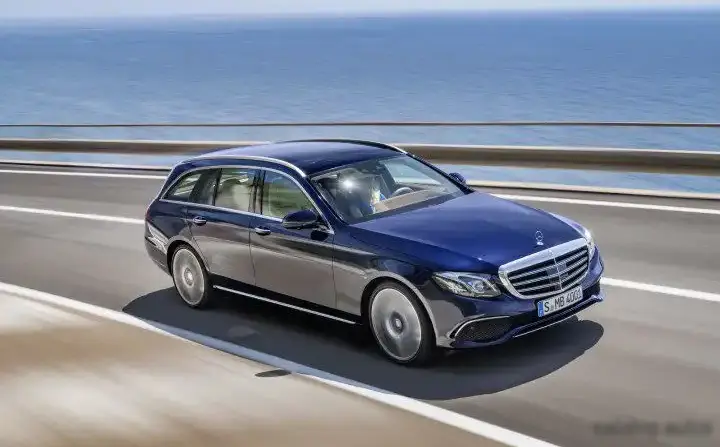
The Mercedes-Benz E 300 T-modell (S213) with the 258 hp EQ Boost and 9G-TRONIC transmission represents a significant iteration of the popular E-Class estate, produced from 2018 to 2020. Positioned as a mid-to-upper range offering within the S213 generation, it blended performance, luxury, and practicality, capitalizing on the growing demand for efficient and technologically advanced wagons. This variant introduced mild-hybrid technology to the E-Class lineup, enhancing fuel economy and providing a smoother driving experience. The S213 E-Class, launched in 2016, succeeded the W212 and continued the E-Class tradition of offering a sophisticated and comfortable vehicle for families and discerning drivers.
Technical Specifications
| Brand | Mercedes-Benz |
| Model | E-class |
| Generation | E-class T-modell (S213) |
| Type | E 300 (258 Hp) EQ Boost 9G-TRONIC |
| Start of production | 2018 |
| End of production | 2020 |
| Powertrain Architecture | MHEV (Mild Hybrid Electric Vehicle) |
| Body type | Station wagon (estate) |
| Seats | 5 |
| Doors | 5 |
| Fuel consumption at Low speed (WLTP) | 7.4 l/100 km (31.8 US mpg) |
| Fuel consumption at very high speed (WLTP) | 8.5 l/100 km (27.7 US mpg) |
| CO2 emissions (WLTP) | 167-194 g/km |
| Fuel consumption (economy) – urban | 8.2-8.7 l/100 km (28.7 – 27 US mpg) |
| Fuel consumption (economy) – extra urban | 5.4-5.8 l/100 km (43.6 – 40.6 US mpg) |
| Fuel consumption (economy) – combined | 6.4-6.9 l/100 km (36.8 – 34.1 US mpg) |
| CO2 emissions | 147-157 g/km |
| Fuel Type | Petrol (Gasoline) |
| Acceleration 0 – 100 km/h | 6.5 sec |
| Acceleration 0 – 62 mph | 6.5 sec |
| Acceleration 0 – 60 mph | 6.2 sec |
| Maximum speed | 250 km/h (155.34 mph) |
| Emission standard | Euro 6d-TEMP-EVAP-ISC |
| Weight-to-power ratio | 6.9 kg/Hp |
| Weight-to-torque ratio | 4.8 kg/Nm |
| Battery voltage | 48 V |
| Electric motor power | 14 Hp |
| Power | 258 Hp |
| Torque | 370 Nm (272.9 lb.-ft.) @ 1800-4000 rpm |
| Engine layout | Front, Longitudinal |
| Engine Model/Code | M 264.920 |
| Engine displacement | 1991 cm3 (121.5 cu. in.) |
| Number of cylinders | 4 |
| Engine configuration | Inline |
| Fuel injection system | Direct injection |
| Engine aspiration | Twin-scroll turbo, Intercooler |
| Valvetrain | DOHC |
| Engine oil capacity | 6.6 l (6.97 US qt | 5.81 UK qt) |
| Kerb Weight | 1770 kg (3902.18 lbs.) |
| Max. weight | 2525 kg (5566.67 lbs.) |
| Max load | 755 kg (1664.49 lbs.) |
| Trunk (boot) space – minimum | 640 l (22.6 cu. ft.) |
| Trunk (boot) space – maximum | 1820 l (64.27 cu. ft.) |
| Fuel tank capacity | 66 l (17.44 US gal | 14.52 UK gal) |
| Permitted trailer load with brakes (12%) | 2100 kg (4629.71 lbs.) |
| Length | 4933 mm (194.21 in.) |
| Width | 1852 mm (72.91 in.) |
| Width including mirrors | 2065 mm (81.3 in.) |
| Height | 1475 mm (58.07 in.) |
| Wheelbase | 2939 mm (115.71 in.) |
| Front track | 1600 mm (62.99 in.) |
| Rear track | 1609 mm (63.35 in.) |
| Gearbox | 9 gears, automatic transmission G-TRONIC |
Powertrain & Engine Architecture
The heart of the E 300 T-modell is the M 264.920 2.0-liter inline-four cylinder engine. This engine utilizes direct injection and a twin-scroll turbocharger to deliver 258 horsepower and 272.9 lb.-ft. of torque. The “EQ Boost” system adds a 48-volt mild-hybrid system, incorporating a belt-driven starter-generator. This system allows for functions like extended coasting with the engine off, regenerative braking, and a smoother start/stop experience. The 9G-TRONIC nine-speed automatic transmission is standard, providing close gear ratios for optimal performance and efficiency. The engine’s design prioritizes thermal efficiency and reduced friction, contributing to the overall fuel economy gains achieved with the mild-hybrid system. The engine is longitudinally mounted, driving the rear wheels.
Driving Characteristics
The E 300 T-modell offers a refined and comfortable driving experience. The 9G-TRONIC transmission provides smooth and almost imperceptible gear changes. While not as overtly sporty as some of its competitors, the E 300 delivers ample power for everyday driving and confident overtaking maneuvers. The EQ Boost system provides a subtle but noticeable boost during acceleration, filling in gaps in the torque curve. Compared to the E 200 variant, the E 300 offers a significant performance upgrade. The rear-wheel drive configuration contributes to balanced handling, although it can be less forgiving in slippery conditions than all-wheel drive options available on other E-Class models. The suspension is tuned for comfort, absorbing bumps and imperfections in the road effectively.
Equipment & Trim Levels
The E 300 T-modell came well-equipped as standard, including features like Mercedes-Benz’s MBUX infotainment system with a large touchscreen display, leather upholstery, automatic climate control, and a suite of safety features such as automatic emergency braking and lane-keeping assist. Optional extras included features like a panoramic sunroof, premium Burmester sound system, advanced driver-assistance systems (such as adaptive cruise control and lane change assist), and various interior trim options. Interior upholstery choices typically included various leather options and wood or aluminum trim accents. The overall interior design emphasized luxury and sophistication, with high-quality materials and meticulous attention to detail.
Chassis & Braking
The S213 E-Class T-modell utilizes an independent multi-link suspension at both the front and rear axles, providing a comfortable ride and good handling characteristics. The E 300 typically featured ventilated disc brakes on all four wheels, providing ample stopping power. Anti-lock braking system (ABS) and electronic stability control (ESC) were standard safety features. Steering is rack and pinion with electric power assistance. The chassis was designed to balance comfort and handling, offering a stable and predictable driving experience. The standard tire size was 225/55 R17, although larger wheel and tire options were available.
Market Reception & Comparison
The E 300 T-modell was generally well-received by automotive critics, who praised its blend of performance, luxury, and practicality. The mild-hybrid system was lauded for its contribution to improved fuel economy without sacrificing driving enjoyment. Compared to competitors like the BMW 5 Series Touring and Audi A6 Avant, the E 300 offered a more luxurious and refined interior, although some critics found its handling less engaging than the BMW. Fuel economy figures were competitive within its class, and the E 300 offered a good balance between performance and efficiency. Reliability reports have generally been positive, although like any complex vehicle, preventative maintenance is crucial.
Legacy
The E 300 T-modell (S213) with the EQ Boost system represents a transitional point in Mercedes-Benz’s powertrain strategy, showcasing the brand’s commitment to electrification. The M 264 engine and 9G-TRONIC transmission have proven to be reliable and durable, and the mild-hybrid system has become a cornerstone of Mercedes-Benz’s efficiency efforts. On the used car market, these models hold their value well, particularly those with low mileage and a comprehensive service history. The S213 E-Class estate remains a popular choice for buyers seeking a practical, luxurious, and technologically advanced wagon.