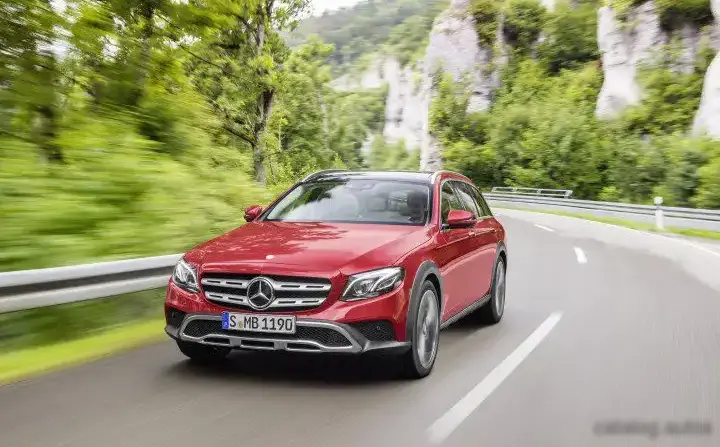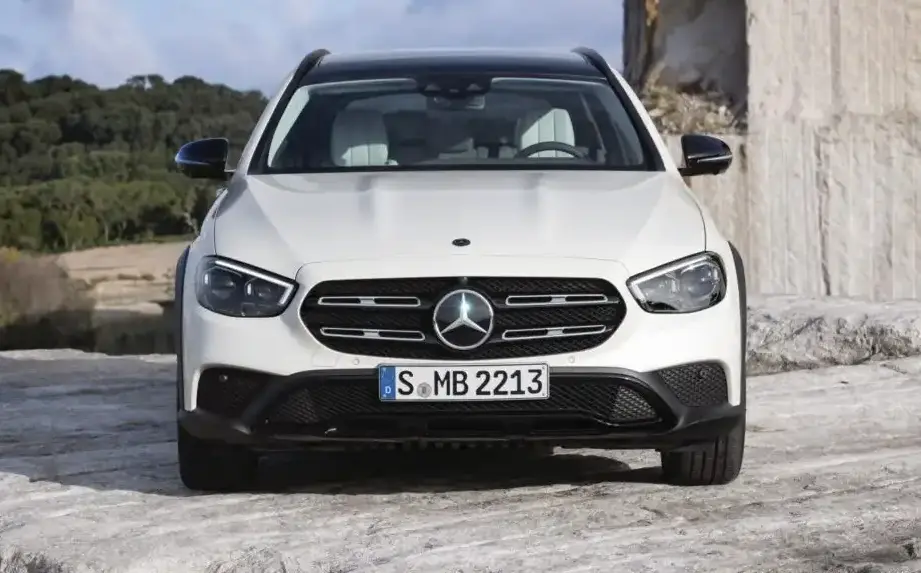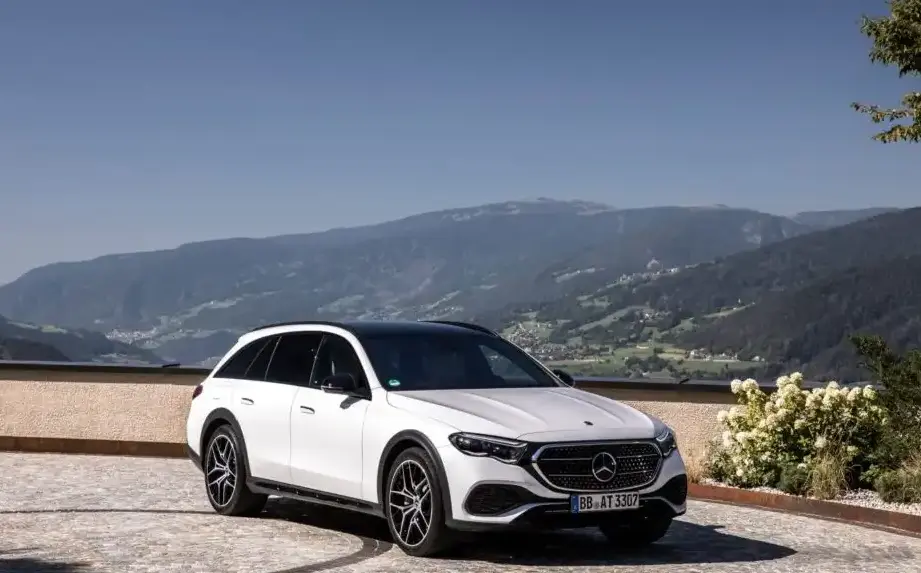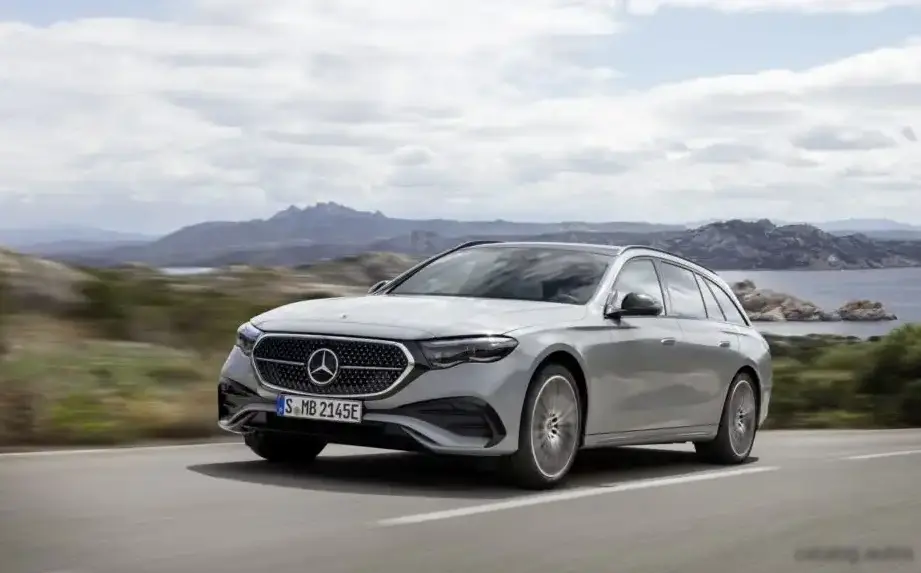
The Mercedes-Benz E-Class T-modell (S214) E 200, introduced in June 2023, represents the entry point into the fifth generation of the E-Class estate (wagon) range. Positioned as a blend of practicality and efficiency, this variant combines a 2.0-liter turbocharged four-cylinder engine with a 48-volt mild hybrid system and a 9G-TRONIC automatic transmission. It caters to buyers seeking the spaciousness of a wagon with a focus on fuel economy and comfortable cruising, rather than outright performance. The S214 generation builds upon the success of the W213, offering updated technology, refined styling, and improved efficiency.
Technical Specifications
| Brand | Mercedes-Benz |
| Model | E-Class |
| Generation | E-Class T-modell (S214) |
| Type | E 200 (204 Hp) Mild Hybrid 9G-TRONIC |
| Start of production | June, 2023 |
| Powertrain Architecture | MHEV (Mild Hybrid Electric Vehicle) |
| Body type | Station wagon (estate) |
| Seats | 5 |
| Doors | 5 |
| Combined fuel consumption (WLTP) | 6.7-7.6 l/100 km (35.1 – 30.9 US mpg, 42.2 – 37.2 UK mpg, 14.9 – 13.2 km/l) |
| CO2 emissions (WLTP) | 152-173 g/km |
| Fuel Type | Petrol (Gasoline) |
| Acceleration 0 – 100 km/h | 7.8 sec |
| Acceleration 0 – 62 mph | 7.8 sec |
| Acceleration 0 – 60 mph | 7.4 sec |
| Maximum speed | 231 km/h (143.54 mph) |
| Emission standard | Euro 6 |
| Weight-to-power ratio | 8.6 kg/Hp, 116.6 Hp/tonne |
| Weight-to-torque ratio | 5.5 kg/Nm, 182.9 Nm/tonne |
| Battery voltage | 48 V |
| Battery technology | Lithium-ion (Li-Ion) |
| Electric motor power | 23 Hp |
| Electric motor Torque | 205 Nm (151.2 lb.-ft.) |
| Electric motor location | Between the combustion engine and the transmission |
| Power | 204 Hp @ 5800 rpm |
| Torque | 320 Nm @ 1600-4000 rpm (236.02 lb.-ft. @ 1600-4000 rpm) |
| Engine layout | Front, Longitudinal |
| Engine Model/Code | M 254 |
| Engine displacement | 1999 cm3 (121.99 cu. in.) |
| Number of cylinders | 4 |
| Engine configuration | Inline |
| Compression ratio | 10:1 |
| Number of valves per cylinder | 4 |
| Fuel injection system | Direct injection |
| Engine oil capacity | 6 l (6.34 US qt | 5.28 UK qt) |
| Kerb Weight | 1750 kg (3858.09 lbs.) |
| Max. weight | 2450 kg (5401.33 lbs.) |
| Max load | 700 kg (1543.24 lbs.) |
| Trunk (boot) space – minimum | 615 l (21.72 cu. ft.) |
| Trunk (boot) space – maximum | 1830 l (64.63 cu. ft.) |
| Fuel tank capacity | 66 l (17.44 US gal | 14.52 UK gal) |
| Permitted trailer load with brakes (12%) | 2100 kg (4629.71 lbs.) |
| Permitted trailer load without brakes | 750 kg (1653.47 lbs.) |
| Permitted towbar download | 84 kg (185.19 lbs.) |
| Length | 4949 mm (194.84 in.) |
| Width | 1880 mm (74.02 in.) |
| Width including mirrors | 2065 mm (81.3 in.) |
| Height | 1469 mm (57.83 in.) |
| Wheelbase | 2961 mm (116.57 in.) |
| Front track | 1634 mm (64.33 in.) |
| Rear track | 1651 mm (65 in.) |
| Drag coefficient (Cd) | 0.26 |
| Minimum turning circle | 11.6 m (38.06 ft.) |
| Drivetrain Architecture | Rear wheel drive. MHEV. ICE and electric motor drive the rear wheels. |
| Number of gears | 9 |
| Gearbox type | Automatic transmission G-TRONIC |
| Front suspension | Coil spring, Independent multi-link suspension, Transverse stabilizer |
| Rear suspension | Independent multi-link suspension, Transverse stabilizer, Coil spring |
| Front brakes | Ventilated discs |
| Rear brakes | Ventilated discs |
| Tires size | 225/60 R17 |
| Wheel rims size | 7.5J x 17 ET30 |
Powertrain & Engine Architecture
The E 200 utilizes the M 254 engine, a 2.0-liter inline-four cylinder gasoline engine. This engine benefits from direct fuel injection and a single turbocharger with an intercooler, producing 204 horsepower at 5800 rpm and 320 Nm (236 lb-ft) of torque between 1600 and 4000 rpm. The mild hybrid system, operating at 48 volts, integrates a 23 horsepower electric motor and a lithium-ion battery. This system allows for features like extended coasting, smoother start/stop operation, and a slight power boost during acceleration. The 9G-TRONIC automatic transmission, a nine-speed unit, is specifically tuned to work in conjunction with the mild hybrid system, optimizing efficiency and providing smooth gear changes. The engine’s longitudinal mounting and rear-wheel drive configuration are traditional for Mercedes-Benz, contributing to balanced handling.
Driving Characteristics
The E 200 T-modell offers a comfortable and refined driving experience. While not designed for sporty performance, the combination of the turbocharged engine and the 9G-TRONIC transmission provides adequate acceleration, achieving 0-60 mph in approximately 7.4 seconds. The mild hybrid system enhances responsiveness at lower speeds and contributes to improved fuel economy. Compared to higher-performance E-Class variants like the E 300 or AMG models, the E 200 prioritizes fuel efficiency and a relaxed driving style. The gear ratios in the 9G-TRONIC are optimized for both highway cruising and city driving, providing a balance between fuel economy and responsiveness. The rear-wheel drive setup offers a more engaging driving experience than front-wheel drive alternatives, though it may require more caution in adverse weather conditions.
Equipment & Trim Levels
The E 200 T-modell typically comes standard with a comprehensive suite of features, including Mercedes-Benz’s MBUX infotainment system with a large touchscreen display, digital instrument cluster, automatic climate control, and a range of safety features such as automatic emergency braking, lane keeping assist, and adaptive cruise control. Interior upholstery is typically a combination of synthetic leather and fabric, with options for genuine leather upgrades. Standard dashboard trim includes wood or aluminum accents. Optional extras include a panoramic sunroof, premium sound system, heated and ventilated seats, and advanced driver-assistance systems like parking assist and surround-view camera.
Chassis & Braking
The S214 E-Class T-modell utilizes a sophisticated chassis design featuring a multi-link suspension at both the front and rear. This setup provides a comfortable ride quality and precise handling. The E 200 typically features ventilated disc brakes on all four wheels, providing ample stopping power. The electronic stability program (ESP) and anti-lock braking system (ABS) are standard features, enhancing safety and control. Stabilizer bars are fitted to both the front and rear axles to reduce body roll during cornering. The suspension tuning is geared towards comfort, prioritizing a smooth ride over aggressive handling.
Market Reception & Comparison
The E 200 T-modell has been generally well-received by automotive critics as a practical and efficient estate car. Its fuel economy is a key selling point, particularly in European markets where fuel prices are high. Compared to other trims in the E-Class lineup, the E 200 offers a more affordable entry point, making it accessible to a wider range of buyers. While some critics have noted that the engine lacks the outright performance of higher-powered variants, the E 200’s smooth operation and comfortable ride have been praised. Competitors in this segment include the Audi A6 Avant and the BMW 5 Series Touring.
Legacy
The M 254 engine, coupled with the 9G-TRONIC transmission, has proven to be a reliable powertrain in other Mercedes-Benz models. The mild hybrid system adds a layer of complexity, but early reports suggest it is relatively trouble-free. As a more recent model, the long-term reliability of the S214 E 200 T-modell is still being established. However, Mercedes-Benz’s reputation for build quality and engineering suggests that it should prove to be a durable and dependable vehicle. On the used car market, the E 200 T-modell is expected to hold its value well, particularly among buyers seeking a practical and efficient estate car with a premium badge.