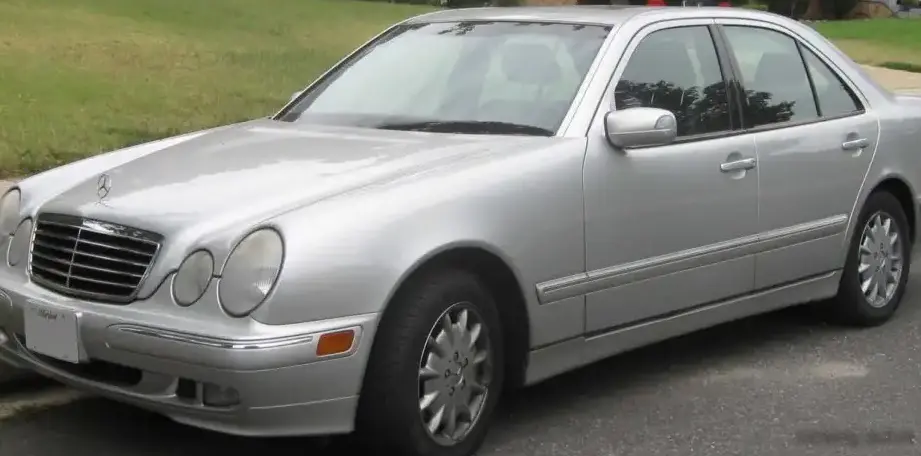
The Mercedes-Benz E 200, produced between July 1999 and June 2000, was a key variant within the W210 facelifted E-Class range. Positioned as an entry-level offering in many markets, it provided a more accessible route into the prestigious E-Class lineup while still delivering the comfort and build quality expected of the brand. This model represented a balance between performance and economy, appealing to buyers seeking a refined mid-size sedan without the higher costs associated with the more powerful E 230, E 280, or E 320 models. The W210 facelift, introduced in 1999, addressed many of the criticisms leveled at the initial W210 release, improving perceived quality and addressing minor mechanical issues.
Technical Specifications
| Brand | Mercedes-Benz |
| Model | E-class |
| Generation | E-class (W210, facelift 1999) |
| Type (Engine) | E 200 (136 Hp) |
| Start of production | July, 1999 |
| End of production | June, 2000 |
| Powertrain Architecture | Internal Combustion engine |
| Body type | Sedan |
| Seats | 5 |
| Doors | 4 |
| Fuel consumption (urban) | 13.2 l/100 km (17.8 US mpg, 21.4 UK mpg, 7.6 km/l) |
| Fuel consumption (extra urban) | 7 l/100 km (33.6 US mpg, 40.4 UK mpg, 14.3 km/l) |
| Fuel consumption (combined) | 9.3 l/100 km (25.3 US mpg, 30.4 UK mpg, 10.8 km/l) |
| Fuel Type | Petrol (Gasoline) |
| Acceleration 0 – 100 km/h | 10.8 sec |
| Acceleration 0 – 62 mph | 10.8 sec |
| Acceleration 0 – 60 mph | 10.3 sec |
| Maximum speed | 209 km/h (129.87 mph) |
| Weight-to-power ratio | 11.1 kg/Hp, 90.1 Hp/tonne |
| Weight-to-torque ratio | 7.9 kg/Nm, 125.8 Nm/tonne |
| Power | 136 Hp @ 5500 rpm |
| Power per litre | 68.1 Hp/l |
| Torque | 190 Nm @ 3700 rpm (140.14 lb.-ft. @ 3700 rpm) |
| Engine layout | Front, Longitudinal |
| Engine Model/Code | M 111 E 20 / 111.945 |
| Engine displacement | 1998 cm3 (121.93 cu. in.) |
| Number of cylinders | 4 |
| Engine configuration | Inline |
| Cylinder Bore | 89.9 mm (3.54 in.) |
| Piston Stroke | 78.7 mm (3.1 in.) |
| Compression ratio | 9.6:1 |
| Number of valves per cylinder | 4 |
| Fuel injection system | Multi-port manifold injection |
| Engine aspiration | Naturally aspirated engine |
| Valvetrain | DOHC |
| Engine oil capacity | 5.5 l (5.81 US qt | 4.84 UK qt) |
| Coolant | 8.5 l (8.98 US qt | 7.48 UK qt) |
| Kerb Weight | 1510 kg (3328.98 lbs.) |
| Max. weight | 2010 kg (4431.29 lbs.) |
| Max load | 500 kg (1102.31 lbs.) |
| Trunk (boot) space – minimum | 520 l (18.36 cu. ft.) |
| Fuel tank capacity | 65 l (17.17 US gal | 14.3 UK gal) |
| Length | 4818 mm (189.69 in.) |
| Width | 1799 mm (70.83 in.) |
| Height | 1440 mm (56.69 in.) |
| Wheelbase | 2833 mm (111.54 in.) |
| Front track | 1542 mm (60.71 in.) |
| Rear (Back) track | 1536 mm (60.47 in.) |
| Drag coefficient (Cd) | 0.27 |
| Drivetrain Architecture | The Internal combustion engine (ICE) drives the rear wheels of the vehicle. |
| Drive wheel | Rear wheel drive |
| Number of gears and type of gearbox | 6 gears, manual transmission |
| Front suspension | Double wishbone |
| Rear suspension | Independent multi-link spring suspension with stabilizer |
| Front brakes | Ventilated discs |
| Rear brakes | Disc |
| Assisting systems | ABS (Anti-lock braking system) |
| Steering type | Steering rack and pinion |
| Power steering | Hydraulic Steering |
| Tires size | 205/65 R15 |
| Wheel rims size | 7J x 15 |
Powertrain & Engine Architecture
The E 200 was powered by the M111 E 20 engine, a 1.998-liter (2.0L) inline-four cylinder gasoline engine. This engine, designated with the code 111.945, featured multi-port fuel injection and a double overhead camshaft (DOHC) valvetrain. The M111 engine family was known for its relatively smooth operation and decent fuel efficiency. The 9.6:1 compression ratio contributed to the engine’s output of 136 horsepower at 5500 rpm and 190 Nm (140 lb-ft) of torque at 3700 rpm. The engine was longitudinally mounted in the engine bay, driving the rear wheels. The standard transmission for this variant was a 6-speed manual gearbox, offering precise control and a more engaging driving experience. While an automatic transmission was available, it was often seen as detracting from the engine’s performance.
Driving Characteristics
The E 200 with the manual transmission offered a reasonably engaging driving experience. Acceleration from 0 to 60 mph took around 10.3 seconds, and top speed was limited to 209 km/h (129.87 mph). The 6-speed manual gearbox allowed the driver to keep the engine in its optimal power band, maximizing performance. However, compared to the more powerful E 230 or E 280 models, the E 200 felt noticeably slower, particularly during overtaking maneuvers. The automatic transmission versions, while offering convenience, further diminished the car’s responsiveness. The suspension, tuned for comfort, provided a smooth ride, but the car wasn’t particularly sporty in handling. The rear-wheel drive configuration offered balanced handling characteristics, but understeer was present at the limit.
Equipment & Trim Levels
The E 200 typically came equipped with a respectable level of standard features, including power windows, central locking, air conditioning, and an AM/FM radio. Interior upholstery was typically cloth, although leather was available as an option. The dashboard layout was typical of the W210 facelift, featuring a straightforward design with clearly labeled controls. Optional extras included a sunroof, upgraded audio system, automatic climate control, and heated seats. The E 200 was generally positioned as the entry point to the E-Class range, so it lacked some of the more luxurious features found on higher-trim models.
Chassis & Braking
The W210 E-Class featured a double wishbone front suspension and an independent multi-link rear suspension, providing a comfortable and controlled ride. The E 200 typically came equipped with ventilated disc brakes at the front and solid disc brakes at the rear. Anti-lock braking system (ABS) was standard, enhancing safety. The steering was a hydraulic power-assisted rack and pinion system, offering precise and responsive steering feel. The standard tire size was 205/65 R15, mounted on 7J x 15 inch alloy wheels.
Market Reception & Comparison
The E 200 was generally well-received as an affordable and practical entry point into the E-Class range. Critics praised its comfortable ride, refined interior, and decent fuel economy. However, some reviewers found the engine to be underpowered, particularly when compared to the more potent alternatives. Compared to the E 230, the E 200 offered significantly less power and performance, but it was also more fuel-efficient and less expensive to purchase. The E 200’s reliability was generally good, although like all W210 models, it was susceptible to corrosion in certain climates.
Legacy
The M111 engine proved to be a durable and reliable powerplant, and many E 200 models are still on the road today. The E 200, while not the most desirable variant in the W210 lineup, offers a relatively affordable way to experience the comfort and prestige of a Mercedes-Benz E-Class. In the used car market, the E 200 is often sought after by buyers looking for a reliable and economical classic Mercedes-Benz. Maintenance costs are generally reasonable, and parts availability is good. However, potential buyers should be aware of the potential for corrosion and the importance of regular maintenance to ensure long-term reliability.