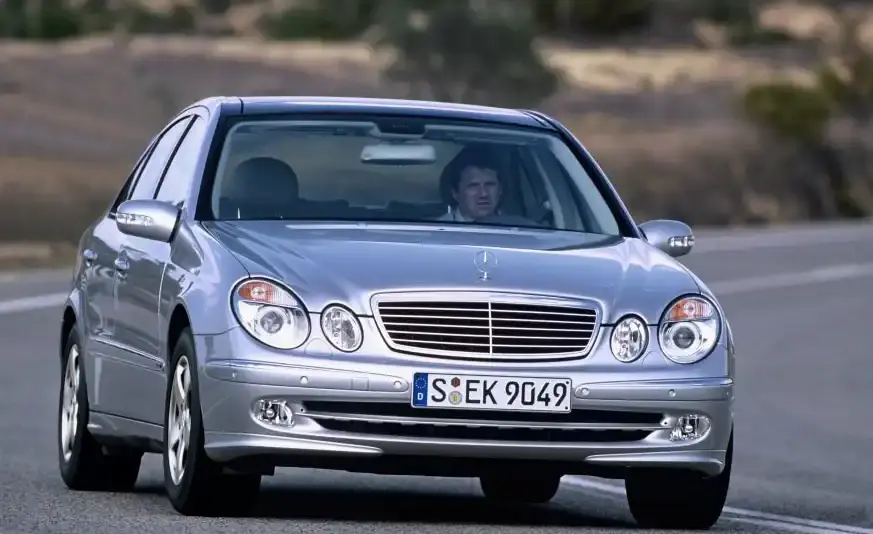
The Mercedes-Benz E 200 CDI, produced between 2003 and 2006 as part of the W211 E-Class generation, represented an entry-level diesel offering in many European markets. Positioned below the more powerful E 220 CDI and E 320 CDI models, the E 200 CDI aimed to provide a balance of fuel efficiency, reasonable performance, and Mercedes-Benz luxury. It was primarily sold in Europe, where diesel engines held a significant market share, and was not officially offered in the United States. This variant utilized a 2.1-liter four-cylinder diesel engine paired with a five-speed 5G-TRONIC automatic transmission.
Technical Specifications
| Brand | Mercedes-Benz |
| Model | E-class |
| Generation | E-class (W211) |
| Type (Engine) | E 200 CDI (122 Hp) 5G-TRONIC |
| Start of production | 2003 |
| End of production | 2006 |
| Powertrain Architecture | Internal Combustion engine |
| Body type | Sedan |
| Seats | 5 |
| Doors | 4 |
| Fuel consumption (urban) | 8.7 l/100 km (27 US mpg, 32.5 UK mpg, 11.5 km/l) |
| Fuel consumption (extra urban) | 5.1 l/100 km (46.1 US mpg, 55.4 UK mpg, 19.6 km/l) |
| Fuel consumption (combined) | 6.4 l/100 km (36.8 US mpg, 44.1 UK mpg, 15.6 km/l) |
| Fuel Type | Diesel |
| Acceleration 0 – 100 km/h | 12.1 sec |
| Acceleration 0 – 62 mph | 12.1 sec |
| Acceleration 0 – 60 mph | 11.5 sec |
| Maximum speed | 203 km/h (126.14 mph) |
| Emission standard | Euro 3 |
| Weight-to-power ratio | 13.4 kg/Hp, 74.6 Hp/tonne |
| Weight-to-torque ratio | 6.1 kg/Nm, 165.1 Nm/tonne |
| Power | 122 Hp @ 4200 rpm |
| Power per litre | 56.8 Hp/l |
| Torque | 270 Nm @ 1400 rpm (199.14 lb.-ft. @ 1400 rpm) |
| Engine layout | Front, Longitudinal |
| Engine Model/Code | OM 646.951 |
| Engine displacement | 2148 cm3 (131.08 cu. in.) |
| Number of cylinders | 4 |
| Engine configuration | Inline |
| Cylinder Bore | 88 mm (3.46 in.) |
| Piston Stroke | 88.3 mm (3.48 in.) |
| Compression ratio | 18:1 |
| Number of valves per cylinder | 4 |
| Fuel injection system | Diesel Commonrail |
| Engine aspiration | Turbocharger, Intercooler |
| Engine oil capacity | 6.5 l (6.87 US qt | 5.72 UK qt) |
| Coolant | 10.2 l (10.78 US qt | 8.97 UK qt) |
| Kerb Weight | 1635 kg (3604.56 lbs.) |
| Max. weight | 2135 kg (4706.87 lbs.) |
| Max load | 500 kg (1102.31 lbs.) |
| Trunk (boot) space – minimum | 540 l (19.07 cu. ft.) |
| Fuel tank capacity | 65 l (17.17 US gal | 14.3 UK gal) |
| Permitted trailer load with brakes (12%) | 1900 kg (4188.78 lbs.) |
| Permitted trailer load without brakes | 750 kg (1653.47 lbs.) |
| Length | 4818 mm (189.69 in.) |
| Width | 1822 mm (71.73 in.) |
| Height | 1452 mm (57.17 in.) |
| Wheelbase | 2854 mm (112.36 in.) |
| Front track | 1577 mm (62.09 in.) |
| Rear (Back) track | 1570 mm (61.81 in.) |
| Drag coefficient (Cd) | 0.27 |
| Minimum turning circle (turning diameter) | 11.4 m (37.4 ft.) |
| Drivetrain Architecture | The Internal combustion engine (ICE) drives the rear wheels of the vehicle. |
| Drive wheel | Rear wheel drive |
| Number of gears and type of gearbox | 5 gears, automatic transmission |
| Front suspension | Double wishbone |
| Rear suspension | Independent multi-link spring suspension with stabilizer |
| Front brakes | Ventilated discs |
| Rear brakes | Disc |
| Assisting systems | ABS (Anti-lock braking system) |
| Steering type | Steering rack and pinion |
| Power steering | Hydraulic Steering |
| Tires size | 205/60 R16 |
| Wheel rims size | 16 |
Powertrain & Engine Architecture
The heart of the E 200 CDI is the OM 646.951, a 2.1-liter inline four-cylinder diesel engine. This engine was a key component of Mercedes-Benz’s efforts to offer more fuel-efficient diesel options. It featured common rail direct injection, a turbocharger with an intercooler, and four valves per cylinder. The common rail system allowed for precise control of fuel delivery, optimizing combustion and reducing emissions. The turbocharger boosted power output, providing a noticeable improvement over naturally aspirated diesel engines. The 5G-TRONIC automatic transmission, a five-speed unit, was chosen for its smooth shifting characteristics and contribution to fuel economy. While not as sophisticated as later seven or nine-speed automatics, it was a reliable and well-regarded transmission for its time.
Driving Characteristics
The E 200 CDI Automatic offered a comfortable, albeit not particularly sporty, driving experience. With 122 horsepower and 270 Nm (199 lb-ft) of torque, acceleration was adequate for everyday driving, but overtaking maneuvers required planning. The automatic transmission, while smooth, could feel somewhat sluggish in kickdown situations. Compared to the E 220 CDI, which offered significantly more power, the E 200 CDI prioritized fuel economy over outright performance. The gear ratios were tuned for efficiency, resulting in lower engine speeds at highway cruising speeds. This contributed to a quiet and relaxed ride, typical of the E-Class.
Equipment & Trim Levels
The E 200 CDI typically came equipped with a respectable level of standard features, including automatic climate control, power windows, power mirrors, and a basic audio system. Upholstery was generally cloth, although leather options were available. Optional extras included a sunroof, upgraded audio systems, navigation, and parking sensors. The trim level could vary depending on the market, but generally, the E 200 CDI represented the entry point into the W211 E-Class range. It was often chosen by drivers who prioritized fuel efficiency and comfort over performance and luxury features.
Chassis & Braking
The W211 E-Class featured a double wishbone front suspension and an independent multi-link rear suspension, providing a comfortable and controlled ride. The E 200 CDI, being a lower-powered variant, typically used smaller diameter wheels and tires (often 205/60 R16) compared to the higher-performance models. Braking was handled by ventilated discs at the front and solid discs at the rear, with ABS (Anti-lock Braking System) as standard. The suspension was tuned to provide a balance between comfort and handling, leaning towards the former.
Market Reception & Comparison
The E 200 CDI was generally well-received in European markets as a practical and economical option. Critics praised its fuel efficiency and comfortable ride, but noted its lack of outright performance. Compared to the E 220 CDI, the E 200 CDI offered lower running costs but sacrificed acceleration and overall driving enjoyment. The E 200 CDI’s fuel economy was a key selling point, particularly in countries with high fuel taxes. Its reliability was generally considered good, although, like all diesel engines, it was susceptible to issues with the fuel injection system and turbocharger over time.
Legacy
The OM 646 engine family, including the 646.951 found in the E 200 CDI, proved to be a durable and reliable powerplant. While not without its potential issues (such as injector failures and turbocharger wear), these engines were generally capable of high mileage with proper maintenance. Today, the W211 E 200 CDI can be found on the used car market at relatively affordable prices. It remains a popular choice for those seeking a comfortable and economical long-distance cruiser, although potential buyers should be aware of the age-related maintenance requirements of any vehicle of this era. The E 200 CDI represents a significant step in Mercedes-Benz’s development of fuel-efficient diesel technology, paving the way for future generations of more advanced diesel engines.