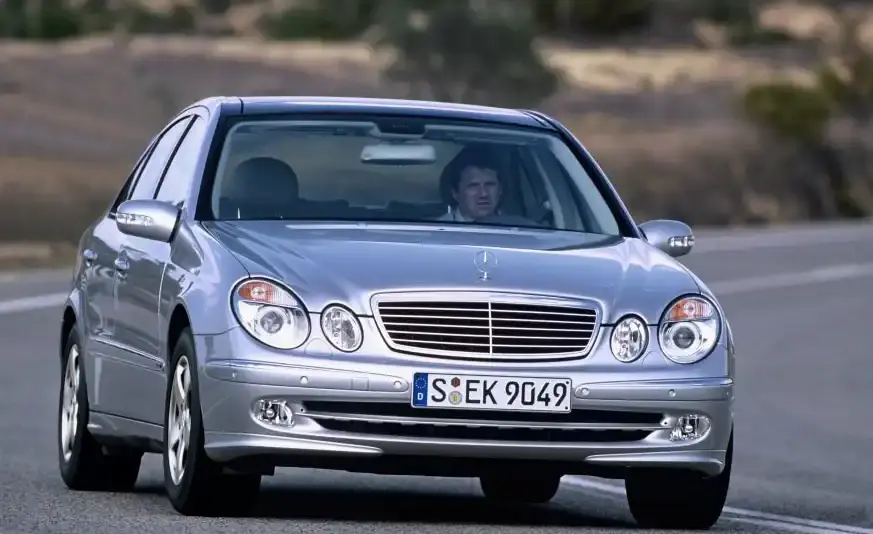
The Mercedes-Benz E 200 NGT, produced between 2002 and 2006, was a unique variant within the W211 E-Class range. “NGT” signified *Natural Gas Technology*, indicating the vehicle’s capability to run on both gasoline and Compressed Natural Gas (CNG). This model was primarily aimed at the European market, particularly Germany, where CNG infrastructure was more developed and incentives existed for alternative fuel vehicles. It occupied a mid-range position in the W211 lineup, offering a more economical and environmentally conscious option compared to the larger displacement gasoline engines, while still providing the comfort and prestige associated with the E-Class. The E 200 NGT utilized the 5G-TRONIC automatic transmission, making it a popular choice for drivers prioritizing ease of use over outright performance.
Technical Specifications
| Brand | Mercedes-Benz |
| Model | E-class |
| Generation | E-class (W211) |
| Type (Engine) | E 200 NGT (163 Hp) 5G-TRONIC |
| Start of production | 2002 |
| End of production | 2006 |
| Powertrain Architecture | Internal Combustion engine |
| Body type | Sedan |
| Seats | 5 |
| Doors | 4 |
| Fuel consumption (economy) – urban | 13.1 l/100 km (18 US mpg, 21.6 UK mpg) |
| Fuel consumption (economy) – urban (CNG) | 14.3 kg/100 km |
| Fuel consumption (economy) – extra urban | 6.9 l/100 km (34.1 US mpg, 40.9 UK mpg) |
| Fuel consumption (economy) – extra urban (CNG) | 7.2 kg/100 km |
| Fuel consumption (economy) – combined | 9.1 l/100 km (25.8 US mpg, 31 UK mpg) |
| Fuel consumption (economy) – combined (CNG) | 9.7 kg/100 km |
| Fuel Type | Petrol / CNG |
| Acceleration 0 – 100 km/h | 10.7 sec |
| Acceleration 0 – 62 mph | 10.7 sec |
| Acceleration 0 – 60 mph | 10.2 sec |
| Maximum speed | 227 km/h (141.05 mph) |
| Emission standard | Euro 4 |
| Weight-to-power ratio | 9.3 kg/Hp |
| Weight-to-torque ratio | 6.3 kg/Nm |
| Power | 163 Hp @ 5300 rpm |
| Torque | 240 Nm @ 3000-4000 rpm (177.01 lb.-ft. @ 3000-4000 rpm) |
| Engine layout | Front, Longitudinal |
| Engine Model/Code | M 271.941 |
| Engine displacement | 1796 cm3 (109.6 cu. in.) |
| Number of cylinders | 4 |
| Engine configuration | Inline |
| Number of valves per cylinder | 4 |
| Fuel injection system | Multi-port manifold injection |
| Engine aspiration | Supercharger |
| Engine oil capacity | 5.5 l (5.81 US qt | 4.84 UK qt) |
| Coolant | 9.2 l (9.72 US qt | 8.09 UK qt) |
| Kerb Weight | 1510 kg (3328.98 lbs.) |
| Max. weight | 2105 kg (4640.73 lbs.) |
| Max load | 595 kg (1311.75 lbs.) |
| Trunk (boot) space – maximum | 540 l (19.07 cu. ft.) |
| Fuel tank capacity | 65 l (17.17 US gal | 14.3 UK gal) |
| Length | 4818 mm (189.69 in.) |
| Width | 1822 mm (71.73 in.) |
| Height | 1452 mm (57.17 in.) |
| Wheelbase | 2854 mm (112.36 in.) |
| Front track | 1577 mm (62.09 in.) |
| Rear (Back) track | 1570 mm (61.81 in.) |
| Drag coefficient (Cd) | 0.27 |
| Drivetrain Architecture | The Internal combustion engine (ICE) drives the rear wheels of the vehicle. |
| Drive wheel | Rear wheel drive |
| Number of gears and type of gearbox | 5 gears, automatic transmission |
| Front suspension | Independent multi-link suspension |
| Rear suspension | Independent multi-link spring suspension with stabilizer |
| Front brakes | Disc |
| Rear brakes | Disc |
| Assisting systems | ABS (Anti-lock braking system) |
| Tires size | 205/60 R16 |
| Wheel rims size | 16 |
Powertrain & Engine Architecture
The heart of the E 200 NGT was the M 271.941 1.8-liter inline-four cylinder engine. This engine was notable for its Kompressor (supercharger) which provided increased torque at lower engine speeds, improving drivability. The M 271 featured multi-port fuel injection and four valves per cylinder, contributing to its relatively high output for its displacement. The engine was longitudinally mounted, a traditional layout for rear-wheel-drive Mercedes-Benz vehicles. The 5G-TRONIC automatic transmission, a five-speed unit, was specifically tuned to work with the engine’s characteristics. The CNG system consisted of a high-pressure fuel tank, a pressure regulator, and a fuel injector system designed to deliver CNG to the engine. The vehicle could seamlessly switch between gasoline and CNG operation, offering flexibility depending on fuel availability and cost.
Driving Characteristics
The E 200 NGT, with its 163 horsepower and 177 lb-ft of torque, offered respectable, though not exhilarating, performance. Acceleration from 0-60 mph took around 10.2 seconds, and top speed was limited to 141 mph. The 5G-TRONIC transmission provided smooth shifts, but could sometimes feel hesitant during quick acceleration. Compared to the E 200 Kompressor (gasoline only), the NGT version offered slightly reduced power and acceleration due to the characteristics of CNG combustion. However, the supercharger helped to mitigate some of this loss. The automatic transmission, while convenient, didn’t offer the same level of driver engagement as the available manual gearbox in other E-Class models. On CNG, the engine ran quieter and produced fewer emissions, but power output was marginally reduced.
Equipment & Trim Levels
The E 200 NGT typically came with a fairly comprehensive standard equipment list, befitting its position in the E-Class range. This included automatic climate control, power windows and mirrors, a multi-function steering wheel, and an audio system. Interior upholstery was generally cloth, with leather options available as an upgrade. Optional extras included a sunroof, navigation system, premium sound system, and parking sensors. The trim level was generally consistent across the NGT models, with variations primarily stemming from individual customer choices regarding optional equipment. The focus was on providing a comfortable and well-equipped vehicle suitable for both daily commuting and longer journeys.
Chassis & Braking
The W211 E-Class featured an independent multi-link suspension at both the front and rear, providing a comfortable ride and good handling characteristics. The E 200 NGT utilized disc brakes on all four wheels, along with ABS (Anti-lock Braking System) as standard. Stabilizer bars were fitted to both axles to reduce body roll during cornering. The suspension was tuned to balance comfort and handling, making it suitable for a variety of driving conditions. The weight distribution was relatively balanced, contributing to predictable handling. Due to the added weight of the CNG tank, the suspension may have been slightly firmer compared to the standard E 200.
Market Reception & Comparison
The E 200 NGT was generally well-received in markets where CNG was readily available. Critics praised its fuel efficiency and reduced emissions compared to conventional gasoline-powered vehicles. However, the limited CNG infrastructure in many regions hampered its wider adoption. Compared to the E 200 Kompressor, the NGT offered similar levels of comfort and equipment, but with a trade-off in performance. The E 200 CDI (diesel) was a popular alternative, offering even better fuel economy but with a different driving experience. The NGT’s appeal was primarily to environmentally conscious buyers and those seeking to reduce their fuel costs.
Legacy
The Mercedes-Benz E 200 NGT represents an interesting chapter in the company’s exploration of alternative fuel technologies. While CNG never achieved widespread popularity in many markets, the E 200 NGT demonstrated Mercedes-Benz’s commitment to reducing emissions and offering more sustainable transportation options. Today, these vehicles are relatively rare, and well-maintained examples are sought after by enthusiasts. The M 271 engine, in general, is considered reasonably reliable, but the CNG system requires specialized maintenance. The long-term durability of the CNG components can vary depending on usage and storage conditions. The E 200 NGT remains a unique and historically significant variant within the W211 E-Class family.