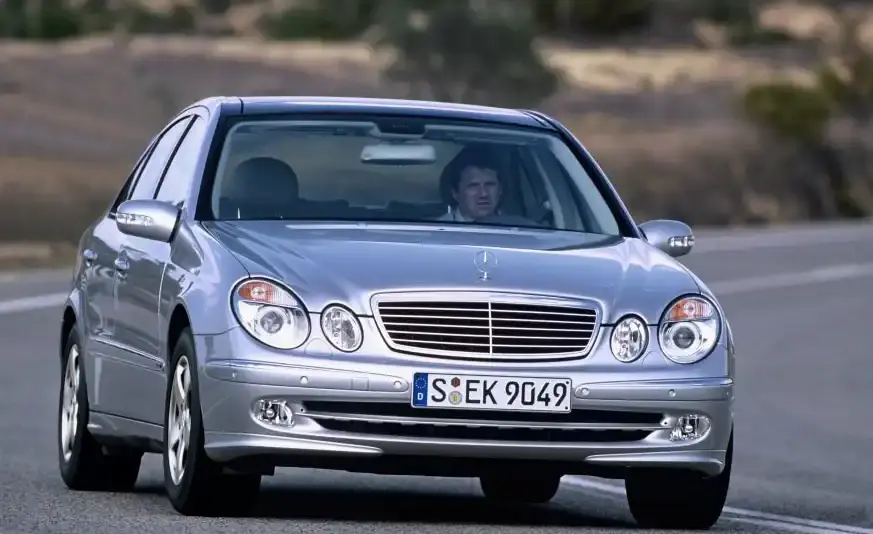
The Mercedes-Benz E 320 4MATIC, produced between 2003 and 2005, represented a compelling blend of luxury, performance, and all-weather capability within the W211 E-Class range. Positioned as a mid-to-upper tier offering, it catered to buyers seeking a refined driving experience coupled with the security of Mercedes-Benz’s 4MATIC all-wheel-drive system. This variant utilized a naturally aspirated 3.2-liter V6 engine paired with a five-speed automatic transmission, offering a balance between power and fuel efficiency. It served as a popular alternative to the more performance-focused E 500 and the diesel-powered E 320 CDI.
Technical Specifications
| Brand | Mercedes-Benz |
| Model | E-class |
| Generation | E-class (W211) |
| Type (Engine) | E 320 V6 (224 Hp) 4MATIC 5G-TRONIC |
| Start of production | 2003 |
| End of production | 2005 |
| Powertrain Architecture | Internal Combustion engine |
| Body type | Sedan |
| Seats | 5 |
| Doors | 4 |
| Fuel consumption (urban) | 14.4 l/100 km (16.3 US mpg, 19.6 UK mpg) |
| Fuel consumption (extra urban) | 7.5 l/100 km (31.4 US mpg, 37.7 UK mpg) |
| Fuel consumption (combined) | 10 l/100 km (23.5 US mpg, 28.2 UK mpg) |
| Fuel Type | Petrol (Gasoline) |
| Acceleration 0 – 100 km/h | 7.9 sec |
| Acceleration 0 – 62 mph | 7.9 sec |
| Acceleration 0 – 60 mph | 7.5 sec |
| Maximum speed | 244 km/h (151.61 mph) |
| Weight-to-power ratio | 7.7 kg/Hp |
| Weight-to-torque ratio | 5.5 kg/Nm |
| Power | 224 Hp @ 5600 rpm |
| Power per litre | 70 Hp/l |
| Torque | 315 Nm @ 3000 rpm (232.33 lb.-ft. @ 3000 rpm) |
| Engine layout | Front, Longitudinal |
| Engine Model/Code | M 112.954 |
| Engine displacement | 3199 cm3 (195.21 cu. in.) |
| Number of cylinders | 6 |
| Engine configuration | V-engine |
| Cylinder Bore | 89.9 mm (3.54 in.) |
| Piston Stroke | 84 mm (3.31 in.) |
| Compression ratio | 10:1 |
| Number of valves per cylinder | 3 |
| Fuel injection system | Multi-port manifold injection |
| Engine aspiration | Naturally aspirated engine |
| Engine oil capacity | 8 l (8.45 US qt | 7.04 UK qt) |
| Coolant capacity | 10 l (10.57 US qt | 8.8 UK qt) |
| Kerb Weight | 1730 kg (3814 lbs.) |
| Max. weight | 2255 kg (4971.42 lbs.) |
| Max load | 525 kg (1157.43 lbs.) |
| Trunk (boot) space – minimum | 540 l (19.07 cu. ft.) |
| Fuel tank capacity | 80 l (21.13 US gal | 17.6 UK gal) |
| Permitted trailer load with brakes (12%) | 1900 kg (4188.78 lbs.) |
| Permitted trailer load without brakes | 750 kg (1653.47 lbs.) |
| Length | 4818 mm (189.69 in.) |
| Width | 1822 mm (71.73 in.) |
| Height | 1452 mm (57.17 in.) |
| Wheelbase | 2854 mm (112.36 in.) |
| Front track | 1577 mm (62.09 in.) |
| Rear (Back) track | 1570 mm (61.81 in.) |
| Drag coefficient (Cd) | 0.27 |
| Drive wheel | All wheel drive (4×4) |
| Number of gears and type of gearbox | 5 gears, automatic transmission |
| Front suspension | Double wishbone |
| Rear suspension | Independent multi-link spring suspension with stabilizer |
| Front brakes | Ventilated discs |
| Rear brakes | Disc |
| Assisting systems | ABS (Anti-lock braking system) |
| Steering type | Steering rack and pinion |
| Power steering | Hydraulic Steering |
| Tires size | 225/55 R16 |
Powertrain & Engine Architecture
The heart of the E 320 4MATIC was the M112.954 3.2-liter V6 engine. This engine was a significant departure from earlier Mercedes-Benz inline-six designs, embracing a more modern, compact V-configuration. It featured a 60-degree V-angle, three valves per cylinder (two intake, one exhaust), and a dual overhead camshaft design. The engine utilized a multi-port fuel injection system, delivering fuel directly into the intake ports. This system, while not as advanced as direct injection, provided smooth and reliable operation. The 5G-TRONIC automatic transmission, a five-speed unit, was specifically tuned to complement the V6’s power delivery. It offered smooth shifts and a relatively quick response, although it lacked the sportiness of some contemporary transmissions. The 4MATIC system was a full-time all-wheel-drive system, distributing power between the front and rear axles for enhanced traction in various conditions.
Driving Characteristics
The E 320 4MATIC offered a comfortable and composed driving experience. The 224 horsepower and 315 lb-ft of torque provided adequate acceleration, with a 0-60 mph time of around 7.5 seconds. While not a sports car, the engine delivered a smooth and linear power band, making it easy to drive in everyday situations. The automatic transmission, while generally smooth, could sometimes feel hesitant during quick downshifts. The 4MATIC system provided excellent grip, particularly in inclement weather, inspiring confidence on slippery roads. Compared to the more powerful E 500, the E 320 felt less urgent in its acceleration, but it offered a more balanced and fuel-efficient driving experience. Compared to the E 320 CDI diesel, the gasoline E 320 offered a more refined and quieter engine note, but at the expense of fuel economy.
Equipment & Trim Levels
The E 320 4MATIC typically came well-equipped, reflecting its position in the Mercedes-Benz lineup. Standard features included leather upholstery, automatic climate control, power-adjustable front seats, a premium sound system, and a sunroof. Optional extras included navigation, heated seats, a rear sunshade, and upgraded interior trim. The interior design was typical of the W211 E-Class, characterized by a luxurious and understated aesthetic. The dashboard featured wood trim and analog gauges, creating a classic Mercedes-Benz ambiance.
Chassis & Braking
The W211 E-Class featured a sophisticated chassis design. The front suspension utilized a double wishbone setup, while the rear employed an independent multi-link spring suspension with a stabilizer bar. This configuration provided a comfortable ride and good handling characteristics. The E 320 4MATIC was equipped with ventilated disc brakes at the front and solid disc brakes at the rear. The anti-lock braking system (ABS) was standard, enhancing braking performance and stability. The steering was a rack-and-pinion system with hydraulic power assistance, providing precise and responsive steering feel.
Market Reception & Comparison
The E 320 4MATIC was generally well-received by automotive critics. It was praised for its comfortable ride, refined interior, and all-weather capability. However, some critics noted that the engine lacked the outright performance of some competitors. Fuel economy was considered average for its class. Compared to the BMW 530xi and Audi A6 quattro, the E 320 4MATIC offered a more luxurious and comfortable ride, but perhaps less engaging handling. The E 320 CDI offered superior fuel economy, while the E 500 provided more exhilarating performance.
Legacy
The M112 engine family, including the M112.954 found in the E 320 4MATIC, is generally considered to be a reliable and durable powerplant. While not immune to age-related issues, these engines are known for their longevity when properly maintained. Common issues include oil leaks, ignition coil failures, and occasional problems with the electronic throttle body. The 5G-TRONIC transmission is also generally reliable, but may require fluid changes and occasional servicing. Today, the W211 E 320 4MATIC represents a relatively affordable entry point into the world of Mercedes-Benz ownership. Well-maintained examples can still provide years of reliable service, offering a comfortable and refined driving experience.