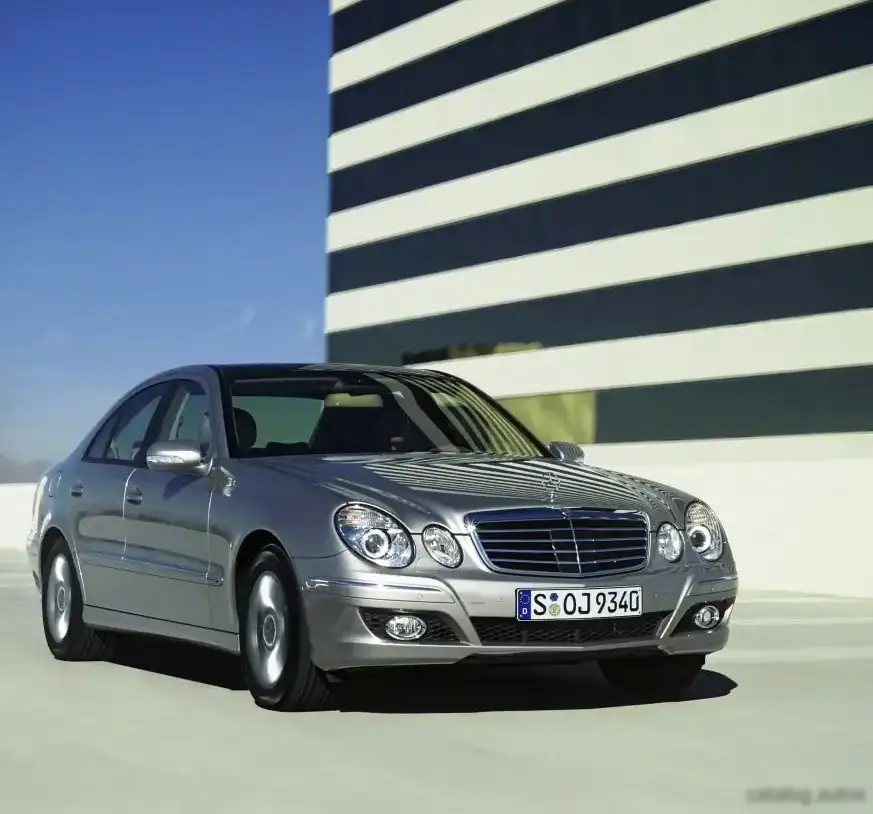
The Mercedes-Benz E 200 NGT, produced from May 2006 to 2009, was a variant of the W211 E-Class facelift, notable for its bi-fuel capability – running on both gasoline and Compressed Natural Gas (CNG). Positioned as a more environmentally conscious and potentially cost-effective option within the E-Class range, it aimed to appeal to drivers seeking a balance between luxury and fuel efficiency. This model represented Mercedes-Benz’s early foray into alternative fuel vehicles within its mainstream lineup, primarily targeted at European markets with established CNG infrastructure. The “NGT” designation stands for “Natural Gas Technology.”
Technical Specifications
| Brand | Mercedes-Benz |
| Model | E-class |
| Generation | E-class (W211, facelift 2006) |
| Type (Engine) | E 200 NGT (163 Hp) 5G-TRONIC |
| Start of production | May, 2006 |
| End of production | 2009 |
| Powertrain Architecture | Internal Combustion engine |
| Body type | Sedan |
| Seats | 5 |
| Doors | 4 |
| Fuel consumption (economy) – urban | 13-13.3 l/100 km (18.1 – 17.7 US mpg, 21.7 – 21.2 UK mpg, 7.7 – 7.5 km/l) |
| Fuel consumption (economy) – urban (CNG) | 13.8-13.9 kg/100 km |
| Fuel consumption (economy) – extra urban | 6.8-7.1 l/100 km (34.6 – 33.1 US mpg, 41.5 – 39.8 UK mpg, 14.7 – 14.1 km/l) |
| Fuel consumption (economy) – extra urban (CNG) | 6.8-7.1 kg/100 km |
| Fuel consumption (economy) – combined | 9-9.3 l/100 km (26.1 – 25.3 US mpg, 31.4 – 30.4 UK mpg, 11.1 – 10.8 km/l) |
| Fuel consumption (economy) – combined (CNG) | 9.4-9.6 kg/100 km |
| Fuel Type | Petrol / CNG |
| Acceleration 0 – 100 km/h | 10.7 sec |
| Acceleration 0 – 62 mph | 10.7 sec |
| Acceleration 0 – 100 km/h (CNG) | 10.8 sec |
| Acceleration 0 – 60 mph (Calculated) | 10.2 sec |
| Maximum speed | 227 km/h (141.05 mph) |
| Weight-to-power ratio | 10.8 kg/Hp, 92.4 Hp/tonne |
| Weight-to-torque ratio | 7.4 kg/Nm, 136 Nm/tonne |
| Power | 163 Hp @ 5500 rpm |
| Power per litre | 90.8 Hp/l |
| Torque | 240 Nm @ 3000-4000 rpm (177.01 lb.-ft. @ 3000-4000 rpm) |
| Engine layout | Front, Longitudinal |
| Engine Model/Code | M 271.941 |
| Engine displacement | 1796 cm3 (109.6 cu. in.) |
| Number of cylinders | 4 |
| Engine configuration | Inline |
| Cylinder Bore | 82 mm (3.23 in.) |
| Piston Stroke | 85 mm (3.35 in.) |
| Compression ratio | 9.5:1 |
| Number of valves per cylinder | 4 |
| Fuel injection system | Multi-port manifold injection |
| Engine aspiration | Supercharger, Intercooler |
| Valvetrain | DOHC |
| Engine oil capacity | 5.5 l (5.81 US qt | 4.84 UK qt) |
| Coolant | 9.2 l (9.72 US qt | 8.09 UK qt) |
| Kerb Weight | 1765 kg (3891.16 lbs.) |
| Max. weight | 2275 kg (5015.52 lbs.) |
| Max load | 510 kg (1124.36 lbs.) |
| Fuel tank capacity | 65 l (17.17 US gal | 14.3 UK gal) |
| CNG cylinder capacity | 18 kg |
| Length | 4856 mm (191.18 in.) |
| Width | 1822 mm (71.73 in.) |
| Height | 1450 mm (57.09 in.) |
| Wheelbase | 2854 mm (112.36 in.) |
| Front track | 1559 mm (61.38 in.) |
| Rear track | 1552 mm (61.1 in.) |
| Drivetrain Architecture | ICE drives rear wheels |
| Drive wheel | Rear wheel drive |
| Number of gears | 5 |
| Gearbox type | Automatic transmission G-TRONIC |
| Front suspension | Double wishbone, Transverse stabilizer |
| Rear suspension | Independent multi-link spring suspension with stabilizer |
| Front brakes | Ventilated discs |
| Rear brakes | Disc |
| Assisting systems | ABS (Anti-lock braking system) |
| Steering type | Steering rack and pinion |
| Power steering | Hydraulic |
| Tires size | 225/550 R16 |
| Wheel rims size | 7.5J x 16 |
Powertrain & Engine Architecture
The E 200 NGT utilized the M271.941 engine, a 1.8-liter inline-four cylinder powerplant. This engine was supercharged, employing an IHI supercharger with an intercooler to boost power output. The M271 featured multi-port fuel injection and a double overhead camshaft (DOHC) valvetrain with four valves per cylinder. What set this engine apart was its ability to run on either gasoline or CNG. When operating on CNG, the engine management system automatically switched fuel sources, optimizing performance for the alternative fuel. The 5G-TRONIC automatic transmission, a five-speed unit, was standard, providing smooth shifts and contributing to the vehicle’s overall refinement. The transmission was tuned to work efficiently with the engine’s torque curve, prioritizing fuel economy and comfortable cruising.
Driving Characteristics
The E 200 NGT with the 5G-TRONIC transmission offered a comfortable and refined driving experience. While not a performance-oriented model, the 163 horsepower and 240 Nm (177 lb-ft) of torque provided adequate power for everyday driving. Acceleration from 0-100 km/h (0-62 mph) took approximately 10.7 seconds. The automatic transmission’s gear ratios were geared towards fuel efficiency, resulting in a slightly less responsive feel compared to the manual transmission options available in other E-Class variants. When running on CNG, a slight reduction in power was noticeable, but the difference was generally minimal for typical driving conditions. The suspension, typical of the W211 E-Class, provided a comfortable ride, absorbing road imperfections effectively.
Equipment & Trim Levels
The E 200 NGT generally came equipped with a respectable level of standard features, reflecting the E-Class’s positioning as a premium vehicle. This included automatic climate control, power windows and mirrors, a multi-function steering wheel, and an audio system. Interior upholstery was typically cloth or leatherette, with optional leather upgrades available. Trim levels varied depending on the market, but generally offered options such as sunroof, navigation system, and upgraded audio systems. The NGT variant didn’t necessarily have a unique trim level, but was often offered with packages similar to other E 200 models.
Chassis & Braking
The E 200 NGT utilized the standard W211 E-Class chassis, featuring a double wishbone front suspension and an independent multi-link rear suspension. Both ends were equipped with stabilizer bars to reduce body roll. Braking consisted of ventilated discs at the front and solid discs at the rear, coupled with an Anti-lock Braking System (ABS) for enhanced safety. The suspension was tuned to provide a balance between comfort and handling, suitable for both city driving and longer journeys. The steering was a hydraulic power-assisted rack and pinion system, offering precise and responsive control.
Market Reception & Comparison
The E 200 NGT was generally well-received in markets with established CNG infrastructure. Critics praised its fuel efficiency and reduced emissions compared to conventional gasoline-powered vehicles. However, the higher initial cost of the NGT variant and the limited availability of CNG refueling stations were noted as potential drawbacks. Compared to the E 200 Kompressor (gasoline only), the NGT offered similar performance but with a greater emphasis on environmental friendliness. Against higher-powered E-Class models like the E 280 or E 320, the NGT prioritized economy over outright performance, appealing to a different segment of buyers.
Legacy
The Mercedes-Benz E 200 NGT represents an early step in the company’s exploration of alternative fuel technologies. While CNG never achieved widespread adoption in many markets, the E 200 NGT demonstrated Mercedes-Benz’s commitment to reducing emissions and offering more sustainable transportation options. Today, these vehicles are relatively rare, and their long-term reliability is generally good, provided they have been properly maintained. The M271 engine is known to be reasonably durable, but regular servicing and attention to the CNG system are crucial. In the used car market, the E 200 NGT can be an attractive option for those seeking a comfortable and fuel-efficient E-Class, particularly in regions where CNG remains a viable fuel source.