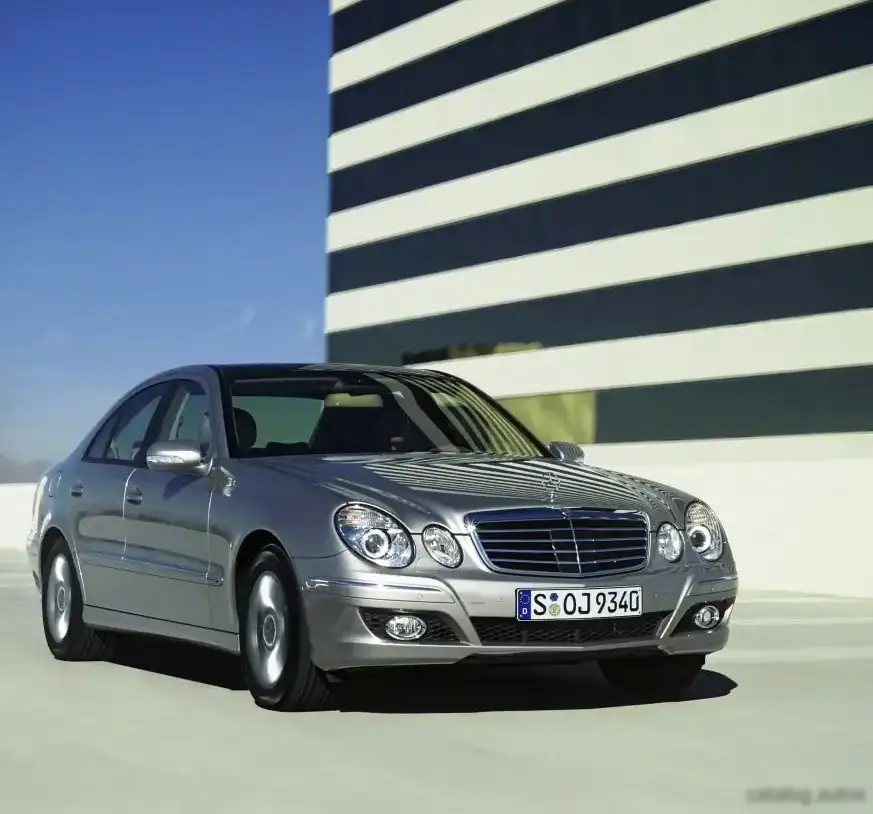
The Mercedes-Benz E 350 V6, powered by the M272 engine and paired with the 7G-TRONIC automatic transmission, represented a significant offering within the W211 E-Class facelift range produced from 2006 to 2009. Positioned as a mid-to-upper tier trim, it bridged the gap between the more economical four-cylinder models and the high-performance AMG variants. This variant aimed to deliver a balance of luxury, performance, and refinement, appealing to buyers seeking a sophisticated and capable executive sedan. The W211 facelift, introduced in late 2002, addressed criticisms of the original W211 design and improved overall build quality, solidifying the E-Class’s reputation as a benchmark in its segment.
Technical Specifications
| Brand | Mercedes-Benz |
| Model | E-class |
| Generation | E-class (W211, facelift 2006) |
| Type (Engine) | E 350 V6 (272 Hp) 7G-TRONIC |
| Start of production | 2006 |
| End of production | 2009 |
| Powertrain Architecture | Internal Combustion engine |
| Body type | Sedan |
| Seats | 5 |
| Doors | 4 |
| Fuel consumption (economy) – urban (NEDC) | 14-14.4 l/100 km (16.8 – 16.3 US mpg, 20.2 – 19.6 UK mpg, 7.1 – 6.9 km/l) |
| Fuel consumption (economy) – extra urban (NEDC) | 7.2-7.8 l/100 km (32.7 – 30.2 US mpg, 39.2 – 36.2 UK mpg, 13.9 – 12.8 km/l) |
| Fuel consumption (economy) – combined (NEDC) | 9.7-10.2 l/100 km (24.2 – 23.1 US mpg, 29.1 – 27.7 UK mpg, 10.3 – 9.8 km/l) |
| CO2 emissions (NEDC) | 231-244 g/km |
| Fuel Type | Petrol (Gasoline) |
| Acceleration 0 – 100 km/h | 6.9 sec |
| Acceleration 0 – 62 mph | 6.9 sec |
| Acceleration 0 – 60 mph | 6.6 sec |
| Maximum speed | 250 km/h (155.34 mph), Electronically limited |
| Emission standard | Euro 4 |
| Weight-to-power ratio | 5.9 kg/Hp, 168.4 Hp/tonne |
| Weight-to-torque ratio | 4.6 kg/Nm, 216.7 Nm/tonne |
| Power | 272 Hp @ 6000 rpm |
| Torque | 350 Nm @ 2400-5000 rpm (258.15 lb.-ft. @ 2400-5000 rpm) |
| Engine layout | Front, Longitudinal |
| Engine Model/Code | M 272.964 |
| Engine displacement | 3498 cm3 (213.46 cu. in.) |
| Number of cylinders | 6 |
| Engine configuration | V-engine |
| Cylinder Bore | 92.9 mm (3.66 in.) |
| Piston Stroke | 86 mm (3.39 in.) |
| Compression ratio | 10.7:1 |
| Number of valves per cylinder | 4 |
| Fuel injection system | Multi-port manifold injection |
| Engine aspiration | Naturally aspirated engine |
| Valvetrain | DOHC |
| Engine oil capacity | 8 l (8.45 US qt | 7.04 UK qt) |
| Coolant | 10 l (10.57 US qt | 8.8 UK qt) |
| Kerb Weight | 1615 kg (3560.47 lbs.) |
| Max. weight | 2215 kg (4883.24 lbs.) |
| Max load | 600 kg (1322.77 lbs.) |
| Trunk (boot) space – minimum | 540 l (19.07 cu. ft.) |
| Fuel tank capacity | 80 l (21.13 US gal | 17.6 UK gal) |
| Permitted trailer load with brakes (12%) | 1900 kg (4188.78 lbs.) |
| Permitted trailer load without brakes | 750 kg (1653.47 lbs.) |
| Length | 4856 mm (191.18 in.) |
| Width | 1822 mm (71.73 in.) |
| Width including mirrors | 2063 mm (81.22 in.) |
| Height | 1484 mm (58.43 in.) |
| Wheelbase | 2854 mm (112.36 in.) |
| Front track | 1559 mm (61.38 in.) |
| Rear (Back) track | 1552 mm (61.1 in.) |
| Front overhang | 869 mm (34.21 in.) |
| Rear overhang | 1133 mm (44.61 in.) |
| Minimum turning circle (turning diameter) | 11.4 m (37.4 ft.) |
| Drivetrain Architecture | The Internal combustion engine (ICE) drives the rear wheels of the vehicle. |
| Drive wheel | Rear wheel drive |
| Number of gears and type of gearbox | 7 gears, automatic transmission G-TRONIC |
| Front suspension | Independent multi-link suspension, Transverse stabilizer |
| Rear suspension | Independent multi-link suspension, Transverse stabilizer |
| Front brakes | Ventilated discs |
| Rear brakes | Ventilated discs |
| Assisting systems | ABS (Anti-lock braking system) |
| Steering type | Steering rack and pinion |
| Power steering | Hydraulic Steering |
| Tires size | 225/55 R16 |
| Wheel rims size | 7.5J x 16 |
Powertrain & Engine Architecture
The heart of the E 350 was the M272.964 3.5-liter naturally aspirated V6 engine. This engine featured all-aluminum construction, three valves per cylinder, and a dual overhead camshaft (DOHC) design. The M272 was known for its smooth operation and relatively high specific output. Fuel delivery was handled by a multi-port fuel injection system, optimized for efficient combustion. The 7G-TRONIC automatic transmission, a seven-speed unit, was a key component of this powertrain. It offered smooth and quick shifts, contributing to both performance and fuel efficiency. The transmission featured a torque converter lock-up clutch that engaged in higher gears to reduce slippage and improve economy. The engine code, M272.964, is crucial for identifying specific parts and service requirements.
Driving Characteristics
The E 350 V6 with the 7G-TRONIC provided a comfortable and refined driving experience. While not overtly sporty, the 272 horsepower and 350 Nm (258 lb-ft) of torque delivered adequate acceleration, with a 0-60 mph time of around 6.6 seconds. The 7G-TRONIC transmission was well-programmed, offering seamless gear changes and a responsive feel. Compared to the base four-cylinder models, the E 350 offered significantly more power and a more relaxed cruising experience. However, it lacked the outright performance of the E 500 or the AMG variants. The automatic transmission, while smooth, didn’t offer the same level of driver engagement as a manual gearbox. The gear ratios were tuned for a balance of acceleration and fuel economy, prioritizing comfort over aggressive performance.
Equipment & Trim Levels
The E 350 V6 typically came standard with a generous array of features, including leather upholstery, automatic climate control, power-adjustable front seats, a premium sound system, and a sunroof. Optional extras included navigation, upgraded leather, wood trim, and advanced safety features like Distronic adaptive cruise control and Parktronic parking assistance. Trim levels varied slightly depending on the market, but generally, the E 350 sat in the middle to upper range of the W211 lineup. Interior appointments were generally luxurious, with a focus on comfort and quality materials.
Chassis & Braking
The W211 E-Class featured an independent multi-link suspension at all four corners, providing a comfortable ride and good handling characteristics. The E 350 typically came equipped with ventilated disc brakes on all wheels, offering ample stopping power. Anti-lock braking system (ABS) was standard. Stabilizer bars were fitted front and rear to reduce body roll during cornering. The suspension tuning was geared towards comfort, but the E 350 still offered a reasonably controlled and stable driving experience.
Market Reception & Comparison
The E 350 V6 was generally well-received by automotive critics. It was praised for its smooth engine, comfortable ride, and refined interior. However, some reviewers noted that it lacked the sporty character of some of its competitors. Fuel economy was considered average for its class. Compared to the E 280 (the base V6 model), the E 350 offered a noticeable performance upgrade. Compared to the E 500, it provided a more affordable entry point into the V8-powered E-Class range. Reliability was generally good, although some owners reported issues with the electronic systems and auxiliary components.
Legacy
The M272 engine, in general, has proven to be a relatively reliable powerplant, although preventative maintenance, particularly regarding oil changes and coolant system servicing, is crucial. The 7G-TRONIC transmission is also generally durable, but can be susceptible to issues if not properly maintained. Today, the W211 E 350 represents a relatively affordable entry point into the Mercedes-Benz luxury sedan market. Well-maintained examples are still sought after by enthusiasts who appreciate their blend of comfort, performance, and build quality. However, potential buyers should be aware of the potential for age-related issues and the cost of maintaining a luxury vehicle.