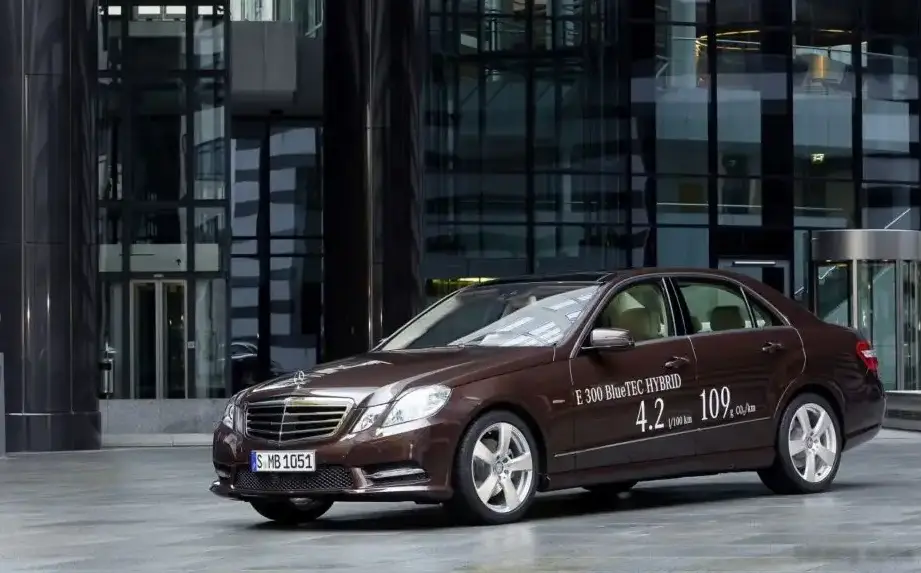
The Mercedes-Benz E 300 BlueTEC Hybrid, produced between June 2012 and January 2013, represented a significant step in the W212 E-Class’s evolution towards greater fuel efficiency. This variant combined a diesel engine with a full hybrid electric system, aiming to deliver both performance and reduced emissions. Positioned as a premium offering within the W212 range, it catered to buyers seeking a sophisticated and environmentally conscious luxury sedan. The E 300 BlueTEC Hybrid was a relatively short-lived model, bridging the gap between traditional internal combustion engines and the growing demand for hybrid technology in the executive car segment.
Technical Specifications
| Brand | Mercedes-Benz |
| Model | E-class |
| Generation | E-class (W212) |
| Type | E 300 BlueTEC Hybrid (204 Hp) 7G-TRONIC PLUS |
| Start of production | June, 2012 |
| End of production | January, 2013 |
| Powertrain Architecture | FHEV (Full Hybrid Electric Vehicle) |
| Body type | Sedan |
| Seats | 5 |
| Doors | 4 |
| Fuel consumption (urban) | 4.2-4.3 l/100 km (56 – 54.7 US mpg) |
| Fuel consumption (extra urban) | 4.2-4.3 l/100 km (56 – 54.7 US mpg) |
| Fuel consumption (combined) | 4.2-4.3 l/100 km (56 – 54.7 US mpg) |
| CO2 emissions | 109-112 g/km |
| Fuel Type | Diesel |
| Acceleration 0 – 100 km/h | 7.5 sec |
| Acceleration 0 – 62 mph | 7.5 sec |
| Acceleration 0 – 60 mph | 7.1 sec |
| Maximum speed | 242 km/h (150.37 mph) |
| Emission standard | Euro 5 |
| Weight-to-power ratio | 8.7 kg/Hp |
| Weight-to-torque ratio | 3.5 kg/Nm |
| Gross battery capacity | 0.8 kWh |
| All-electric range | 1 km (0.62 mi) |
| Max speed (electric) | 35 km/h (21.75 mph) |
| Electric motor power | 27 Hp |
| Electric motor Torque | 250 Nm (184.39 lb.-ft.) |
| Engine Power | 204 Hp @ 4200 rpm |
| Engine Torque | 500 Nm @ 1600-1800 rpm (368.78 lb.-ft. @ 1600-1800 rpm) |
| Engine displacement | 2143 cm3 (130.77 cu. in.) |
| Number of cylinders | 4 |
| Engine Code | OM 651.927 |
| Kerb Weight | 1770 kg (3902.18 lbs.) |
| Max. weight | 2390 kg (5269.05 lbs.) |
| Trunk space | 505 l (17.83 cu. ft.) |
| Fuel tank capacity | 59 l (15.59 US gal) |
| Length | 4868 mm (191.65 in.) |
| Width | 1854 mm (72.99 in.) |
| Height | 1471 mm (57.91 in.) |
| Wheelbase | 2874 mm (113.15 in.) |
| Gearbox | 7 gears, automatic transmission G-TRONIC PLUS |
Powertrain & Engine Architecture
The heart of the E 300 BlueTEC Hybrid is the OM 651.927 2.1-liter inline-four cylinder diesel engine. This engine utilizes a sophisticated commonrail direct injection system and a bi-turbocharger setup with an intercooler. The twin turbos, one large and one small, work in sequence to provide both low-end torque and high-end power. The engine produces 204 horsepower at 4200 rpm and a substantial 368.78 lb-ft of torque between 1600 and 1800 rpm. This engine is known for its durability and efficiency. The electric motor, rated at 27 horsepower and 184.39 lb-ft of torque, is positioned between the engine and the 7G-TRONIC PLUS seven-speed automatic transmission. This placement allows the electric motor to assist the diesel engine during acceleration and to provide limited all-electric driving capability. The hybrid system features a 0.8 kWh battery pack, enabling an all-electric range of just 1 kilometer (0.62 miles) and a maximum electric speed of 35 km/h (21.75 mph). The 7G-TRONIC PLUS transmission is a seven-speed automatic known for its smooth shifting and efficiency, and it’s specifically calibrated to work seamlessly with the hybrid powertrain.
Driving Characteristics
The E 300 BlueTEC Hybrid offers a unique driving experience. The electric motor provides instant torque, supplementing the diesel engine during initial acceleration, resulting in a responsive feel. While the 0-60 mph time of around 7.1 seconds isn’t particularly sporty, it’s respectable for a full-size luxury sedan. The hybrid system prioritizes fuel efficiency, and the car excels in urban driving conditions where the electric motor can be utilized more frequently. On the highway, the diesel engine takes over, providing ample power for cruising. Compared to the E 300 CDI (diesel only) or the E 350 (gasoline), the Hybrid offers superior fuel economy but slightly less outright performance. The 7G-TRONIC PLUS transmission contributes to a smooth and refined ride, with well-chosen gear ratios that optimize both fuel efficiency and performance. The gear ratios are tuned to maximize the benefits of the electric motor’s torque fill, providing a seamless transition between electric and diesel power.
Equipment & Trim Levels
The E 300 BlueTEC Hybrid typically came well-equipped, reflecting its premium positioning. Standard features included leather upholstery, automatic climate control, a high-quality audio system, and a suite of safety features such as ABS, traction control, and multiple airbags. The interior design mirrored other W212 E-Class models, with a focus on luxury and comfort. Optional extras included a navigation system, a panoramic sunroof, upgraded audio systems (such as Harman Kardon), and various driver-assistance technologies like lane-keeping assist and adaptive cruise control. The trim levels were generally aligned with the standard E-Class offerings, with options for different wood veneers and interior color schemes.
Chassis & Braking
The E 300 BlueTEC Hybrid utilizes an independent multi-link suspension system at both the front and rear, providing a comfortable and controlled ride. The suspension is tuned to balance handling and comfort, making it suitable for both city driving and long-distance journeys. The braking system consists of ventilated discs at the front and solid discs at the rear. ABS (Anti-lock Braking System) is standard, ensuring safe and effective braking in various conditions. The steering is a rack-and-pinion system with electric power steering, offering precise and responsive handling. The standard tire size was 225/55 R16, mounted on 7.5J x 16 inch alloy wheels.
Market Reception & Comparison
The E 300 BlueTEC Hybrid was generally well-received by automotive critics, who praised its fuel efficiency and smooth driving experience. However, some reviewers noted that the limited all-electric range and the relatively high price tag were drawbacks. Compared to the E 300 CDI, the Hybrid offered similar performance but significantly better fuel economy, particularly in urban environments. Against the E 350 gasoline model, the Hybrid provided comparable refinement but with lower emissions and improved fuel efficiency. The Hybrid’s fuel economy of 4.2-4.3 l/100 km (56-54.7 US mpg) was a key selling point, appealing to environmentally conscious buyers. Reliability reports suggest that the hybrid system itself is generally reliable, but the diesel engine components require regular maintenance, as with any diesel vehicle.
Legacy
The Mercedes-Benz E 300 BlueTEC Hybrid, while a short-lived model, played a role in paving the way for Mercedes-Benz’s broader adoption of hybrid technology. The powertrain, while not groundbreaking in terms of all-electric range, demonstrated the potential for combining diesel engines with electric motors to achieve significant fuel efficiency gains. On the used car market, these models are relatively scarce, and well-maintained examples command a premium. The OM 651 diesel engine is known for its longevity, but potential buyers should be aware of the maintenance requirements associated with diesel engines, including regular servicing of the particulate filter and fuel injection system. The hybrid components, including the battery pack and electric motor, have proven to be reasonably durable, but a thorough inspection by a qualified mechanic is recommended before purchase.