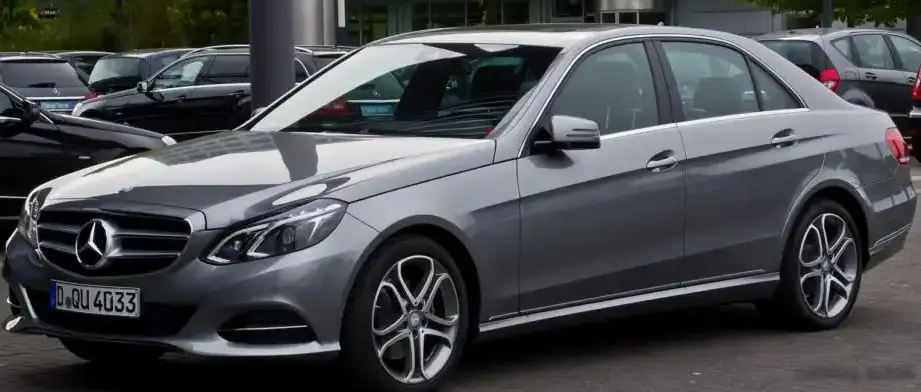
The Mercedes-Benz E 400 V6 3.5 (333 Hp) 4MATIC, produced from July 2014 to January 2016, represents a significant iteration within the W212 E-Class facelift generation. Positioned as a high-performance variant, it bridged the gap between the more mainstream E350 models and the full-fledged AMG offerings. This model combined a potent 3.5-liter V6 engine with Mercedes-Benz’s 4MATIC all-wheel-drive system and the 7G-TRONIC PLUS seven-speed automatic transmission, aiming to deliver a refined yet engaging driving experience. It was primarily marketed towards buyers seeking a blend of luxury, performance, and all-weather capability in a mid-size executive sedan.
Technical Specifications
| Brand | Mercedes-Benz |
| Model | E-class |
| Generation | E-class (W212, facelift 2013) |
| Type | E 400 V6 3.5 (333 Hp) 4MATIC 7G-TRONIC PLUS |
| Start of production | July, 2014 |
| End of production | January, 2016 |
| Powertrain Architecture | Internal Combustion engine |
| Body type | Sedan |
| Seats | 5 |
| Doors | 4 |
| Fuel consumption (urban) | 9.9-10.2 l/100 km (23.8 – 23.1 US mpg) |
| Fuel consumption (extra urban) | 5.9-6.3 l/100 km (39.9 – 37.3 US mpg) |
| Fuel consumption (combined) | 7.4-7.7 l/100 km (31.8 – 30.5 US mpg) |
| CO2 emissions | 172-179 g/km |
| Fuel Type | Petrol (Gasoline) |
| Acceleration 0 – 100 km/h | 5.3 sec |
| Acceleration 0 – 62 mph | 5.3 sec |
| Acceleration 0 – 60 mph | 5 sec |
| Maximum speed | 250 km/h (155.34 mph) |
| Emission standard | Euro 6 |
| Weight-to-power ratio | 5.3 kg/Hp |
| Weight-to-torque ratio | 3.7 kg/Nm |
| Power | 333 Hp @ 5250-6000 rpm |
| Torque | 480 Nm @ 1200-4000 rpm (354.03 lb.-ft. @ 1200-4000 rpm) |
| Engine layout | Front, Longitudinal |
| Engine Model/Code | M 276.850 |
| Engine displacement | 3498 cm3 (213.46 cu. in.) |
| Number of cylinders | 6 |
| Engine configuration | V-engine |
| Cylinder Bore | 92.9 mm (3.66 in.) |
| Piston Stroke | 86 mm (3.39 in.) |
| Number of valves per cylinder | 4 |
| Fuel injection system | Direct injection |
| Engine aspiration | BiTurbo, Intercooler |
| Valvetrain | DOHC |
| Engine oil capacity | 6.5 l (6.87 US qt | 5.72 UK qt) |
| Coolant capacity | 10.3 l (10.88 US qt | 9.06 UK qt) |
| Kerb Weight | 1770 kg (3902.18 lbs.) |
| Max. weight | 2410 kg (5313.14 lbs.) |
| Max load | 640 kg (1410.96 lbs.) |
| Trunk (boot) space | 540 l (19.07 cu. ft.) |
| Fuel tank capacity | 59 l (15.59 US gal | 12.98 UK gal) |
| Max. roof load | 100 kg (220.46 lbs.) |
| Permitted trailer load (braked) | 2100 kg (4629.71 lbs.) |
| Permitted trailer load (unbraked) | 750 kg (1653.47 lbs.) |
| Permitted towbar download | 84 kg (185.19 lbs.) |
| Length | 4879 mm (192.09 in.) |
| Width | 1854 mm (72.99 in.) |
| Width including mirrors | 2071 mm (81.54 in.) |
| Height | 1474 mm (58.03 in.) |
| Wheelbase | 2874 mm (113.15 in.) |
| Front track | 1598 mm (62.91 in.) |
| Rear track | 1614 mm (63.54 in.) |
| Front overhang | 849 mm (33.43 in.) |
| Rear overhang | 1156 mm (45.51 in.) |
| Minimum turning circle | 11.5 m (37.73 ft.) |
| Drivetrain | All wheel drive (4×4) |
| Number of gears | 7 |
| Gearbox type | Automatic transmission G-TRONIC PLUS |
INTRODUCTION
The W212 E-Class facelift, introduced in 2013, brought a refreshed design and updated technology to Mercedes-Benz’s mid-size executive sedan. The E 400 V6 4MATIC, launched in 2014, was a key component of this update, offering a significant power upgrade over the base E350 models. It was designed to appeal to drivers who desired a more spirited driving experience without sacrificing the comfort and luxury expected from a Mercedes-Benz. The vehicle sat above the E250 and E350 in the lineup, offering a substantial performance increase, and below the high-performance AMG variants. Production continued until early 2016, making way for the next-generation W213 E-Class.
Powertrain & Engine Architecture
At the heart of the E 400 V6 4MATIC lies the M276.850 3.5-liter V6 engine. This engine is a naturally aspirated powerplant featuring direct fuel injection and twin turbochargers. The engine produces 333 horsepower at 5250-6000 rpm and 480 Nm (354 lb-ft) of torque between 1200-4000 rpm. The engine utilizes a double overhead camshaft (DOHC) valvetrain with four valves per cylinder. The direct injection system precisely meters fuel into the combustion chambers, optimizing combustion efficiency and power output. The 7G-TRONIC PLUS seven-speed automatic transmission is a crucial component of the powertrain. This transmission is known for its smooth and responsive shifts, contributing to both performance and fuel efficiency. It features a torque converter lock-up clutch that engages at higher speeds to reduce slippage and improve fuel economy. The transmission is electronically controlled, adapting shift points based on driving conditions and driver input.
Driving Characteristics
The E 400 V6 4MATIC delivers a noticeably more engaging driving experience compared to the E350. The increased horsepower and torque, combined with the quick-shifting 7G-TRONIC PLUS transmission, result in brisk acceleration – 0 to 60 mph in approximately 5 seconds. The 4MATIC all-wheel-drive system provides excellent traction in all weather conditions, enhancing stability and confidence. The gear ratios are tuned to provide a balance between acceleration and fuel efficiency. Lower gears offer strong off-the-line acceleration, while higher gears allow for relaxed cruising at highway speeds. While not as overtly sporty as the AMG models, the E 400 offers a refined and capable driving experience that is well-suited for both daily commuting and longer journeys.
Equipment & Trim Levels
The E 400 V6 4MATIC typically came well-equipped as standard. Features included leather upholstery, power-adjustable front seats with memory function, dual-zone automatic climate control, a premium sound system, and a navigation system. The infotainment system featured a central display screen controlled by a rotary dial and buttons. Optional extras included a panoramic sunroof, adaptive cruise control, lane-keeping assist, blind-spot monitoring, and a rear-seat entertainment system. Interior trim options included various wood veneers and aluminum accents, allowing buyers to personalize the cabin to their preferences.
Chassis & Braking
The E 400 V6 4MATIC utilizes a sophisticated suspension system designed to provide a comfortable ride and precise handling. The front suspension features a multi-link design with coil springs and a stabilizer bar. The rear suspension also employs a multi-link setup with coil springs and a stabilizer bar. Air suspension was available as an option, further enhancing ride comfort and allowing for adjustable ride height. The braking system consists of ventilated discs on all four wheels, providing ample stopping power. Anti-lock braking system (ABS) and electronic stability control (ESC) are standard features, enhancing safety and control.
Market Reception & Comparison
The E 400 V6 4MATIC was generally well-received by automotive critics. It was praised for its powerful engine, smooth transmission, comfortable ride, and all-weather capability. Compared to the E350, the E 400 offered a significant performance upgrade, while remaining more affordable and less aggressive than the AMG models. Fuel economy was respectable for a V6-powered sedan, although not as efficient as the four-cylinder E250 or the diesel-powered E350 BlueTEC. Reliability was generally good, although some owners reported minor issues with the infotainment system and electronic components.
Legacy
The E 400 V6 4MATIC has proven to be a relatively reliable and durable vehicle. The M276 engine is known for its robust construction and longevity, provided it receives regular maintenance. On the used car market, these models hold their value reasonably well, particularly those with low mileage and a well-documented service history. The combination of luxury, performance, and all-wheel-drive capability continues to make the E 400 V6 4MATIC an attractive option for buyers seeking a refined and capable mid-size executive sedan.