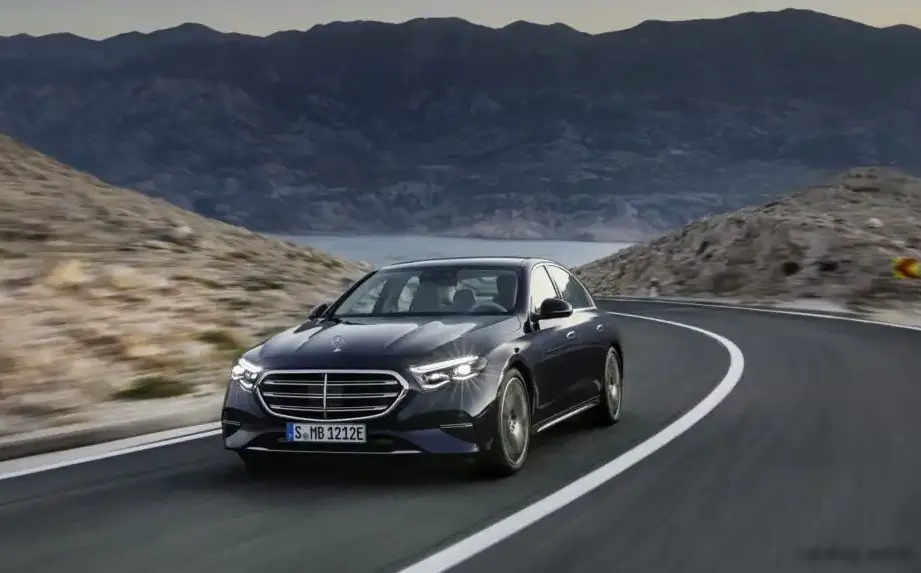
The Mercedes-Benz E 300 (W214), introduced in 2024, represents the latest iteration of the brand’s mid-size executive car. This variant, equipped with a 2.0-liter turbocharged inline-four engine and a 48-volt mild hybrid system paired with a 9G-TRONIC nine-speed automatic transmission, occupies a central position within the W214 E-Class lineup. It serves as a balance between performance, efficiency, and technology, appealing to buyers seeking a refined and modern luxury sedan. The W214 generation signifies a substantial technological leap for the E-Class, incorporating advanced driver-assistance systems and a comprehensively updated interior.
Technical Specifications
| Brand | Mercedes-Benz |
| Model | E-class |
| Generation | E-class (W214) |
| Type | E 300 (258 Hp) Mild Hybrid 9G-TRONIC |
| Start of production | 2024 |
| Powertrain Architecture | MHEV (Mild Hybrid Electric Vehicle) |
| Body type | Sedan |
| Seats | 5 |
| Doors | 4 |
| Fuel consumption (combined) | 7.2 l/100 km (32.7 US mpg, 39.2 UK mpg, 13.9 km/l) |
| CO2 emissions | 162 g/km |
| Fuel Type | Petrol (Gasoline) |
| Acceleration 0 – 100 km/h | 6.3 sec |
| Acceleration 0 – 62 mph | 6.3 sec |
| Acceleration 0 – 60 mph | 6 sec |
| Maximum speed | 250 km/h (155.34 mph) |
| Emission standard | Euro 6 |
| Weight-to-power ratio | 7.3 kg/Hp |
| Weight-to-torque ratio | 4.7 kg/Nm |
| Battery voltage | 48 V |
| Battery technology | Lithium-ion (Li-Ion) |
| Power | 258 Hp @ 5800 rpm |
| Torque | 400 Nm @ 2000-3200 rpm (295.02 lb.-ft. @ 2000-3200 rpm) |
| Engine layout | Front, Longitudinal |
| Engine Model/Code | M 254.920 |
| Engine displacement | 1999 cm3 (121.99 cu. in.) |
| Number of cylinders | 4 |
| Engine configuration | Inline |
| Cylinder Bore | 83 mm (3.27 in.) |
| Piston Stroke | 92.4 mm (3.64 in.) |
| Compression ratio | 10:1 |
| Number of valves per cylinder | 4 |
| Fuel injection system | Direct injection |
| Engine aspiration | Twin-scroll turbo, Intercooler |
| Valvetrain | DOHC, CAMTRONIC |
| Engine oil capacity | 6 l (6.34 US qt | 5.28 UK qt) |
| Kerb Weight | 1875-1895 kg (4133.67 – 4177.76 lbs.) |
| Max. weight | 2450 kg (5401.33 lbs.) |
| Max load | 555-575 kg (1223.57 – 1267.66 lbs.) |
| Trunk (boot) space – minimum | 540 l (19.07 cu. ft.) |
| Fuel tank capacity | 66 l (17.44 US gal | 14.52 UK gal) |
| Length | 4949 mm (194.84 in.) |
| Width | 1880 mm (74.02 in.) |
| Width including mirrors | 2065 mm (81.3 in.) |
| Height | 1469 mm (57.83 in.) |
| Wheelbase | 2961 mm (116.57 in.) |
| Front overhang | 848 mm (33.39 in.) |
| Rear overhang | 1140 mm (44.88 in.) |
| Minimum turning circle | 11.6 m (38.06 ft.) |
| Drivetrain Architecture | Rear wheel drive, MHEV |
| Drive wheel | Rear wheel drive |
| Number of gears | 9 |
| Gearbox type | Automatic transmission G-TRONIC |
| Front suspension | Coil spring, Independent multi-link suspension, Transverse stabilizer, Air Suspension – Optional |
| Rear suspension | Independent multi-link spring suspension with stabilizer, Air Suspension – Optional |
| Front brakes | Ventilated discs |
| Rear brakes | Ventilated discs |
| Assisting systems | ABS (Anti-lock braking system) |
| Steering type | Steering rack and pinion |
| Power steering | Electric Steering |
| Tires size (Front) | 245/45 R19; 245/40 R20 |
| Tires size (Rear) | 275/40 R19; 275/35 R20 |
| Wheel rims size (Front) | 8.5J x 19; 8.5J x 20 |
| Wheel rims size (Rear) | 9.5J x 19; 9.5J x 20 |
INTRODUCTION
The W214 E 300, launched in 2024, builds upon the established reputation of the E-Class as a benchmark for mid-size luxury. It represents the fifth generation of the E-Class, continuing a lineage that began in 1993. The E 300 variant, powered by the M 254 engine and utilizing the 9G-TRONIC transmission, is positioned as a core offering within the range, providing a compelling blend of performance and efficiency. It caters to buyers who prioritize a comfortable driving experience and advanced technology without necessarily requiring the higher performance of the AMG-tuned models or the fuel economy focus of the diesel variants.
Powertrain & Engine Architecture
At the heart of the E 300 lies the M 254.920 2.0-liter inline-four cylinder engine. This engine is a key component of Mercedes-Benz’s modular engine family, known for its efficiency and refinement. It features direct fuel injection, a twin-scroll turbocharger, and CAMTRONIC variable valve timing, allowing for optimized performance and fuel economy across a wide range of driving conditions. The engine produces 258 horsepower at 5800 rpm and 400 Nm (295 lb-ft) of torque between 2000 and 3200 rpm. The mild hybrid system, utilizing a 48-volt electrical architecture, adds a boost during acceleration and enables features like coasting with engine-off to further enhance fuel efficiency. The 9G-TRONIC nine-speed automatic transmission is a sophisticated unit, offering smooth and quick shifts. It’s designed to work seamlessly with the engine’s torque curve, providing optimal acceleration and fuel economy. The transmission features a wide gear ratio spread, contributing to both relaxed highway cruising and responsive acceleration.
Driving Characteristics
The E 300 delivers a refined and comfortable driving experience. The 9G-TRONIC transmission is programmed for smooth shifts, prioritizing comfort over aggressive gear changes. While not as overtly sporty as some competitors, the E 300 offers ample power for everyday driving and confident overtaking maneuvers. The mild hybrid system provides a noticeable boost during acceleration, filling in any potential gaps in the torque curve. Compared to higher-output E-Class variants, the E 300 prioritizes fuel efficiency and a more relaxed driving style. The gear ratios are tuned for efficiency, meaning it may require a downshift or two when tackling steep inclines or performing quick overtaking maneuvers. Compared to a manual transmission equipped E-Class (not currently offered in this configuration), the 9G-TRONIC provides a more effortless driving experience, particularly in urban traffic.
Equipment & Trim Levels
The E 300 comes standard with a comprehensive suite of features, reflecting its position as a premium luxury sedan. Standard equipment typically includes Mercedes-Benz User Experience (MBUX) infotainment system with a large touchscreen display, premium upholstery, automatic climate control, and a range of driver-assistance systems such as automatic emergency braking and lane-keeping assist. Optional extras include features like a Burmester surround sound system, ventilated and massaging front seats, a panoramic sunroof, and advanced driver-assistance packages offering features like adaptive cruise control and lane change assist. Interior trim options range from wood veneers to aluminum accents, allowing buyers to personalize the cabin to their preferences.
Chassis & Braking
The W214 E 300 utilizes a sophisticated chassis design focused on comfort and handling. The front suspension features a multi-link setup with coil springs, while the rear suspension employs an independent multi-link design as well. Air suspension is available as an option, further enhancing ride comfort and providing adjustable ride height. The braking system consists of ventilated discs on all four wheels, providing ample stopping power. Anti-lock braking system (ABS) and electronic stability control (ESC) are standard features, enhancing safety and control. The steering system is a rack-and-pinion setup with electric power assistance, offering precise and responsive steering feel.
Market Reception & Comparison
The W214 E 300 has been generally well-received by automotive critics, praised for its refined driving experience, advanced technology, and luxurious interior. Comparisons to rivals like the BMW 5 Series and Audi A6 often highlight the E 300’s comfortable ride and sophisticated infotainment system. Fuel economy is competitive within its class, benefiting from the mild hybrid system. Reliability is expected to be in line with other Mercedes-Benz models, although long-term data is still emerging. Compared to the E 450, the E 300 offers a more affordable entry point into the E-Class range, while still providing a premium experience. The E 300d diesel variant offers superior fuel economy but lacks the responsiveness of the gasoline engine.
Legacy
The M 254 engine family, and the 9G-TRONIC transmission, are expected to be reliable powertrains, building on Mercedes-Benz’s reputation for engineering excellence. The mild hybrid technology incorporated into the E 300 represents a significant step towards electrification, and its long-term durability will be a key factor in its overall legacy. On the used car market, the W214 E 300 is anticipated to hold its value well, appealing to buyers seeking a modern and well-equipped luxury sedan with a proven track record.