
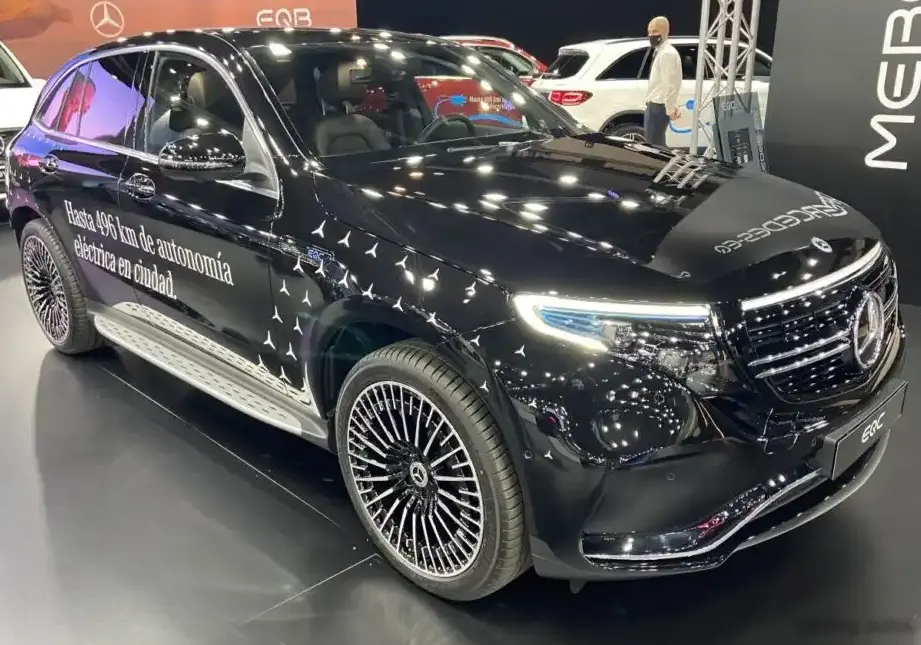
The Mercedes-Benz EQC 400 85 kWh (408 Hp) 4MATIC, internally designated N293, represents Mercedes-Benz’s initial foray into the all-electric luxury SUV segment. Production commenced in May 2019 and continued through 2023. Positioned as a direct competitor to vehicles like the Tesla Model X and Audi e-tron, the EQC aimed to deliver a premium electric experience combining Mercedes-Benz’s renowned build quality and technology with zero-emission driving. It’s built on a modified version of the MRA (Modular Ride Architecture) platform, adapted to accommodate the electric powertrain and battery pack. The EQC 400 85 kWh served as the primary and, for most markets, the sole variant offered throughout its production run.
Technical Specifications
| Brand | Mercedes-Benz |
| Model | EQC |
| Generation | EQC (N293) |
| Type (Engine) | EQC 400 85 kWh (408 Hp) 4MATIC |
| Start of production | May, 2019 |
| End of production | 2023 |
| Powertrain Architecture | BEV (Electric Vehicle) |
| Body type | SUV |
| Seats | 5 |
| Doors | 5 |
| Fuel Type | Electricity |
| Acceleration 0 – 100 km/h | 5.1 sec |
| Acceleration 0 – 62 mph | 5.1 sec |
| Acceleration 0 – 60 mph | 4.8 sec |
| Maximum speed | 180 km/h (111.85 mph) |
| Weight-to-power ratio | 5.9 kg/Hp, 168.6 Hp/tonne |
| Weight-to-torque ratio | 3.2 kg/Nm, 314 Nm/tonne |
| Gross battery capacity | 85 kWh |
| Net (usable) battery capacity | 80 kWh |
| Battery voltage | 405 V |
| Battery technology | Lithium-ion (Li-Ion) |
| Battery weight | 652 kg (1437.41 lbs) |
| Battery location | Below the floor |
| All-electric range (WLTP) | 373-437 km (231.77 – 271.54 mi) |
| All-electric range (NEDC) | 436-495 km (270.92 – 307.58 mi) |
| Average Energy consumption (WLTP) | 21.3-25 kWh/100 km (34.28 – 40.23 kWh/100 mi) |
| Average Energy consumption (NEDC) | 19.4-21.9 kWh/100 km (31.22 – 35.24 kWh/100 mi) |
| System power | 408 Hp |
| System torque | 760 Nm (560.55 lb.-ft.) |
| Kerb Weight | 2420 kg (5335.19 lbs) |
| Max. weight | 2940 kg (6481.59 lbs) |
| Max load | 520 kg (1146.4 lbs) |
| Trunk (boot) space – minimum | 500 l (17.66 cu. ft.) |
| Trunk (boot) space – maximum | 1460 l (51.56 cu. ft.) |
| Max. roof load | 75 kg (165.35 lbs) |
| Permitted trailer load with brakes (12%) | 1800 kg (3968.32 lbs) |
| Permitted trailer load without brakes | 750 kg (1653.47 lbs) |
| Permitted towbar download | 72 kg (158.73 lbs) |
| Length | 4762 mm (187.48 in) |
| Width | 1884 mm (74.17 in) |
| Width including mirrors | 2096 mm (82.52 in) |
| Height | 1624 mm (63.94 in) |
| Wheelbase | 2873 mm (113.11 in) |
| Front track | 1624 mm (63.94 in) |
| Rear (Back) track | 1615 mm (63.58 in) |
| Front overhang | 867 mm (34.13 in) |
| Rear overhang | 1022 mm (40.24 in) |
| Drag coefficient (Cd) | 0.29 |
| Minimum turning circle (turning diameter) | 11.8 m (38.71 ft) |
| Approach angle | 17.5° |
| Departure angle | 19.5° |
| Ramp-over (brakeover) angle | 9.7° |
| Drivetrain Architecture | One electric motor drives the front wheels, one electric motor drives the rear wheels. |
| Drive wheel | All wheel drive (4×4) |
| Number of gears and type of gearbox | 1 gears, automatic transmission |
| Front suspension | Double wishbone |
| Rear suspension | Independent multi-link suspension |
| Front brakes | Ventilated discs |
| Rear brakes | Ventilated discs |
| Assisting systems | ABS (Anti-lock braking system) |
| Steering type | Steering rack and pinion |
| Power steering | Electric Steering |
| Front wheel tires | 235/55 R19; 235/50 R20; 235/45 R21 |
| Rear wheel tires | 235/55 R19; 255/50 R19; 255/45 R20; 255/40 R21 |
| Front wheel rims | 7.5J x 19; 8J x 19; 7.5J x 20; 8J x 21 |
| Rear wheel rims | 8J x 19; 8.5J x 20; 9J x 21 |
Powertrain & Engine Architecture
The EQC 400 85 kWh utilizes a dual-motor, all-wheel-drive (4MATIC) powertrain. Each axle features a permanently excited synchronous electric motor. These motors deliver instant torque, contributing to the vehicle’s brisk acceleration. The combined system output is 408 horsepower and 760 Nm (560.55 lb-ft) of torque. The 85 kWh lithium-ion battery pack is located under the floor, contributing to a low center of gravity and improved handling. The battery employs a sophisticated thermal management system to maintain optimal operating temperatures, crucial for both performance and longevity. The EQC doesn’t have a traditional multi-gear transmission; instead, it utilizes a single-speed gearbox for each axle. The power electronics are integrated into the powertrain, managing the flow of energy between the battery, motors, and other vehicle systems.
Driving Characteristics
The EQC 400 85 kWh delivers a smooth and refined driving experience. The instant torque from the electric motors provides strong acceleration, with a 0-60 mph time of around 4.8 seconds. While not a sports car, the EQC feels surprisingly agile for its size and weight. The single-speed gearbox provides seamless acceleration, although it lacks the distinct gear changes of a traditional automatic transmission. Compared to potential higher-performance variants (which were never offered), the EQC 400 prioritizes efficiency and comfort over outright speed. The regenerative braking system is adjustable, allowing drivers to customize the level of deceleration when lifting off the throttle. This helps to recapture energy and extend the vehicle’s range.
Equipment & Trim Levels
The EQC 400 85 kWh came well-equipped as standard. Interior features included MB-Tex artificial leather upholstery, heated front seats, a dual 10.25-inch display screen for the instrument cluster and infotainment system, and Mercedes-Benz’s MBUX infotainment system with voice control. Standard safety features included automatic emergency braking, lane keeping assist, and adaptive cruise control. Optional extras included genuine leather upholstery, a panoramic sunroof, a Burmester surround sound system, and advanced driver-assistance features like park assist. Trim levels were relatively limited, with most customization options available as individual add-ons rather than distinct packages.
Chassis & Braking
The EQC features a double-wishbone front suspension and an independent multi-link rear suspension, tuned for comfort and stability. The suspension is designed to handle the added weight of the battery pack while providing a controlled and predictable ride. The EQC is equipped with ventilated disc brakes on all four wheels. The braking system is augmented by an electronic stability program (ESP) and anti-lock braking system (ABS). Due to the weight distribution from the battery pack, the EQC exhibits balanced handling characteristics. The steering is electrically assisted, providing precise and responsive control.
Market Reception & Comparison
The EQC received mixed reviews upon its launch. Critics praised its luxurious interior, smooth ride, and quiet operation. However, some criticized its relatively limited range compared to competitors like the Tesla Model X and its higher price point. Fuel economy, measured in kWh per 100 km, varied depending on driving conditions, but generally fell within the range of 21.3-25 kWh/100 km (WLTP). Compared to a hypothetical gasoline-powered equivalent, the EQC offered significantly lower running costs due to the lower price of electricity versus gasoline. Reliability reports were initially mixed, with some owners reporting issues with the infotainment system and battery management system.
Legacy
The Mercedes-Benz EQC, while not a runaway sales success, played a crucial role in establishing Mercedes-Benz as a serious contender in the electric vehicle market. It demonstrated the brand’s commitment to electrification and paved the way for future EV models like the EQS and EQE. On the used car market, the EQC 400 85 kWh represents a relatively affordable entry point into the luxury electric SUV segment. The long-term reliability of the powertrain remains a key consideration for potential buyers, with battery health being a primary concern. Despite some early teething issues, the EQC’s robust construction and advanced technology suggest that it has the potential to provide years of reliable service.
