
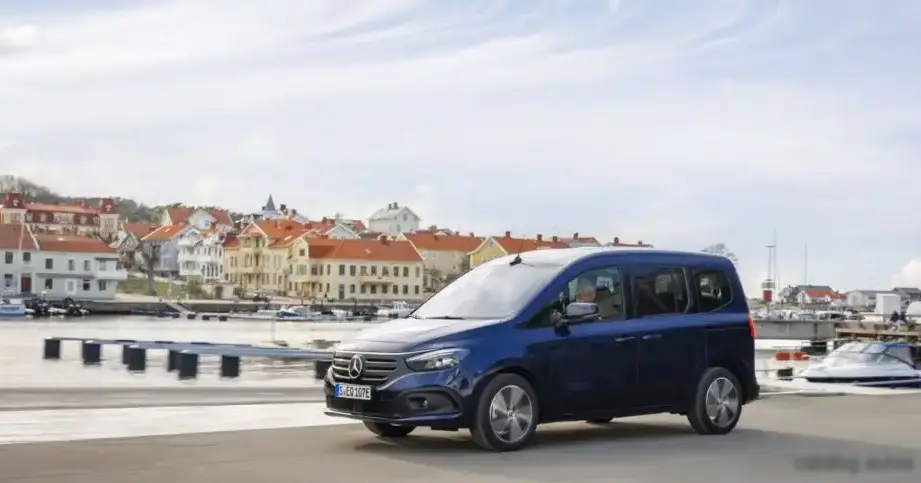
The Mercedes-Benz EQT 200 48 kWh, launched in 2023, represents the entry point into the all-electric EQT minivan range. Based on the E420 generation, this variant is designed to offer practical, zero-emission transportation for families and businesses. Positioned as a versatile multi-purpose vehicle (MPV), the EQT 200 aims to combine the practicality of a compact van with the benefits of electric propulsion. It’s a key component of Mercedes-Benz’s expanding electric vehicle lineup, targeting a market segment increasingly focused on sustainable mobility. The EQT shares its platform with the Renault Kangoo E-Tech Electric, a result of the collaboration between Mercedes-Benz and Renault.
Technical Specifications
| Brand | Mercedes-Benz |
| Model | EQT |
| Generation | EQT (E420) |
| Type (Engine) | EQT 200 48 kWh (122 Hp) |
| Start of production | 2023 |
| Powertrain Architecture | BEV (Electric Vehicle) |
| Body type | Minivan |
| Seats | 5 |
| Doors | 5 |
| Fuel Type | Electricity |
| Acceleration 0 – 100 km/h | 12.6 sec |
| Acceleration 0 – 62 mph | 12.6 sec |
| Acceleration 0 – 60 mph | 12 sec |
| Maximum speed | 132 km/h (82.02 mph) |
| Weight-to-power ratio | 14.7 kg/Hp, 67.8 Hp/tonne |
| Weight-to-torque ratio | 7.3 kg/Nm, 136.2 Nm/tonne |
| Gross battery capacity | 48 kWh |
| Net (usable) battery capacity | 45 kWh |
| Battery voltage | 400 V |
| Battery technology | Lithium-ion (Li-Ion) |
| Battery weight | 320 kg (705.48 lbs) |
| Battery location | Below the floor, under the rear seats |
| All-electric range (WLTP) | 263-282 km (163.42 – 175.23 mi) |
| Average Energy consumption (WLTP) | 19.3-20.7 kWh/100 km (31.06 – 33.31 kWh/100 mi) |
| Average Energy consumption (MPGe) | 108 – 101 |
| Average Energy consumption (km/kWh) | 5.2 – 4.8 |
| Average Energy consumption (mi/kWh) | 3.2 – 3 |
| Electric motor power | 122 Hp |
| Electric motor Torque | 245 Nm (180.7 lb.-ft.) |
| Electric motor model/code | 5AQ-60 |
| Electric motor location | Front axle, Transverse |
| Electric motor type | Synchronous |
| System power | 122 Hp |
| System torque | 245 Nm (180.7 lb.-ft.) |
| Kerb Weight | 1799-1940 kg (3966.12 – 4276.97 lbs) |
| Max. weight | 2390 kg (5269.05 lbs) |
| Max load | 450-591 kg (992.08 – 1302.93 lbs) |
| Trunk (boot) space – minimum | 551 l (19.46 cu. ft.) |
| Trunk (boot) space – maximum | 1979 l (69.89 cu. ft.) |
| Max. roof load | 80 kg (176.37 lbs) |
| Permitted trailer load with brakes (12%) | 1500 kg (3306.93 lbs) |
| Permitted trailer load without brakes | 750 kg (1653.47 lbs) |
| Permitted towbar download | 75 kg (165.35 lbs) |
| Length | 4498 mm (177.09 in) |
| Width | 1859 mm (73.19 in) |
| Width including mirrors | 2159 mm (85 in) |
| Height | 1819 mm (71.61 in) |
| Wheelbase | 2716 mm (106.93 in) |
| Front track | 1585 mm (62.4 in) |
| Rear (Back) track | 1606 mm (63.23 in) |
| Minimum turning circle | 11.2 m (36.75 ft) |
| Drivetrain Architecture | One electric motor drives the front wheels |
| Drive wheel | Front wheel drive |
| Number of gears | 1 |
| Gearbox type | Automatic transmission |
| Front suspension | Independent, type McPherson with coil spring and anti-roll bar |
| Rear suspension | Rigid axle suspension |
| Front brakes | Ventilated discs |
| Rear brakes | Ventilated discs |
| Assisting systems | ABS (Anti-lock braking system) |
| Steering type | Steering rack and pinion |
| Power steering | Electric |
| Wheel rims size | 16; 17 |
Powertrain & Engine Architecture
The EQT 200 utilizes a single electric motor, designated 5AQ-60, producing 122 horsepower and 245 Nm (180.7 lb-ft) of torque. This motor is transversely mounted on the front axle, driving the front wheels. The powertrain operates on a 400V architecture and is powered by a lithium-ion battery pack with a gross capacity of 48 kWh, providing a usable capacity of 45 kWh. The battery is positioned under the floor and beneath the rear seats, optimizing space within the vehicle. The single-speed automatic transmission delivers power smoothly and efficiently. The electric motor is a synchronous design, known for its efficiency and relatively compact size. The EQT 200 does not employ a traditional internal combustion engine, eliminating emissions and offering a quiet driving experience.
Driving Characteristics
The EQT 200 48 kWh offers a comfortable and practical driving experience, prioritizing efficiency over outright performance. Acceleration from 0-100 km/h (0-62 mph) takes approximately 12.6 seconds, and the top speed is limited to 132 km/h (82 mph). The single-speed transmission provides seamless acceleration, and the instant torque delivery characteristic of electric motors makes for responsive driving in urban environments. Compared to potential higher-output EQT variants (which are not currently available in the US market), the 200 model offers a more relaxed driving experience. The focus is on maximizing range and minimizing energy consumption. The front-wheel-drive configuration provides adequate traction for most driving conditions, but may exhibit some torque steer under hard acceleration.
Equipment & Trim Levels
The EQT 200 typically comes standard with features such as air conditioning, a touchscreen infotainment system compatible with Apple CarPlay and Android Auto, and a suite of safety features including ABS, stability control, and multiple airbags. Interior upholstery is generally cloth, with options for upgraded materials available. The dashboard layout is functional and modern, with a focus on ease of use. Optional extras may include parking sensors, a rearview camera, and advanced driver-assistance systems. Trim levels are relatively simple, with the 200 representing the base offering. The interior is designed to be durable and practical, reflecting the vehicle’s intended use as a family or commercial vehicle.
Chassis & Braking
The EQT 200 features an independent McPherson strut suspension at the front, providing a comfortable ride and responsive handling. The rear suspension utilizes a rigid axle design, which is a cost-effective solution for maximizing cargo space. The braking system consists of ventilated discs on all four wheels, providing adequate stopping power. Electric vehicles often incorporate regenerative braking, which helps to recapture energy during deceleration and extend the vehicle’s range. The EQT 200 includes ABS (Anti-lock Braking System) as standard, enhancing safety during emergency braking situations. Steering is rack and pinion with electric power assistance, offering a light and precise feel.
Market Reception & Comparison
The Mercedes-Benz EQT 200 has been generally well-received as a practical and affordable electric MPV. Critics have praised its spacious interior, comfortable ride, and zero-emission operation. However, some have noted its relatively modest performance compared to other electric vehicles. Compared to potential higher-trim EQT models, the 200 offers a more accessible price point, making it attractive to budget-conscious buyers. Its fuel economy, measured in kWh/100km, is competitive with other electric vans and MPVs in its class. Reliability is expected to be good, given Mercedes-Benz’s reputation for build quality, although long-term data is still emerging.
Legacy
The EQT 200 represents a significant step for Mercedes-Benz in expanding its electric vehicle offerings into the compact MPV segment. Its powertrain, while not the most powerful, is expected to be durable and reliable. As the electric vehicle market matures, the EQT 200 is likely to become a popular choice for families and businesses seeking a practical and sustainable transportation solution. The long-term value of the EQT 200 will depend on factors such as battery health and the availability of charging infrastructure. The EQT’s platform sharing with Renault also demonstrates a trend towards collaboration in the automotive industry to reduce development costs and accelerate the transition to electric mobility.
