
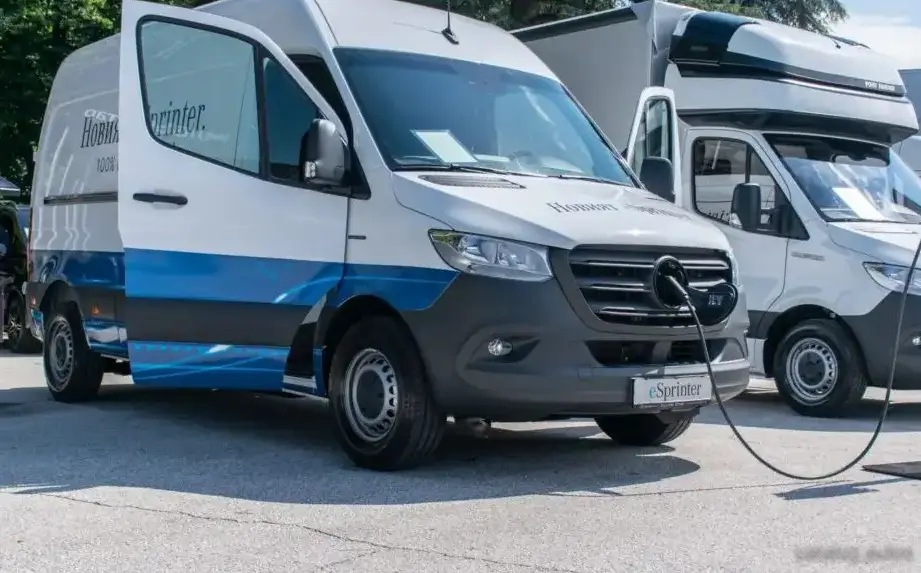
The Mercedes-Benz eSprinter Panel Van, specifically the W907/W910 generation equipped with the 41 kWh battery pack and 116 horsepower electric motor, represents the brand’s initial foray into a fully electric commercial vehicle offering. Production commenced in December 2019, positioning it as a key component of Mercedes-Benz Vans’ strategy to electrify its entire portfolio. This variant is primarily targeted at urban delivery services and businesses seeking a zero-emission solution for short to medium-range transport needs. It’s built on the established Sprinter platform, but fundamentally altered with a battery-electric powertrain. The eSprinter aims to provide the practicality and cargo capacity of the conventional Sprinter, while addressing growing environmental concerns and increasingly stringent emissions regulations in major cities.
Technical Specifications
| Brand | Mercedes-Benz |
| Model | Sprinter |
| Generation | eSprinter Panel Van (W907/W910) |
| Type (Engine) | 41 kWh (116 Hp) |
| Start of production | December, 2019 |
| Powertrain Architecture | BEV (Electric Vehicle) |
| Body type | Van |
| Seats | 3 |
| Doors | 4 |
| Fuel Type | Electricity |
| Maximum speed | 120 km/h (74.56 mph) |
| Weight-to-power ratio | 20.9 kg/Hp (47.9 Hp/tonne) |
| Weight-to-torque ratio | 8.2 kg/Nm (121.7 Nm/tonne) |
| Gross battery capacity | 41 kWh |
| Net (usable) battery capacity | 35 kWh |
| Battery voltage | 365 V |
| Battery technology | Lithium-ion (Li-Ion) |
| Battery location | Below the floor |
| All-electric range (NEDC) | 120 km (74.56 mi) |
| Average Energy consumption (WLTP) | 33.9 kWh/100 km (54.56 kWh/100 mi) |
| Average Energy consumption (NEDC) | 37.1 kWh/100 km (59.71 kWh/100 mi) |
| Electric motor power | 116 Hp @ 9001 rpm |
| Electric motor Torque | 295 Nm @ 203 rpm (217.58 lb.-ft. @ 203 rpm) |
| Electric motor model/code | EM6000 |
| Electric motor location | Front axle, Transverse |
| System power | 116 Hp @ 9001 rpm |
| System torque | 295 Nm @ 203 rpm (217.58 lb.-ft. @ 203 rpm) |
| Kerb Weight | 2424 kg (5344.01 lbs) |
| Max. weight | 3500 kg (7716.18 lbs) |
| Max load | 1076 kg (2372.17 lbs) |
| Trunk (boot) space – minimum | 11000 l (388.46 cu. ft) |
| Max. roof load | 150 kg (330.69 lbs) |
| Length | 6088 mm (239.69 in) |
| Width | 2020 mm (79.53 in) |
| Height | 2687 mm (105.79 in) |
| Wheelbase | 3924 mm (154.49 in) |
| Front overhang | 1021 mm (40.2 in) |
| Rear overhang | 1152 mm (45.35 in) |
| Minimum turning circle | 15.7 m (51.51 ft) |
| Drivetrain Architecture | One electric motor drives the front wheels |
| Drive wheel | Front wheel drive |
| Number of gears | 1, automatic transmission |
| Front suspension | Leaf spring |
| Rear suspension | Leaf spring |
| Assisting systems | ABS (Anti-lock braking system) |
| Tires size | 225/75 R16 |
| Wheel rims size | 6.5J x 16 |
Powertrain & Engine Architecture
The eSprinter 41 kWh utilizes a single electric motor, designated EM6000, producing 116 horsepower and 295 Nm (217.58 lb-ft) of torque. This motor is mounted transversely at the front axle, driving the front wheels. The powertrain is a fully electric system, eliminating the internal combustion engine entirely. The 41 kWh lithium-ion battery pack is positioned under the vehicle floor, contributing to a lower center of gravity and maximizing cargo space. The battery operates at 365 volts. The eSprinter employs a single-speed automatic transmission, simplifying operation and focusing on efficient power delivery. The electric motor provides instant torque, characteristic of electric powertrains, but the 116 hp output is relatively modest compared to higher-powered variants of the conventional Sprinter.
Driving Characteristics
The 116 hp and 295 Nm of torque provide adequate, though not exhilarating, performance for urban delivery tasks. Acceleration is brisk from a standstill due to the instant torque of the electric motor, making it well-suited for stop-and-go traffic. However, when fully loaded, the eSprinter’s performance is noticeably diminished, particularly when climbing hills. The single-speed transmission simplifies driving, but also means there’s no gear shifting to optimize power delivery at different speeds. The electronically limited top speed of 120 km/h (74.56 mph) is sufficient for most highway applications, but the range is significantly reduced at higher speeds. Compared to diesel-powered Sprinters, the eSprinter offers a quieter and smoother driving experience, with no engine vibrations or exhaust fumes.
Equipment & Trim Levels
The eSprinter Panel Van, in its base 41 kWh configuration, is typically equipped with standard commercial vehicle features. This includes a functional interior designed for durability and ease of cleaning. Standard features generally include a driver’s seat with basic adjustments, power windows, and a basic audio system. Air conditioning is often included, but more advanced infotainment systems and driver-assistance features are typically optional extras. Interior upholstery is typically hard-wearing fabric. The dashboard layout is functional and straightforward, prioritizing practicality over luxury. Options often include upgraded seating, navigation systems, and advanced safety features like lane keeping assist and adaptive cruise control.
Chassis & Braking
The eSprinter retains the robust chassis of the conventional Sprinter, featuring a leaf spring suspension at both the front and rear. This suspension setup is designed to handle heavy loads and provide a stable ride. The braking system incorporates ABS (Anti-lock Braking System) as standard. Due to the regenerative braking capabilities of the electric motor, the eSprinter can recover energy during deceleration, extending its range. The rear brakes are typically drum brakes, while the front brakes are disc brakes. The tires are typically 225/75 R16, chosen for a balance of durability and fuel efficiency.
Market Reception & Comparison
The eSprinter 41 kWh received generally positive reviews for its practicality and zero-emission capabilities. Critics praised its suitability for urban delivery applications and its quiet operation. However, the limited range of 120 km (74.56 mi) (NEDC) was a common criticism, particularly compared to longer-range electric vans. Fuel economy, expressed as energy consumption, is rated at 33.9 kWh/100 km (WLTP) or 37.1 kWh/100 km (NEDC). Compared to diesel-powered Sprinters, the eSprinter offers lower running costs due to the reduced price of electricity compared to diesel fuel, but the initial purchase price is higher. The 41 kWh variant sits at the entry-level of the eSprinter lineup, offering a more affordable option for businesses with shorter delivery routes.
Legacy
The Mercedes-Benz eSprinter 41 kWh represents a significant step towards the electrification of the commercial vehicle segment. While the initial 41 kWh battery pack offers a limited range, it provides a viable solution for businesses operating in urban environments with predictable routes. The powertrain has proven to be relatively reliable, with the electric motor requiring minimal maintenance compared to a conventional internal combustion engine. On the used car market, these early eSprinters are becoming increasingly attractive to businesses seeking a cost-effective and environmentally friendly delivery solution. As battery technology advances and range anxiety diminishes, the eSprinter is poised to play an increasingly important role in the future of urban logistics.
