
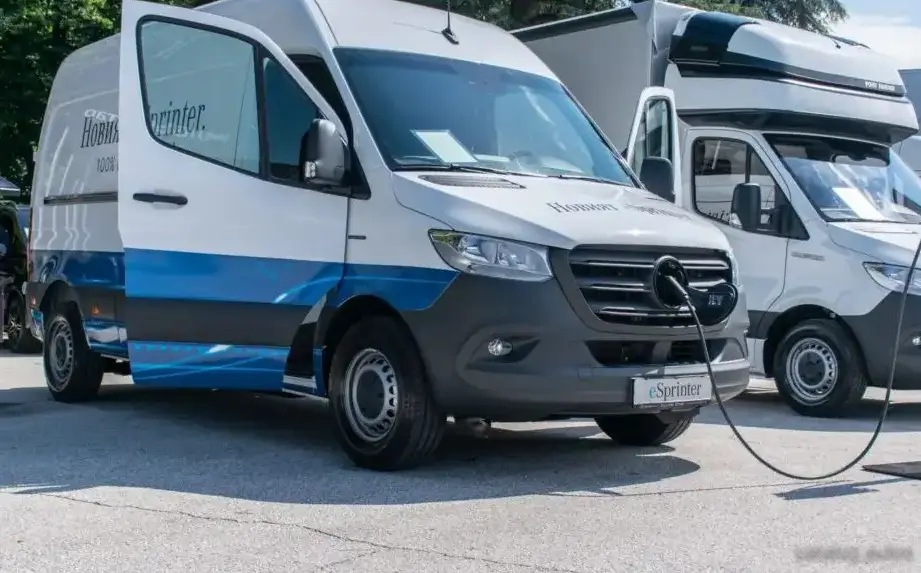
The Mercedes-Benz eSprinter Panel Van, specifically the W907/W910 generation equipped with the 55 kWh battery pack and 116 horsepower electric motor, represents the brand’s entry into the burgeoning electric commercial vehicle market. Production commenced in December 2019, initially focused on the European market, with limited availability in other regions. This variant serves as the base model within the eSprinter lineup, offering a balance between affordability, practicality, and zero-emission capability for urban delivery and service applications. It’s positioned as a direct competitor to other electric vans like the Ford E-Transit and the Volkswagen ID. Buzz Cargo.
Technical Specifications
| Brand | Mercedes-Benz |
| Model | Sprinter |
| Generation | eSprinter Panel Van (W907/W910) |
| Type (Engine) | 55 kWh (116 Hp) |
| Start of production | December, 2019 |
| Powertrain Architecture | BEV (Electric Vehicle) |
| Body type | Van |
| Seats | 3 |
| Doors | 4 |
| Fuel Type | Electricity |
| Maximum speed | 120 km/h (74.56 mph) |
| Weight-to-power ratio | 22.2 kg/Hp (45 Hp/tonne) |
| Weight-to-torque ratio | 8.7 kg/Nm (114.5 Nm/tonne) |
| Gross battery capacity | 55 kWh |
| Net (usable) battery capacity | 47 kWh |
| Battery voltage | 365 V |
| Battery technology | Lithium-ion (Li-Ion) |
| Battery location | Below the floor |
| All-electric range (WLTP) | 158 km (98.18 mi) |
| All-electric range (NEDC) | 168 km (104.39 mi) |
| Average Energy consumption (WLTP) | 34.8 kWh/100 km (56.01 kWh/100 mi) (60 MPGe, 2.9 km/kWh, 1.8 mi/kWh) |
| Average Energy consumption (NEDC) | 32.5 kWh/100 km (52.3 kWh/100 mi) (64 MPGe, 3.1 km/kWh, 1.9 mi/kWh) |
| Electric motor power | 116 Hp @ 9001 rpm |
| Electric motor Torque | 295 Nm @ 203 rpm (217.58 lb.-ft. @ 203 rpm) |
| Electric motor model/code | EM6000 |
| Electric motor location | Front axle, Transverse |
| System power | 116 Hp @ 9001 rpm |
| System torque | 295 Nm @ 203 rpm (217.58 lb.-ft. @ 203 rpm) |
| Kerb Weight | 2577 kg (5681.31 lbs) |
| Max. weight | 3500 kg (7716.18 lbs) |
| Max load | 923 kg (2034.87 lbs) |
| Trunk (boot) space – minimum | 11000 l (388.46 cu. ft) |
| Max. roof load | 150 kg (330.69 lbs) |
| Length | 6088 mm (239.69 in) |
| Width | 2020 mm (79.53 in) |
| Height | 2687 mm (105.79 in) |
| Wheelbase | 3924 mm (154.49 in) |
| Front overhang | 1021 mm (40.2 in) |
| Rear overhang | 1152 mm (45.35 in) |
| Minimum turning circle | 15.7 m (51.51 ft) |
| Drivetrain Architecture | One electric motor drives the front wheels |
| Drive wheel | Front wheel drive |
| Number of gears | 1 |
| Gearbox type | Automatic transmission |
| Front suspension | Leaf spring |
| Rear suspension | Leaf spring |
| Assisting systems | ABS (Anti-lock braking system) |
| Tires size | 225/75 R16 |
| Wheel rims size | 6.5J x 16 |
INTRODUCTION
The Mercedes-Benz eSprinter Panel Van, launched in late 2019, marks a significant step for the brand in the commercial electric vehicle segment. Built on the W907/W910 platform, which also underpins the conventional Sprinter, the eSprinter aims to provide a zero-emission alternative for businesses operating in urban environments. The 55 kWh variant, producing 116 horsepower, serves as the entry point to the eSprinter range, prioritizing affordability and range suitable for shorter delivery routes and inner-city operations. It’s designed to appeal to businesses seeking to reduce their carbon footprint without compromising on the practicality and cargo capacity expected from a Sprinter van.
Powertrain & Engine Architecture
At the heart of the eSprinter 55 kWh is a single electric motor, designated EM6000, producing 116 horsepower and 295 Nm (217.58 lb-ft) of torque. This motor is mounted transversely at the front axle, driving the front wheels. The power is delivered through a single-speed automatic transmission, characteristic of most electric vehicles. The 55 kWh lithium-ion battery pack is located under the vehicle floor, contributing to a lower center of gravity and maximizing cargo space. The battery operates at 365 volts. The eSprinter utilizes a sophisticated battery management system to optimize performance, longevity, and safety. While not featuring the rapid charging capabilities of some competitors, the eSprinter supports AC charging for overnight replenishment and DC fast charging for quicker top-ups when needed. The electric motor’s torque curve provides instant acceleration, making it well-suited for stop-and-go city driving.
Driving Characteristics
The 116 horsepower and 295 Nm of torque provide adequate, though not exhilarating, performance for typical urban delivery tasks. Acceleration is brisk from a standstill due to the nature of electric motors, but the eSprinter’s top speed is electronically limited to 120 km/h (74.56 mph) to conserve energy and extend range. The single-speed automatic transmission offers seamless acceleration, but lacks the gear ratios found in conventional transmissions, which can sometimes feel less refined at higher speeds. Compared to higher-powered eSprinter variants or diesel-powered Sprinters, this 55 kWh model prioritizes efficiency over outright performance. The front-wheel-drive configuration provides predictable handling in most conditions, but traction can be limited when fully loaded on slippery surfaces. The regenerative braking system helps to recapture energy during deceleration, further enhancing efficiency.
Equipment & Trim Levels
The eSprinter 55 kWh typically comes standard with features geared towards commercial use, including a driver’s seat, a double passenger seat, and basic infotainment system. Standard safety equipment includes ABS (Anti-lock Braking System) and various driver-assistance features. Interior upholstery is typically durable and practical, designed to withstand the rigors of commercial use. Optional extras include upgraded infotainment systems with navigation, parking sensors, a rearview camera, and various cargo area configurations. Climate control and heated seats are also available as options. The trim level is generally basic, focusing on functionality and cost-effectiveness rather than luxury.
Chassis & Braking
The eSprinter 55 kWh utilizes a robust chassis designed to handle substantial payloads. The suspension system employs leaf springs at both the front and rear, providing a comfortable ride even when the van is fully loaded. The braking system features disc brakes at the front and drum brakes at the rear, providing adequate stopping power for the vehicle’s weight. The vehicle’s weight distribution is influenced by the location of the battery pack under the floor, contributing to improved stability. The steering is hydraulically assisted, providing a responsive and predictable driving experience.
Market Reception & Comparison
The eSprinter 55 kWh has been generally well-received by critics as a viable electric van option for businesses. Its relatively affordable price point and practical cargo capacity make it an attractive alternative to diesel-powered vans. However, its limited range compared to some competitors has been a point of criticism. Fuel economy, measured in kWh per 100 km, is competitive within the electric van segment. Compared to higher-output eSprinter variants, the 55 kWh model offers a lower purchase price but sacrifices performance and range. Compared to diesel Sprinters, the eSprinter offers zero emissions and lower running costs, but may require adjustments to operational practices to accommodate charging times.
Legacy
The Mercedes-Benz eSprinter 55 kWh represents an important step in the electrification of the commercial vehicle market. While early adoption has been somewhat limited by range concerns and charging infrastructure availability, the eSprinter is expected to become increasingly popular as battery technology improves and charging networks expand. The powertrain, while not groundbreaking, has proven to be reliable in early testing and real-world use. On the used car market, these early eSprinters are beginning to appear, offering businesses a cost-effective entry point into electric van ownership. The long-term durability of the battery pack remains a key factor in the vehicle’s overall value proposition.
