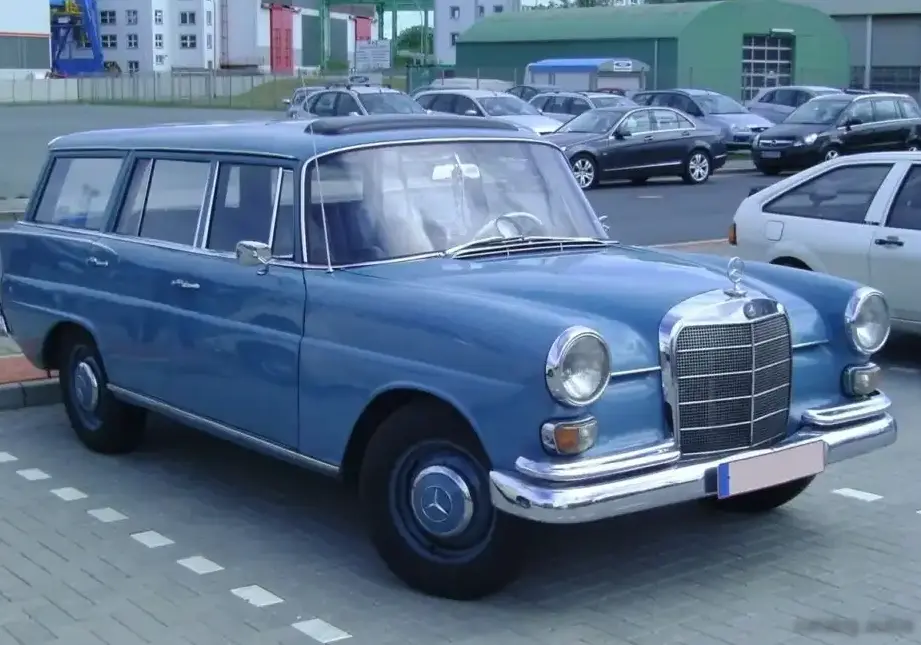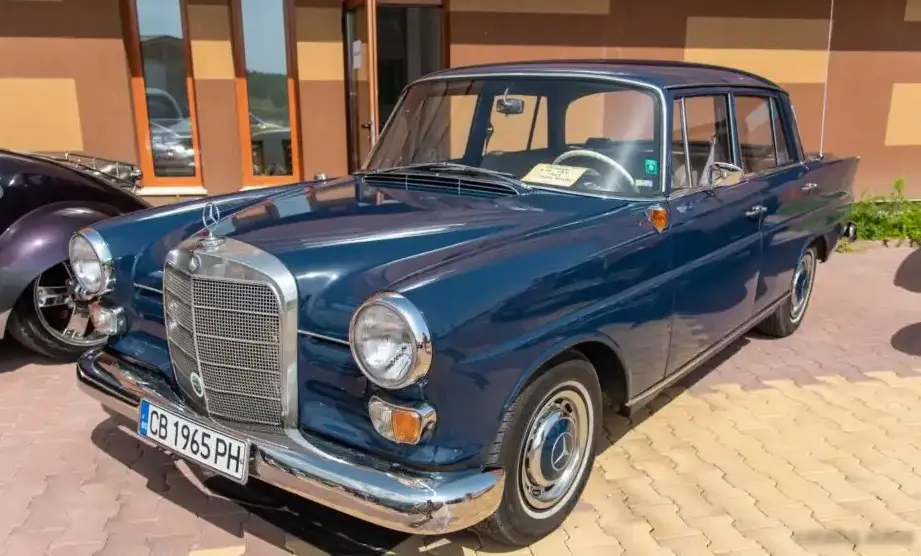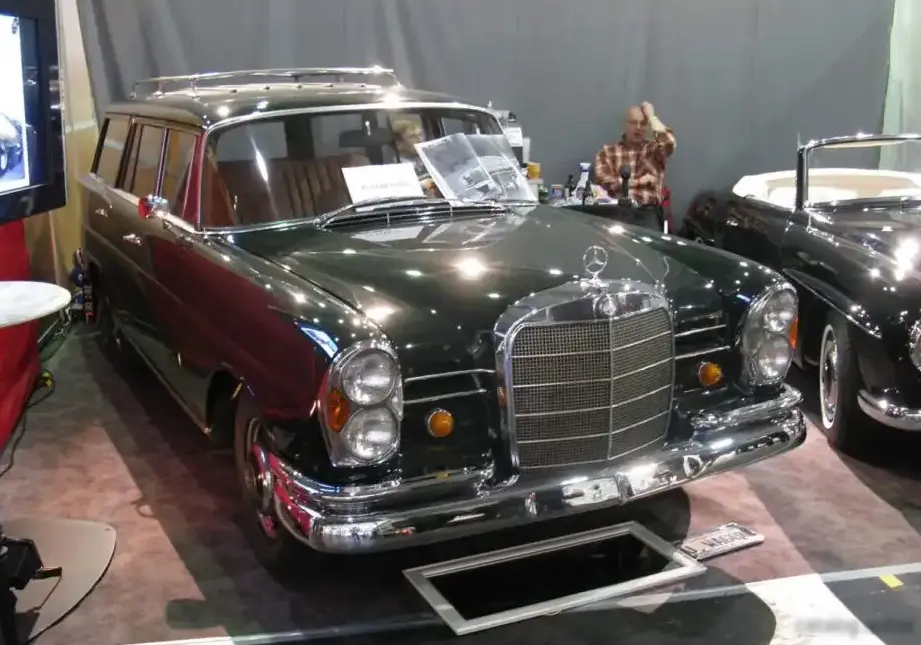
The Mercedes-Benz W111 Fintail Universal, specifically the 230 S variant with a 120 horsepower engine and automatic transmission, represents a significant evolution in the post-war Mercedes-Benz lineup. Produced from 1966 to 1968, this model combined the elegant styling of the Fintail sedans with the practicality of a station wagon (estate) body style. It occupied a middle ground within the W111 range, offering a balance of luxury, performance, and space, appealing to families and those requiring a versatile vehicle. The “Universal” designation, used by Mercedes-Benz for its estate cars, highlighted its utility and broadened appeal beyond the traditional luxury sedan buyer.
Technical Specifications
| Brand | Mercedes-Benz |
| Model | Fintail |
| Generation | Fintail Universal (W111) |
| Type (Engine) | 230 S (120 Hp) Automatic |
| Start of production | 1966 |
| End of production | 1968 |
| Powertrain Architecture | Internal Combustion engine |
| Body type | Station wagon (estate) |
| Seats | 5 |
| Doors | 5 |
| Fuel consumption (combined) | 11.5 l/100 km (20.5 US mpg, 24.6 UK mpg, 8.7 km/l) |
| Fuel Type | Petrol (Gasoline) |
| Maximum speed | 170 km/h (105.63 mph) |
| Weight-to-power ratio | 12.7 kg/Hp, 78.9 Hp/tonne |
| Weight-to-torque ratio | 8.5 kg/Nm, 117.1 Nm/tonne |
| Power | 120 Hp @ 5400 rpm |
| Power per litre | 52 Hp/l |
| Torque | 178 Nm @ 4000 rpm (131.29 lb.-ft. @ 4000 rpm) |
| Engine layout | Front, Longitudinal |
| Engine Model/Code | M 180 VIII / 180.947 |
| Engine displacement | 2306 cm3 (140.72 cu. in.) |
| Number of cylinders | 6 |
| Engine configuration | Inline |
| Cylinder Bore | 82 mm (3.23 in.) |
| Piston Stroke | 72.8 mm (2.87 in.) |
| Compression ratio | 9:1 |
| Number of valves per cylinder | 2 |
| Fuel injection system | Carburettor |
| Engine aspiration | Naturally aspirated engine |
| Valvetrain | SOHC |
| Kerb Weight | 1520 kg (3351.03 lbs.) |
| Max. weight | 2170 kg (4784.03 lbs.) |
| Max load | 650 kg (1433 lbs.) |
| Fuel tank capacity | 65 l (17.17 US gal | 14.3 UK gal) |
| Length | 4885 mm (192.32 in.) |
| Width | 1795 mm (70.67 in.) |
| Height | 1530 mm (60.24 in.) |
| Wheelbase | 2750 mm (108.27 in.) |
| Front track | 1482 mm (58.35 in.) |
| Rear track | 1485 mm (58.46 in.) |
| Drivetrain Architecture | The Internal combustion engine (ICE) drives the rear wheels of the vehicle. |
| Drive wheel | Rear wheel drive |
| Number of gears and type of gearbox | 4 gears, automatic transmission |
| Front suspension | Double wishbone, Transverse stabilizer |
| Rear suspension | Hydro-pneumatic element, Trailing arm |
| Front brakes | Disc |
| Rear brakes | Drum |
| Steering type | Cone worm with recirculation balls |
Powertrain & Engine Architecture
The 230 S Universal was powered by the M180.947 engine, a 2.3-liter inline-six cylinder gasoline engine. This engine featured a single overhead camshaft (SOHC) valvetrain and utilized a Solex carburetor for fuel delivery. The engine produced 120 horsepower at 5400 rpm and 178 Nm (131.29 lb-ft) of torque at 4000 rpm. The engine’s longitudinal front-mounted layout was typical for Mercedes-Benz vehicles of the era. The automatic transmission was a four-speed hydraulic unit, providing smooth, albeit not particularly quick, gear changes. This transmission was chosen to provide ease of driving, appealing to a broader demographic than the available manual transmission.
Driving Characteristics
The 230 S Automatic offered a comfortable and refined driving experience. However, the combination of the 120 hp engine and the automatic transmission resulted in performance that was adequate rather than sporty. Acceleration was leisurely, and overtaking required careful planning. Compared to the manual transmission versions or the more powerful 250 S and 280 S models, the 230 S Automatic felt noticeably slower. The automatic transmission’s gear ratios were optimized for fuel economy and smooth cruising, rather than outright performance. The car excelled in long-distance highway driving, providing a stable and comfortable ride.
Equipment & Trim Levels
The 230 S Universal came reasonably well-equipped for its time. Standard features included comfortable cloth upholstery, a wood-trimmed dashboard, and whitewall tires. Power steering and power-assisted brakes were often included, enhancing the driving experience. Optional extras included a sunroof, radio, and upgraded upholstery materials. The interior was spacious and practical, reflecting the vehicle’s estate car body style. The rear seats could be folded down to increase cargo capacity, making it a versatile vehicle for families and those with active lifestyles.
Chassis & Braking
The W111 Universal chassis featured independent suspension at the front, utilizing double wishbones and a transverse stabilizer bar. The rear suspension employed a trailing arm setup with a hydro-pneumatic element, providing a comfortable ride. Braking was accomplished via disc brakes at the front and drum brakes at the rear. While the braking system was adequate for the car’s weight and performance, it lacked the stopping power of more modern systems. The steering was a cone worm with recirculation balls, providing precise but somewhat heavy steering feel.
Market Reception & Comparison
The 230 S Universal Automatic was generally well-received by critics and buyers alike. It was praised for its practicality, comfort, and build quality. However, some reviewers noted its relatively modest performance compared to other models in the W111 range. Fuel economy, at 11.5 l/100 km, was typical for a vehicle of its size and era. Compared to the manual transmission 230 S, the automatic version offered greater convenience but sacrificed some performance and fuel efficiency. The 250 S and 280 S Universals, with their larger engines, provided significantly more power but came at a higher price point.
Legacy
The Mercedes-Benz W111 Fintail Universal, including the 230 S Automatic variant, is now considered a classic car. These vehicles are sought after by collectors and enthusiasts for their elegant styling, robust engineering, and historical significance. The M180 engine, while not known for its high performance, is generally regarded as a reliable and durable unit. However, like all classic cars, the 230 S Universal requires regular maintenance and attention to detail to keep it in good running order. Parts availability can be a challenge, but a dedicated network of suppliers and enthusiasts exists to support owners. Today, a well-maintained 230 S Universal represents a piece of automotive history and a testament to Mercedes-Benz’s commitment to quality and innovation.