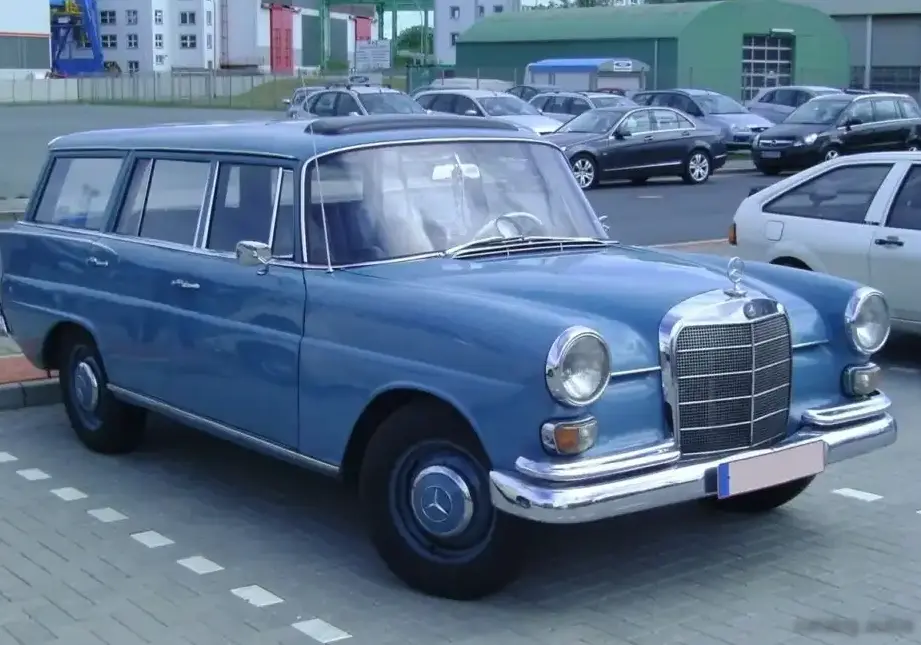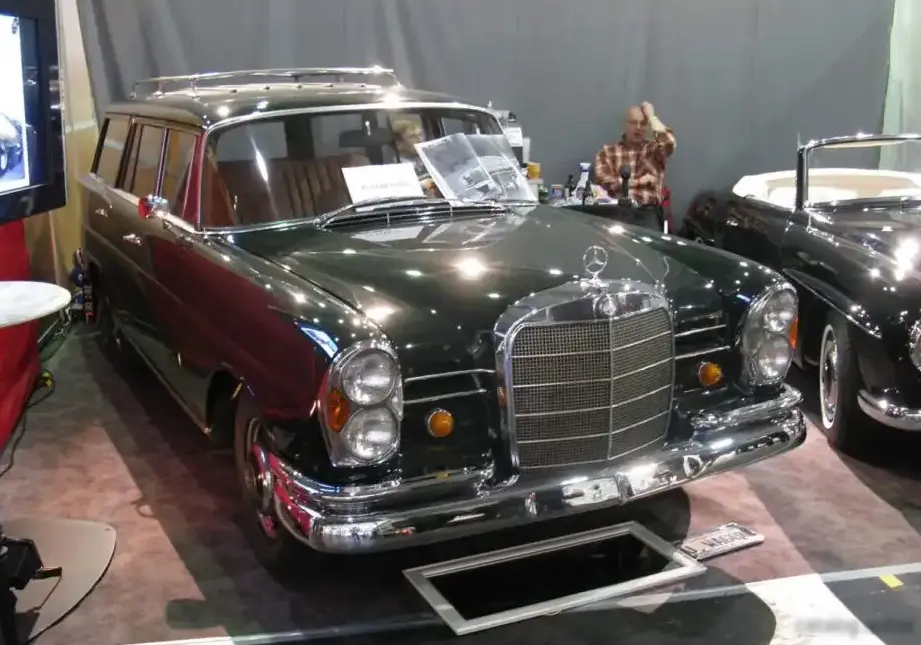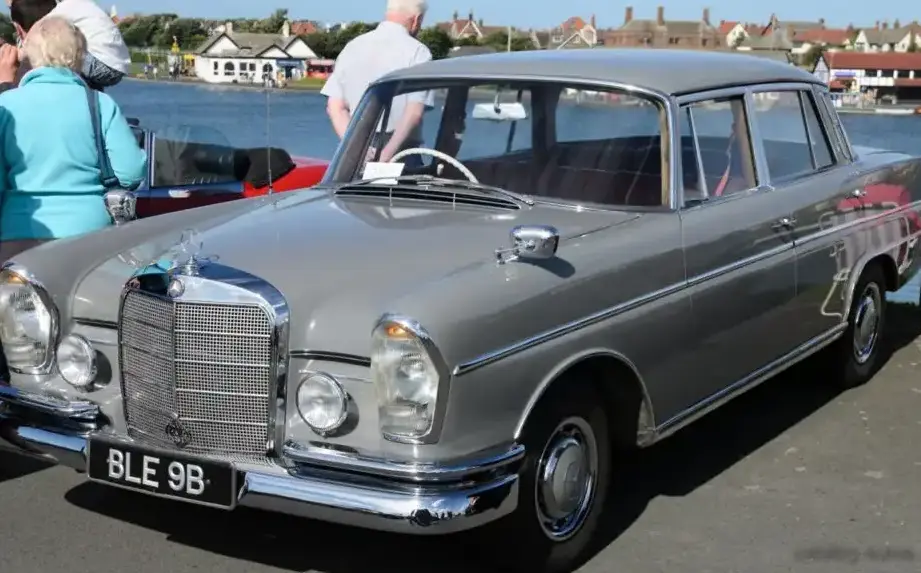
The Mercedes-Benz W112 “Fintail” 300 SE Automatic, produced between January 1964 and July 1965, represented a significant step forward in luxury and technology for the German automaker. Positioned as the top-of-the-line sedan within the W112 series, it bridged the gap between the more austere “Fintail” models and the flagship 600 Grosser. The 300 SE Automatic was a key component of Mercedes-Benz’s strategy to appeal to a discerning clientele seeking both performance and refined comfort, particularly in the lucrative North American market. It was built on the W112 chassis, sharing its platform with the 220SE and 260SE, but distinguished itself through its larger engine and more comprehensive standard equipment.
Technical Specifications
| Brand | Mercedes-Benz |
| Model | Fintail |
| Generation | Fintail (W112) |
| Type (Engine) | 300 SE (170 Hp) Automatic |
| Start of production | January, 1964 |
| End of production | July, 1965 |
| Powertrain Architecture | Internal Combustion engine |
| Body type | Sedan |
| Seats | 5 |
| Doors | 4 |
| Fuel consumption (combined) | 13.7 l/100 km (17.2 US mpg, 20.6 UK mpg, 7.3 km/l) |
| Fuel Type | Petrol (Gasoline) |
| Acceleration 0 – 100 km/h | 10.7 sec |
| Acceleration 0 – 62 mph | 10.7 sec |
| Acceleration 0 – 60 mph | 10.2 sec |
| Maximum speed | 180 km/h (111.85 mph) |
| Weight-to-power ratio | 9.2 kg/Hp, 108.6 Hp/tonne |
| Weight-to-torque ratio | 6.3 kg/Nm, 159.1 Nm/tonne |
| Power | 170 Hp @ 5400 rpm |
| Power per litre | 56.7 Hp/l |
| Torque | 249 Nm @ 4000 rpm (183.65 lb.-ft. @ 4000 rpm) |
| Engine layout | Front, Longitudinal |
| Engine Model/Code | M 189 V / 189.986 |
| Engine displacement | 2996 cm3 (182.83 cu. in.) |
| Number of cylinders | 6 |
| Engine configuration | Inline |
| Cylinder Bore | 85 mm (3.35 in.) |
| Piston Stroke | 88 mm (3.46 in.) |
| Compression ratio | 8.8:1 |
| Number of valves per cylinder | 2 |
| Fuel injection system | Multi-port manifold injection |
| Engine aspiration | Naturally aspirated engine |
| Valvetrain | SOHC |
| Kerb Weight | 1565 kg (3450.23 lbs.) |
| Max. weight | 2065 kg (4552.55 lbs.) |
| Max load | 500 kg (1102.31 lbs.) |
| Fuel tank capacity | 82 l (21.66 US gal | 18.04 UK gal) |
| Length | 4875 mm (191.93 in.) |
| Width | 1795 mm (70.67 in.) |
| Height | 1455 mm (57.28 in.) |
| Wheelbase | 2750 mm (108.27 in.) |
| Front track | 1482 mm (58.35 in.) |
| Rear (Back) track | 1490 mm (58.66 in.) |
| Drivetrain Architecture | The Internal combustion engine (ICE) drives the rear wheels of the vehicle. |
| Drive wheel | Rear wheel drive |
| Number of gears and type of gearbox | 4 gears, automatic transmission |
| Front suspension | Double wishbone, Transverse stabilizer, Air suspension |
| Rear suspension | Air suspension, Transverse stabilizer, Trailing arm |
| Front brakes | Disc |
| Rear brakes | Disc |
| Steering type | Cone worm with recirculation balls |
Powertrain & Engine Architecture
The heart of the 300 SE Automatic was the M189 V 3.0-liter inline-six engine. This engine was a significant upgrade over the smaller engines found in the 220SE and 260SE. It featured a cast iron block and aluminum cylinder head, employing a single overhead camshaft (SOHC) design. Crucially, the M189 utilized Bosch mechanical multi-port fuel injection, a sophisticated system for the time that contributed to its smooth power delivery and relatively good fuel efficiency. The engine produced 170 horsepower at 5,400 rpm and 249 Nm (183.65 lb-ft) of torque at 4,000 rpm. The automatic transmission was a four-speed hydraulic unit, providing a comfortable and effortless driving experience. This transmission was specifically chosen to complement the engine’s torque curve and provide smooth shifts, catering to the luxury-oriented nature of the vehicle.
Driving Characteristics
The 300 SE Automatic offered a distinctly different driving experience compared to its manual transmission counterparts or the lower-powered models. While not a sports car, the automatic transmission allowed for relaxed cruising and effortless acceleration. The 4-speed automatic, while not as quick-shifting as modern transmissions, provided a smooth and predictable power delivery. The gear ratios were optimized for comfortable highway driving, but could feel slightly sluggish during quick overtaking maneuvers. The air suspension, standard on the 300 SE, contributed to a remarkably smooth ride, absorbing bumps and imperfections in the road with ease. The steering, though not particularly direct, was light and easy to use, making it well-suited for city driving.
Equipment & Trim Levels
The 300 SE Automatic was generously equipped as standard. It featured power steering, power-assisted disc brakes on all four wheels, and the aforementioned air suspension. The interior was lavishly appointed with high-quality materials, including leather upholstery (often in shades of red, blue, or beige), wood trim, and plush carpeting. Standard features included a heater, a radio, and whitewall tires. Optional extras included air conditioning, a sunroof, and a self-adjusting steering wheel. The 300 SE Automatic was positioned as the premium offering within the Fintail range, and its price reflected this.
Chassis & Braking
The W112 chassis featured independent suspension all around. The front suspension utilized double wishbones with a transverse stabilizer and, importantly, air springs. The rear suspension employed a trailing arm design, also with air springs and a transverse stabilizer. This air suspension system was a defining feature of the 300 SE, providing a remarkably comfortable and level ride. Braking was handled by disc brakes on all four wheels, a relatively advanced feature for the early 1960s. The power-assisted braking system provided ample stopping power, even for a car of this size and weight.
Market Reception & Comparison
The 300 SE Automatic was well-received by critics and buyers alike. It was praised for its smooth ride, luxurious interior, and refined performance. However, its relatively high price tag limited its appeal to a smaller segment of the market. Compared to the 220SE and 260SE, the 300 SE offered significantly more power and a more luxurious experience. However, it also came with a higher price and slightly worse fuel economy (approximately 17.2 US mpg combined). The 300 SE Automatic was often seen as a more practical and affordable alternative to the even more exclusive Mercedes-Benz 600.
Legacy
The Mercedes-Benz W112 300 SE Automatic holds a respected place in automotive history. The M189 engine, while not without its quirks, proved to be a durable and reliable powerplant when properly maintained. Today, these cars are sought after by collectors and enthusiasts, particularly well-preserved examples. The air suspension system can require maintenance, and parts availability can be a challenge, but the overall reliability of the drivetrain is generally good. The 300 SE Automatic represents a high point in 1960s Mercedes-Benz engineering and design, offering a unique blend of luxury, performance, and technological innovation. Its enduring appeal lies in its ability to provide a comfortable and refined driving experience, even by modern standards.