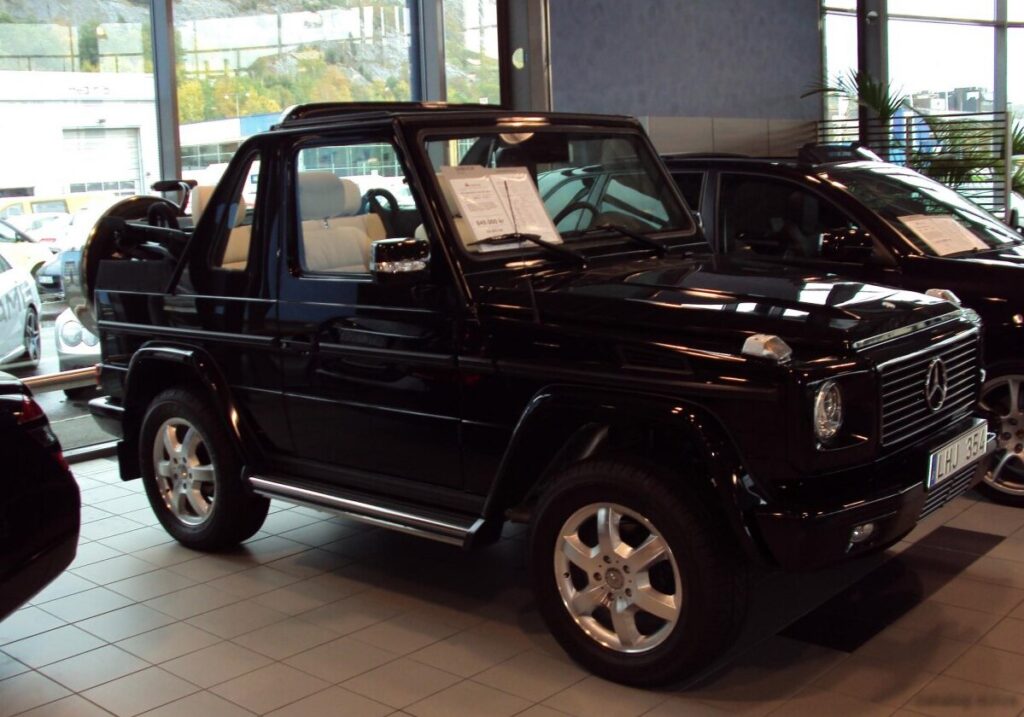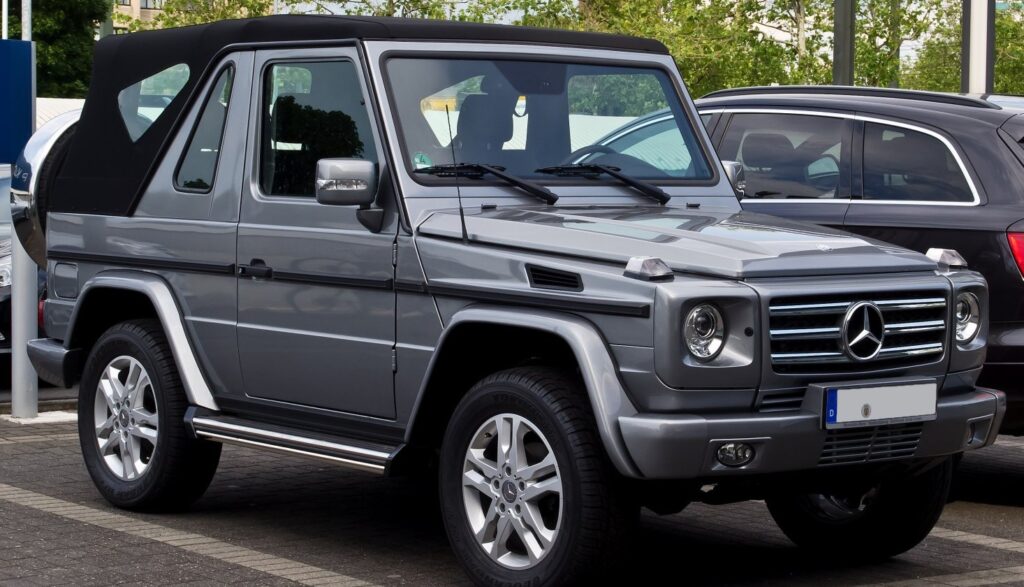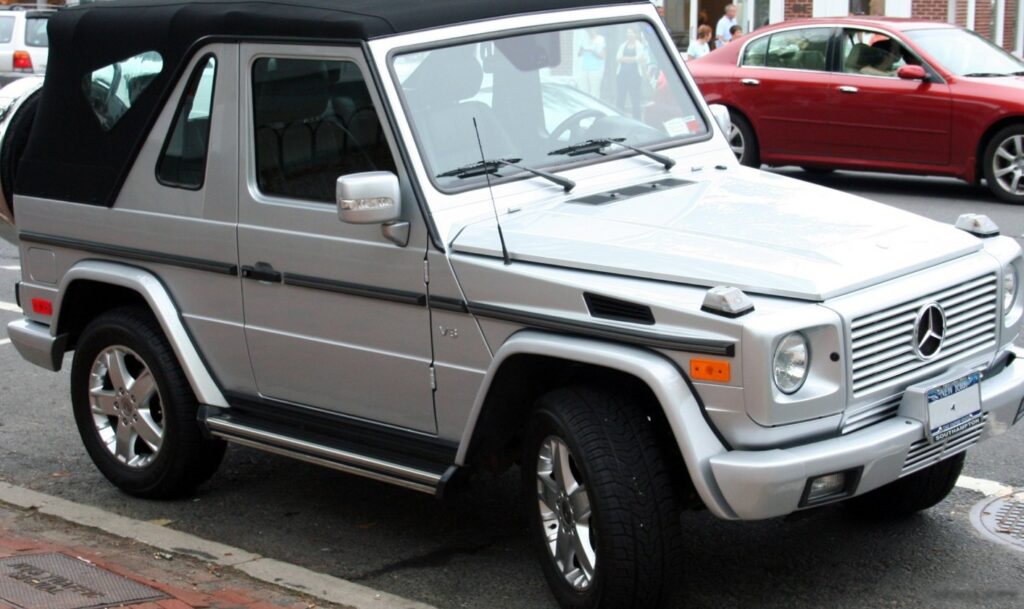
The Mercedes-Benz G-Class Cabriolet G 320, produced from 2001 to 2006 as part of the W463 facelift series, represents a unique blend of luxury, off-road capability, and open-air motoring. This variant, powered by the M112.945 3.2-liter V6 engine and paired with a five-speed automatic transmission, occupied a middle ground within the G-Class lineup, offering a more accessible entry point than the high-performance G500 or the diesel-powered G400 CDI, while still delivering the iconic G-Wagen experience. It was primarily marketed in Europe and other international markets, appealing to buyers seeking a distinctive and capable vehicle with a touch of exclusivity.
Technical Specifications
| Brand | Mercedes-Benz |
| Model | G-class |
| Generation | G-class Cabriolet (W463, facelift 2000) |
| Type (Engine) | G 320 V6 (215 Hp) 4MATIC Automatic |
| Start of production | February, 2001 |
| End of production | August, 2006 |
| Powertrain Architecture | Internal Combustion engine |
| Body type | Off-road vehicle, Cabriolet |
| Seats | 4 |
| Doors | 2 |
| Fuel consumption (economy) – urban (NEDC) | 19.7 l/100 km (11.9 US mpg, 14.3 UK mpg, 5.1 km/l) |
| Fuel consumption (economy) – extra urban (NEDC) | 12.7 l/100 km (18.5 US mpg, 22.2 UK mpg, 7.9 km/l) |
| Fuel consumption (economy) – combined (NEDC) | 15.5 l/100 km (15.2 US mpg, 18.2 UK mpg, 6.5 km/l) |
| CO2 emissions (NEDC) | 370 g/km |
| Fuel Type | Petrol (Gasoline) |
| Acceleration 0 – 100 km/h | 10.9 sec |
| Acceleration 0 – 62 mph | 10.9 sec |
| Acceleration 0 – 60 mph | 10.4 sec |
| Maximum speed | 175 km/h (108.74 mph) |
| Emission standard | Euro 4 |
| Weight-to-power ratio | 10.4 kg/Hp, 96 Hp/tonne |
| Weight-to-torque ratio | 7.5 kg/Nm, 133.9 Nm/tonne |
| Power | 215 Hp @ 5500 rpm |
| Power per litre | 67.2 Hp/l |
| Torque | 300 Nm @ 2800-4800 rpm (221.27 lb.-ft. @ 2800-4800 rpm) |
| Engine layout | Front, Longitudinal |
| Engine Model/Code | M 112.945 |
| Engine displacement | 3199 cm3 (195.21 cu. in.) |
| Number of cylinders | 6 |
| Engine configuration | V-engine |
| Cylinder Bore | 89.9 mm (3.54 in.) |
| Piston Stroke | 84 mm (3.31 in.) |
| Compression ratio | 10:1 |
| Number of valves per cylinder | 3 |
| Fuel injection system | Multi-port manifold injection |
| Engine aspiration | Naturally aspirated engine |
| Valvetrain | SOHC |
| Engine oil capacity | 8 l (8.45 US qt | 7.04 UK qt) |
| Coolant | 11.5 l (12.15 US qt | 10.12 UK qt) |
| Kerb Weight | 2240 kg (4938.35 lbs.) |
| Max. weight | 2850 kg (6283.17 lbs.) |
| Max load | 610 kg (1344.82 lbs.) |
| Trunk (boot) space – minimum | 238 l (8.4 cu. ft.) |
| Trunk (boot) space – maximum | 1580 l (55.8 cu. ft.) |
| Fuel tank capacity | 96 l (25.36 US gal | 21.12 UK gal) |
| Permitted trailer load with brakes (12%) | 2850 kg (6283.17 lbs.) |
| Permitted trailer load without brakes | 750 kg (1653.47 lbs.) |
| Length | 4275 mm (168.31 in.) |
| Width | 1760 mm (69.29 in.) |
| Width including mirrors | 2007 mm (79.02 in.) |
| Height | 1941 mm (76.42 in.) |
| Wheelbase | 2400 mm (94.49 in.) |
| Front track | 1475 mm (58.07 in.) |
| Rear (Back) track | 1475 mm (58.07 in.) |
| Ride height (ground clearance) | 205 mm (8.07 in.) |
| Drag coefficient (Cd) | 0.54 |
| Minimum turning circle (turning diameter) | 11.3 m (37.07 ft.) |
| Approach angle | 34° |
| Departure angle | 26° |
| Ramp-over (brakeover) angle | 23° |
| Climb angle | 38.7° |
| Wading depth | 500 mm (19.69 in.) |
| Drivetrain Architecture | The Internal combustion engine (ICE) drives permanently the four wheels of the vehicle. |
| Drive wheel | All wheel drive (4×4) |
| Number of gears and type of gearbox | 5 gears, automatic transmission |
| Front suspension | Coil spring, Rigid axle suspension, Trailing arm |
| Rear suspension | Rigid axle suspension, Trailing arm, Coil spring |
| Front brakes | Disc |
| Rear brakes | Disc |
| Assisting systems | ABS (Anti-lock braking system) |
| Steering type | Cone worm with recirculation balls |
| Power steering | Hydraulic Steering |
| Tires size | 265/70 R 16 |
| Wheel rims size | 7.5 J x 16 H 2 |
Powertrain & Engine Architecture
The heart of the G 320 Cabriolet is the M112.945 3.2-liter V6 engine. This engine, a member of Mercedes-Benz’s M112 family, is a naturally aspirated, three-valve-per-cylinder design featuring multi-port fuel injection. The engine’s architecture prioritizes smooth power delivery and refinement over outright performance. The 60-degree V-angle contributes to a relatively compact engine layout. The engine produces 215 horsepower at 5500 rpm and 300 Nm (221 lb-ft) of torque between 2800 and 4800 rpm. Paired with this engine is a five-speed automatic transmission (typically the 722.6), chosen for its ease of use and suitability for both on-road cruising and moderate off-road excursions. This transmission isn’t known for rapid shifts, but it provides a comfortable driving experience.
Driving Characteristics
The G 320 Automatic offers a driving experience that is distinctly G-Wagen. While not particularly quick – 0-60 mph takes around 10.4 seconds – the engine provides adequate power for everyday driving and even some challenging terrain. The automatic transmission, while smooth, doesn’t offer the responsiveness of a manual gearbox, and the gear ratios are geared more towards fuel efficiency and relaxed cruising than spirited acceleration. The vehicle’s substantial weight (2240 kg / 4938 lbs) is noticeable, particularly during braking and cornering. However, the permanent four-wheel drive system provides excellent traction in a variety of conditions. The high-ratio gearing and robust suspension allow for confident off-road performance, though it lacks the extreme capabilities of some more specialized off-road vehicles.
Equipment & Trim Levels
The G 320 Cabriolet typically came equipped with a respectable level of standard features, including leather upholstery, power windows and locks, air conditioning, and an AM/FM radio. Optional extras were plentiful, and could include features like heated seats, a premium sound system, a sunroof (in addition to the convertible top), and various exterior enhancements. The interior design, while functional, is relatively spartan compared to other luxury SUVs of the era, reflecting the G-Wagen’s utilitarian origins. The convertible top is a manually operated soft top, adding to the vehicle’s rugged character.
Chassis & Braking
The G-Class chassis is a body-on-frame construction, providing exceptional strength and durability. The suspension consists of coil springs and rigid axles front and rear, offering a comfortable ride on paved roads and excellent articulation off-road. Braking duties are handled by disc brakes on all four wheels, assisted by an Anti-lock Braking System (ABS). The braking performance is adequate for the vehicle’s weight, but not particularly sporty. The steering is a recirculating ball system, which provides a direct feel but can feel somewhat heavy at low speeds.
Market Reception & Comparison
The G 320 Cabriolet was generally well-received by automotive critics, who praised its unique styling, off-road capability, and overall build quality. However, some criticized its relatively high price, fuel consumption (15.5 l/100 km combined), and somewhat dated interior. Compared to the G500, the G 320 offered a more affordable entry point into the G-Wagen world, but with significantly less power. Compared to the G400 CDI (diesel), the G 320 offered a smoother, quieter driving experience, but with lower fuel economy and torque. The G 320 appealed to buyers who prioritized style and exclusivity over outright performance.
Legacy
The M112-powered G 320 Cabriolet has proven to be a relatively reliable vehicle, with the engine and transmission generally holding up well over time. However, like any older vehicle, it requires regular maintenance to prevent issues. Common maintenance items include oil changes, coolant flushes, and inspection of the suspension components. Today, the G 320 Cabriolet is a sought-after vehicle among collectors and enthusiasts, particularly those who appreciate its unique combination of luxury, off-road capability, and open-air motoring. Values have been steadily increasing in recent years, reflecting the growing demand for classic G-Wagens.