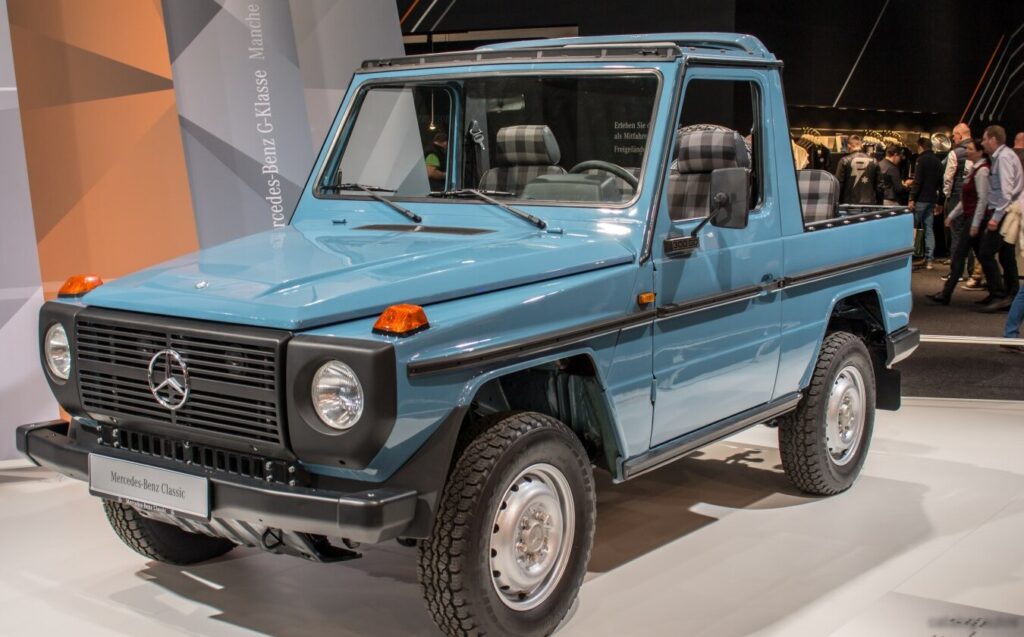
The Mercedes-Benz G 270 CDI 4MATIC, produced from December 2001 to August 2006, represents a significant iteration of the long-wheelbase (W463) G-Class following the 2000 facelift. Positioned as a mid-range offering within the G-Class lineup, it aimed to provide a balance between capability, comfort, and fuel efficiency, particularly appealing to European markets where diesel engines were highly favored. This variant combined a 2.7-liter five-cylinder turbodiesel engine with a five-speed automatic transmission and the renowned Mercedes-Benz 4MATIC all-wheel-drive system. The G 270 CDI offered a more accessible entry point into the G-Class range compared to the more powerful and expensive G 500 or AMG models, while still retaining the iconic vehicle’s legendary off-road prowess.
| Brand | Mercedes-Benz |
| Model | G-Class |
| Generation | G-Class Long (W463, facelift 2000) |
| Type | G 270 CDI (156 Hp) 4MATIC Automatic |
| Start of Production | December, 2001 |
| End of Production | August, 2006 |
| Powertrain Architecture | Internal Combustion Engine |
| Body Type | Off-Road Vehicle |
| Seats | 5 |
| Doors | 5 |
| Fuel Consumption (Urban) | 13.7 l/100 km (17.2 US mpg, 20.6 UK mpg) |
| Fuel Consumption (Extra Urban) | 9.9 l/100 km (23.8 US mpg, 28.5 UK mpg) |
| Fuel Consumption (Combined) | 11.3 l/100 km (20.8 US mpg, 25 UK mpg) |
| CO2 Emissions | 289 g/km |
| Fuel Type | Diesel |
| Acceleration 0-100 km/h | 13.7 sec |
| Acceleration 0-60 mph | 13 sec |
| Maximum Speed | 156 km/h (96.93 mph) |
| Emission Standard | Euro 3 |
| Weight-to-Power Ratio | 15.4 kg/Hp |
| Weight-to-Torque Ratio | 6 kg/Nm |
| Power | 156 Hp @ 3800 rpm |
| Torque | 400 Nm @ 1800-2600 rpm (295.02 lb.-ft.) |
| Engine Layout | Front, Longitudinal |
| Engine Model/Code | OM 612.966 |
| Engine Displacement | 2685 cm3 (163.85 cu. in.) |
| Number of Cylinders | 5 |
| Engine Configuration | Inline |
| Cylinder Bore | 88 mm (3.46 in.) |
| Piston Stroke | 88.3 mm (3.48 in.) |
| Compression Ratio | 18:1 |
| Valves per Cylinder | 4 |
| Fuel Injection System | Diesel Commonrail |
| Engine Aspiration | Turbocharger, Intercooler |
| Valvetrain | DOHC |
| Engine Oil Capacity | 7.5 l (7.93 US qt, 6.6 UK qt) |
| Coolant Capacity | 8 l (8.45 US qt, 7.04 UK qt) |
| Kerb Weight | 2410 kg (5313.14 lbs.) |
| Max. Weight | 3200 kg (7054.79 lbs.) |
| Max. Load | 790 kg (1741.65 lbs.) |
| Trunk Space (Min) | 480 l (16.95 cu. ft.) |
| Trunk Space (Max) | 2250 l (79.46 cu. ft.) |
| Fuel Tank Capacity | 96 l (25.36 US gal, 21.12 UK gal) |
| Max. Roof Load | 200 kg (440.92 lbs.) |
| Trailer Load (Braked) | 3500 kg (7716.18 lbs.) |
| Trailer Load (Unbraked) | 750 kg (1653.47 lbs.) |
| Length | 4680 mm (184.25 in.) |
| Width | 1760 mm (69.29 in.) |
| Width (with Mirrors) | 2007 mm (79.02 in.) |
| Height | 1936 mm (76.22 in.) |
| Wheelbase | 2850 mm (112.2 in.) |
| Front Track | 1475 mm (58.07 in.) |
| Rear Track | 1475 mm (58.07 in.) |
| Ride Height | 205 mm (8.07 in.) |
| Drag Coefficient | 0.54 |
| Turning Circle | 13.3 m (43.64 ft.) |
| Approach Angle | 37° |
| Departure Angle | 31° |
| Ramp-Over Angle | 23° |
| Wading Depth | 500 mm (19.69 in.) |
| Drivetrain | All Wheel Drive (4×4) |
| Gears/Gearbox | 5 gears, automatic transmission |
| Front Suspension | Coil spring, Rigid axle, Trailing arm |
| Rear Suspension | Rigid axle, Trailing arm, Coil spring |
| Front Brakes | Ventilated Discs |
| Rear Brakes | Discs |
| Steering Type | Cone worm with recirculation balls |
| Power Steering | Hydraulic |
| Tire Size | 265/70 R 16 |
| Wheel Rim Size | 7.5 J x 16 |
Powertrain & Engine Architecture
The heart of the G 270 CDI is the OM 612.966, a 2.7-liter inline five-cylinder diesel engine. This engine was a member of Mercedes-Benz’s OM612 family, known for its robust construction and relatively smooth operation for a five-cylinder diesel. It featured a cast iron block and aluminum cylinder head, incorporating a turbocharger with an intercooler to boost power and torque. The engine utilized a common rail direct injection system, delivering fuel at extremely high pressures for improved combustion efficiency and reduced emissions. The DOHC (Double Overhead Camshaft) valvetrain, with four valves per cylinder, further enhanced breathing and performance. The five-speed automatic transmission (typically the 5G-Tronic) was chosen for its ease of use and suitability for both on-road and moderate off-road conditions. While not as quick-shifting as some modern automatics, it provided smooth gear changes and adequate control for the engine’s torque characteristics.
Driving Characteristics
The G 270 CDI, with its 156 horsepower and 295 lb-ft of torque, offered a distinctly different driving experience compared to the higher-performance G-Class models. Acceleration was modest, taking around 13.7 seconds to reach 62 mph (100 km/h). However, the engine’s strong low-end torque made it surprisingly capable in everyday driving and particularly well-suited for off-road excursions. The automatic transmission, while smooth, could feel somewhat sluggish, especially during quick overtaking maneuvers. Compared to the manual transmission options available in other G-Class variants, the automatic prioritized comfort and ease of use over outright performance. The 4MATIC all-wheel-drive system, a hallmark of the G-Class, provided excellent traction on various surfaces, making the G 270 CDI a highly competent off-roader.
Equipment & Trim Levels
The G 270 CDI typically came equipped with a reasonable level of standard features, reflecting its mid-range positioning. These included air conditioning, power windows, central locking, and a basic audio system. Interior upholstery was generally cloth, although leather options were available. The dashboard layout was functional and utilitarian, typical of the G-Class’s focus on practicality rather than luxury. Optional extras included a sunroof, upgraded audio systems, heated seats, and various off-road packages with features like a locking differential and reinforced underbody protection. The long-wheelbase configuration provided significantly more rear passenger space and cargo capacity compared to the standard-wheelbase G-Class.
Chassis & Braking
The G 270 CDI retained the G-Class’s traditional body-on-frame construction, providing exceptional durability and off-road capability. The suspension consisted of coil springs and rigid axles front and rear, offering a comfortable ride on paved roads while maintaining excellent articulation for off-road use. Braking duties were handled by ventilated discs at the front and solid discs at the rear. Anti-lock Braking System (ABS) was standard, enhancing safety and control during braking. The steering system utilized a recirculating ball mechanism, providing a direct and robust feel, although it lacked the precision of more modern steering systems.
Market Reception & Comparison
The G 270 CDI was generally well-received in European markets, where diesel engines were popular and fuel economy was a significant consideration. Critics praised its off-road capability, robust construction, and relatively affordable price point compared to other G-Class models. However, some reviewers noted its modest performance and somewhat dated interior. Compared to the G 500, the G 270 CDI offered significantly less power and refinement, but it also consumed considerably less fuel. Against other diesel-powered SUVs of the time, the G 270 CDI stood out for its unique combination of luxury, off-road prowess, and iconic styling.
Legacy
The OM 612 engine, while generally reliable, can be prone to issues with the fuel injectors and turbocharger over time. Regular maintenance, including oil changes and injector cleaning, is crucial for ensuring longevity. The five-speed automatic transmission is also relatively durable, but may require servicing to maintain smooth operation. Today, the G 270 CDI is gaining recognition as a collectible vehicle, particularly among enthusiasts who appreciate its unique character and off-road capabilities. Well-maintained examples command a premium in the used car market, reflecting the enduring appeal of the G-Class and the relative rarity of this particular variant. Its blend of practicality, capability, and iconic design ensures its place as a notable chapter in the G-Class’s storied history.