Technical Specifications
| Brand | Mercedes-Benz |
| Model | G-class |
| Generation | G-class Long (W463, facelift 2007) |
| Type (Engine) | G 500 V8 (296 Hp) 4MATIC 7G-TRONIC |
| Start of production | April, 2007 |
| End of production | June, 2008 |
| Powertrain Architecture | Internal Combustion engine |
| Body type | Off-road vehicle |
| Seats | 5 |
| Doors | 5 |
| Fuel consumption (economy) – urban (NEDC) | 20.6 l/100 km (11.4 US mpg, 13.7 UK mpg, 4.9 km/l) |
| Fuel consumption (economy) – extra urban (NEDC) | 12.5 l/100 km (18.8 US mpg, 22.6 UK mpg, 8 km/l) |
| Fuel consumption (economy) – combined (NEDC) | 15.5 l/100 km (15.2 US mpg, 18.2 UK mpg, 6.5 km/l) |
| CO2 emissions (NEDC) | 370 g/km |
| Fuel Type | Petrol (Gasoline) |
| Acceleration 0 – 100 km/h | 7.5 sec |
| Acceleration 0 – 62 mph | 7.5 sec |
| Acceleration 0 – 60 mph | 7.1 sec |
| Maximum speed | 190 km/h (118.06 mph) |
| Emission standard | Euro 4 |
| Weight-to-power ratio | 7.9 kg/Hp, 127.3 Hp/tonne |
| Weight-to-torque ratio | 5.1 kg/Nm, 196.1 Nm/tonne |
| Power | 296 Hp @ 5500 rpm |
| Power per litre | 59.6 Hp/l |
| Torque | 456 Nm @ 2800-4000 rpm (336.33 lb.-ft. @ 2800-4000 rpm) |
| Engine layout | Front, Longitudinal |
| Engine Model/Code | M 113.962 |
| Engine displacement | 4966 cm3 (303.04 cu. in.) |
| Number of cylinders | 8 |
| Engine configuration | V-engine |
| Cylinder Bore | 97 mm (3.82 in.) |
| Piston Stroke | 84 mm (3.31 in.) |
| Compression ratio | 10:1 |
| Number of valves per cylinder | 3 |
| Fuel injection system | Multi-port manifold injection |
| Engine aspiration | Naturally aspirated engine |
| Valvetrain | SOHC |
| Engine oil capacity | 8 l (8.45 US qt | 7.04 UK qt) |
| Coolant | 12 l (12.68 US qt | 10.56 UK qt) |
| Kerb Weight | 2325 kg (5125.75 lbs.) |
| Max. weight | 3200 kg (7054.79 lbs.) |
| Max load | 875 kg (1929.04 lbs.) |
| Trunk (boot) space – minimum | 480 l (16.95 cu. ft.) |
| Trunk (boot) space – maximum | 2250 l (79.46 cu. ft.) |
| Fuel tank capacity | 96 l (25.36 US gal | 21.12 UK gal) |
| Max. roof load | 200 kg (440.92 lbs.) |
| Permitted trailer load with brakes (12%) | 3500 kg (7716.18 lbs.) |
| Permitted trailer load without brakes | 750 kg (1653.47 lbs.) |
| Permitted towbar download | 140 kg (308.65 lbs.) |
| Length | 4662 mm (183.54 in.) |
| Width | 1760 mm (69.29 in.) |
| Width including mirrors | 2007 mm (79.02 in.) |
| Height | 1931 mm (76.02 in.) |
| Wheelbase | 2850 mm (112.2 in.) |
| Front track | 1475 mm (58.07 in.) |
| Rear (Back) track | 1475 mm (58.07 in.) |
| Ride height (ground clearance) | 205 mm (8.07 in.) |
| Minimum turning circle (turning diameter) | 13.3 m (43.64 ft.) |
| Approach angle | 37° |
| Departure angle | 31° |
| Ramp-over (brakeover) angle | 23° |
| Climb angle | 38.7° |
| Wading depth | 500 mm (19.69 in.) |
| Drivetrain Architecture | The Internal combustion engine (ICE) drives permanently the four wheels of the vehicle. |
| Drive wheel | All wheel drive (4×4) |
| Number of gears and type of gearbox | 7 gears, automatic transmission G-TRONIC |
| Front suspension | Coil spring, Rigid axle suspension, Trailing arm |
| Rear suspension | Rigid axle suspension, Trailing arm, Coil spring |
| Front brakes | Ventilated discs |
| Rear brakes | Disc |
| Assisting systems | ABS (Anti-lock braking system) |
| Steering type | Cone worm with recirculation balls |
| Power steering | Hydraulic Steering |
| Tires size | 265/60 R 18 |
| Wheel rims size | 7.5 J x 18 |
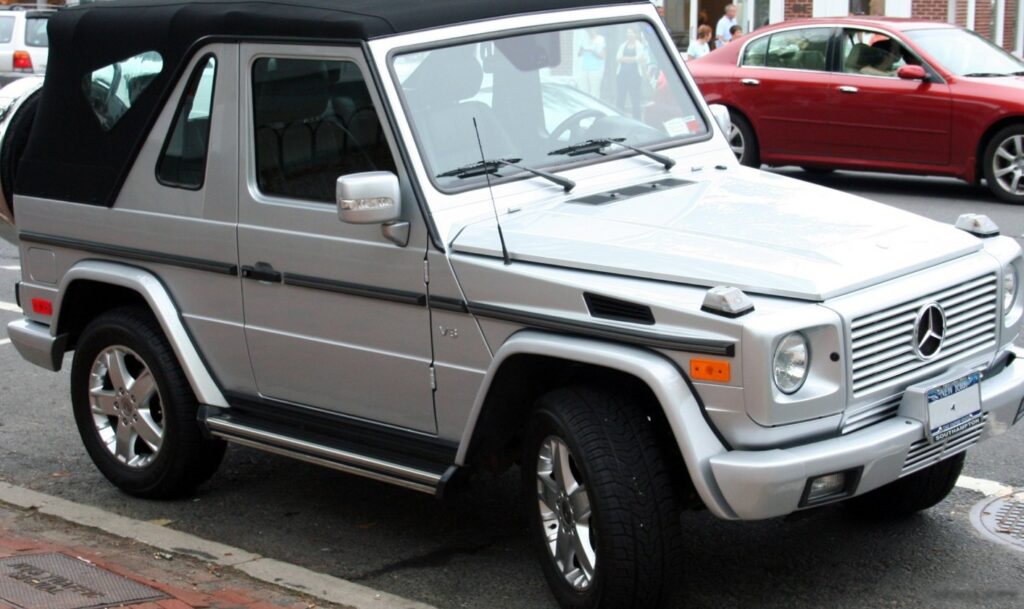
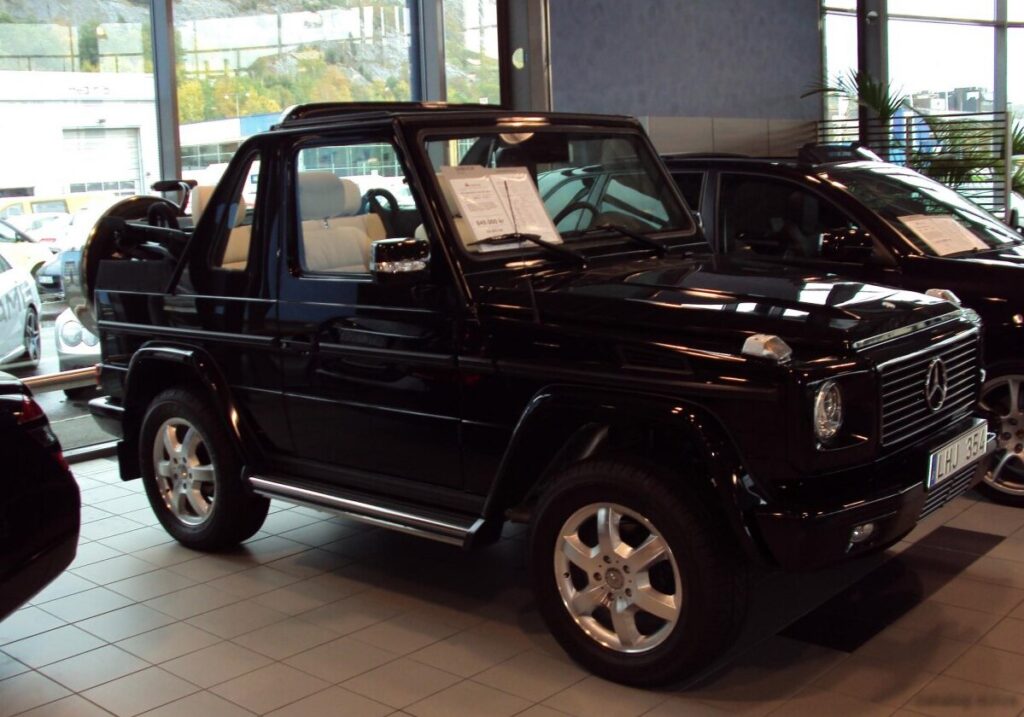
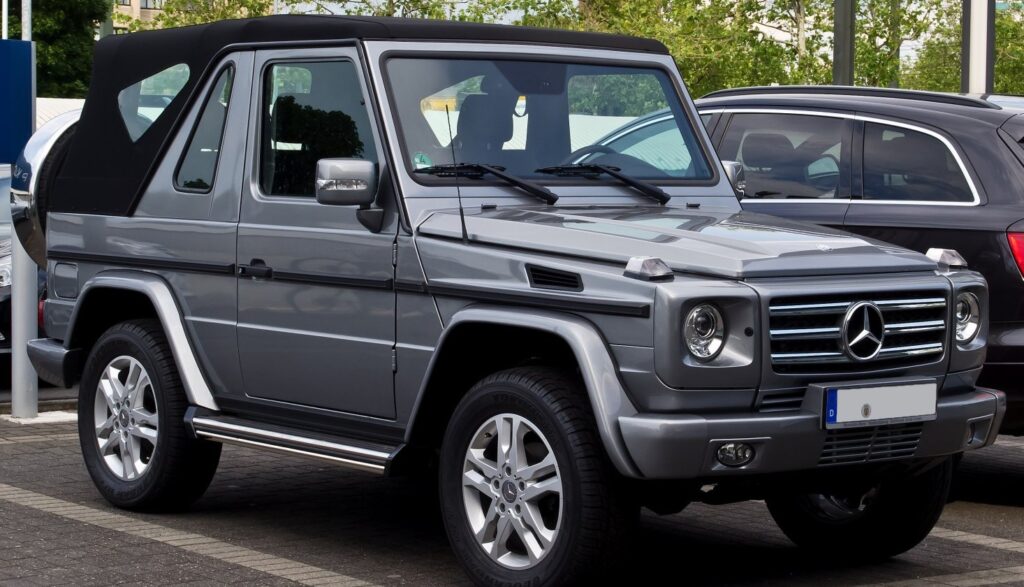
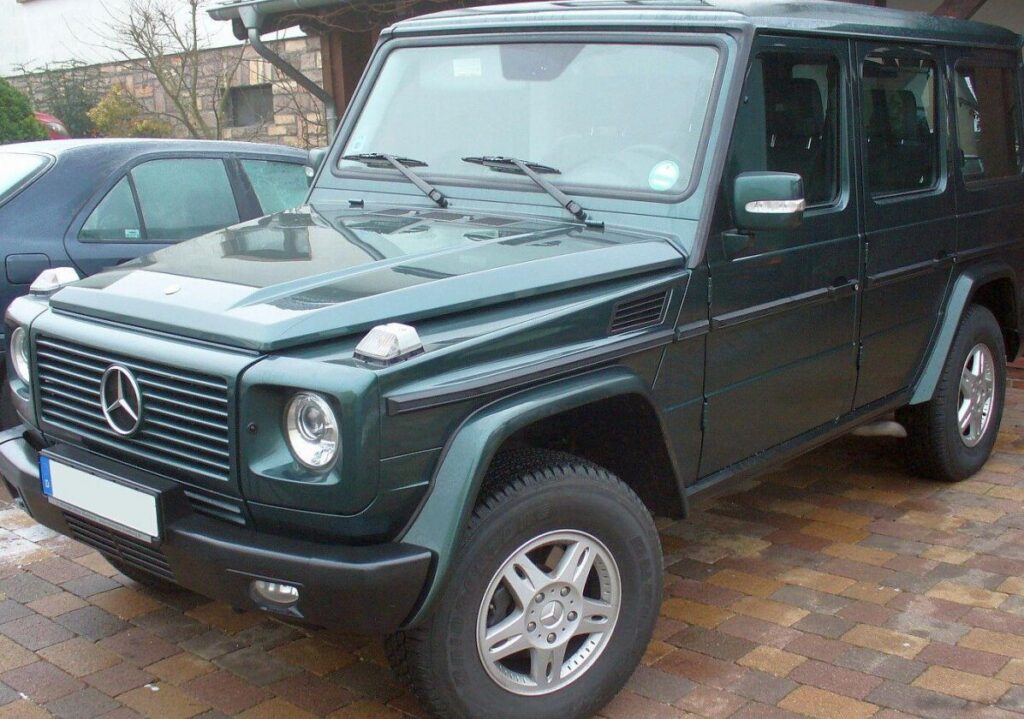
The G 500 V8 4MATIC, introduced as part of the W463 facelift in 2007, built upon the G-Class’s established reputation for off-road capability and durability. The facelift brought subtle cosmetic updates and, crucially, improvements to interior refinement and technology. The extended wheelbase version, the focus of this article, offered enhanced comfort for passengers, making it a more appealing option for those seeking a luxurious yet capable SUV. This model year represented a transitional period for the G-Class, bridging the gap between its purely utilitarian origins and its increasing status as a high-end luxury vehicle.
Powertrain & Engine Architecture
At the heart of the G 500 V8 lay the M 113.962 engine, a naturally aspirated 5.0-liter (4966 cc) V8. This engine, a staple of Mercedes-Benz performance models for years, produced 296 horsepower at 5500 rpm and 456 Nm (336.33 lb-ft) of torque between 2800 and 4000 rpm. The engine utilized multi-port fuel injection and a single overhead camshaft (SOHC) valvetrain. Its robust construction and relatively simple design contributed to its reliability. The power was delivered through a 7G-TRONIC automatic transmission, a seven-speed unit known for its smooth shifting and efficiency. This transmission featured a torque converter lock-up clutch to improve fuel economy at cruising speeds. The 7G-TRONIC was a significant upgrade over previous automatic transmissions offered in the G-Class, providing more refined gear changes and a wider gear ratio spread.
Driving Characteristics
The G 500 V8 4MATIC offered a unique driving experience. While possessing considerable power, the vehicle’s substantial weight (2325 kg / 5125.75 lbs) meant that acceleration, while brisk at 7.5 seconds to 62 mph, wasn’t overtly sporty. The 7G-TRONIC transmission helped to keep the engine in its optimal power band, providing responsive acceleration for overtaking and highway cruising. Compared to the smaller displacement G-Class models, the V8 offered significantly more effortless power delivery. The automatic transmission, while smooth, lacked the direct engagement of a manual gearbox, which some enthusiasts preferred for off-road control. However, the 7G-TRONIC’s ability to hold gears and provide engine braking was beneficial in challenging terrain. The long wheelbase contributed to a more stable ride on paved roads, but slightly reduced maneuverability in tight spaces.
Equipment & Trim Levels
The G 500 V8 4MATIC came standard with a comprehensive list of features, reflecting its premium positioning. Interior appointments included leather upholstery, wood trim, and automatic climate control. Standard safety equipment included ABS, traction control, and multiple airbags. Optional extras included a sunroof, upgraded audio system, parking sensors, and various customization options through Mercedes-Benz’s designo program. The long wheelbase model specifically offered increased legroom for rear passengers, enhancing comfort on long journeys. The dashboard layout was typical of Mercedes-Benz vehicles of the era, with a focus on functionality and understated elegance.
Chassis & Braking
The G-Class chassis remained largely unchanged from its original design, retaining its ladder-frame construction for exceptional strength and durability. The front suspension utilized coil springs and a rigid axle with trailing arms, while the rear suspension also featured a rigid axle with trailing arms and coil springs. Braking duties were handled by ventilated discs at the front and solid discs at the rear. ABS (Anti-lock Braking System) was standard. The G 500 V8’s increased weight necessitated a robust braking system, but stopping distances were still relatively long compared to more modern SUVs. The suspension was tuned to provide a balance between on-road comfort and off-road capability, although the ride could be firm on rough surfaces.
Market Reception & Comparison
The G 500 V8 4MATIC was generally well-received by automotive critics, who praised its powerful engine, refined transmission, and luxurious interior. However, its high price and relatively poor fuel economy (15.5 l/100 km combined) were often cited as drawbacks. Compared to the G 320 CDI diesel variant, the G 500 V8 offered significantly more power but consumed considerably more fuel. The V8 was also more expensive to maintain due to its more complex engine and higher parts costs. The G 500 V8 appealed to buyers who prioritized performance and luxury over fuel efficiency and practicality.
Legacy
The G 500 V8 4MATIC (W463 facelift) remains a sought-after vehicle in the used car market, particularly among collectors and enthusiasts. The M 113 V8 engine is known for its reliability when properly maintained, although regular servicing is essential. Parts availability is generally good, but can be expensive. The long-wheelbase version is particularly desirable due to its increased passenger space. This model represents a pivotal point in the G-Class’s evolution, showcasing its ability to blend rugged off-road capability with a level of luxury and refinement that appealed to a wider audience. Today, these vehicles are often seen as a classic example of a high-performance, luxury SUV.