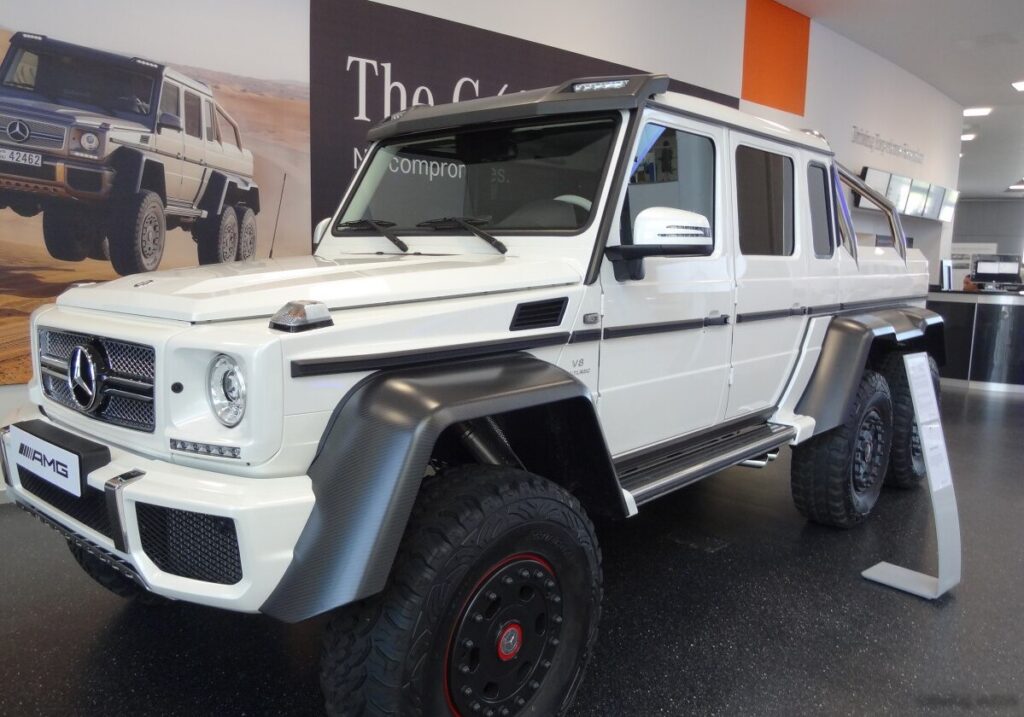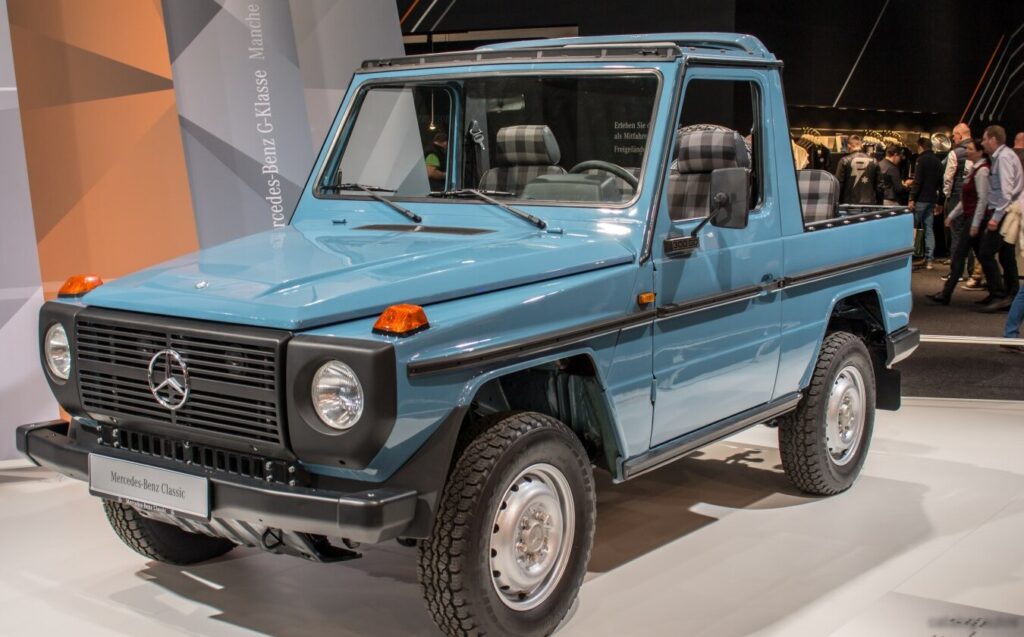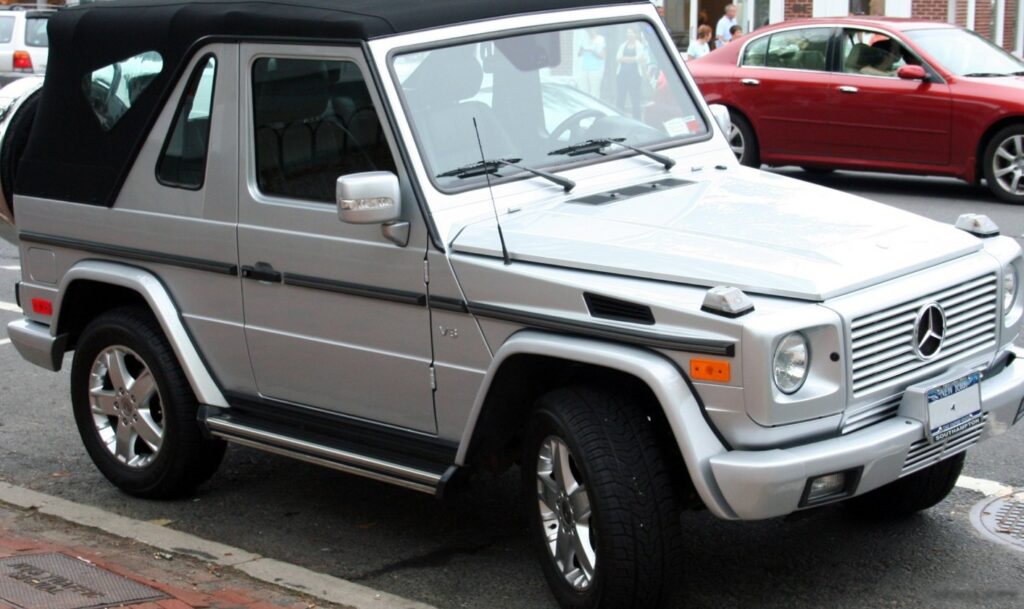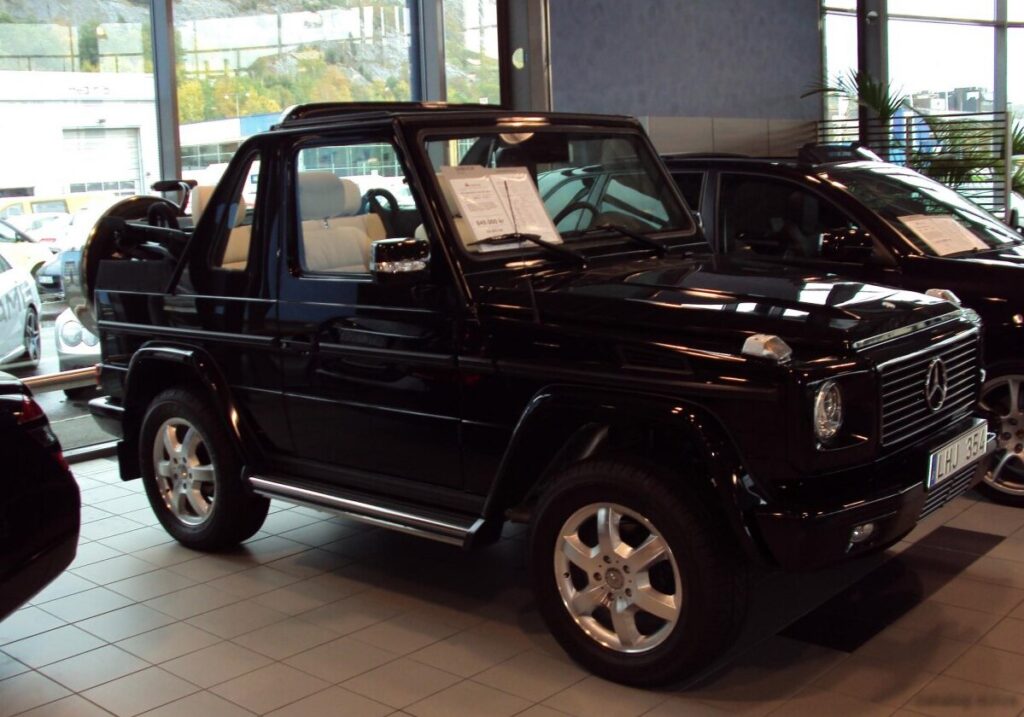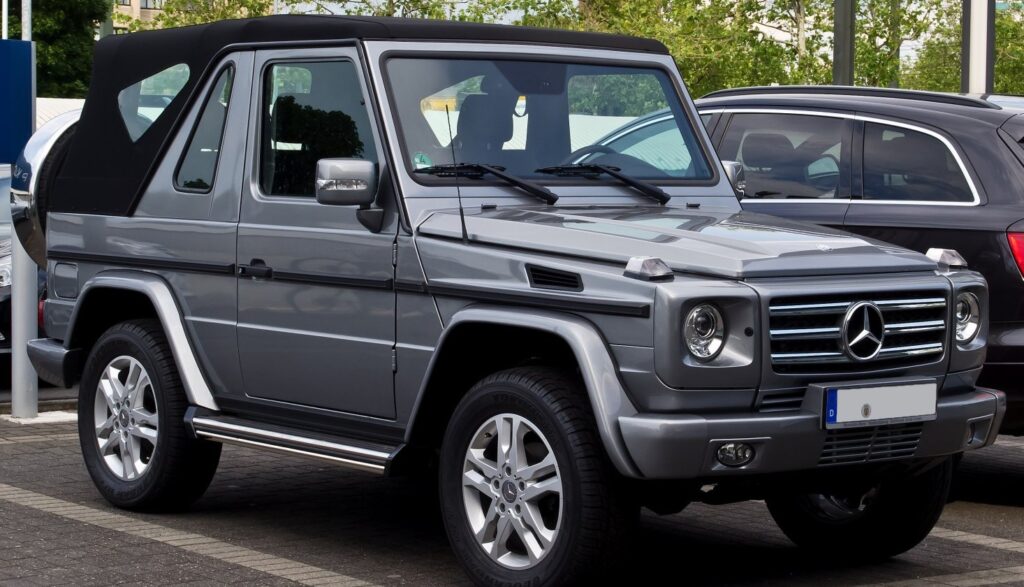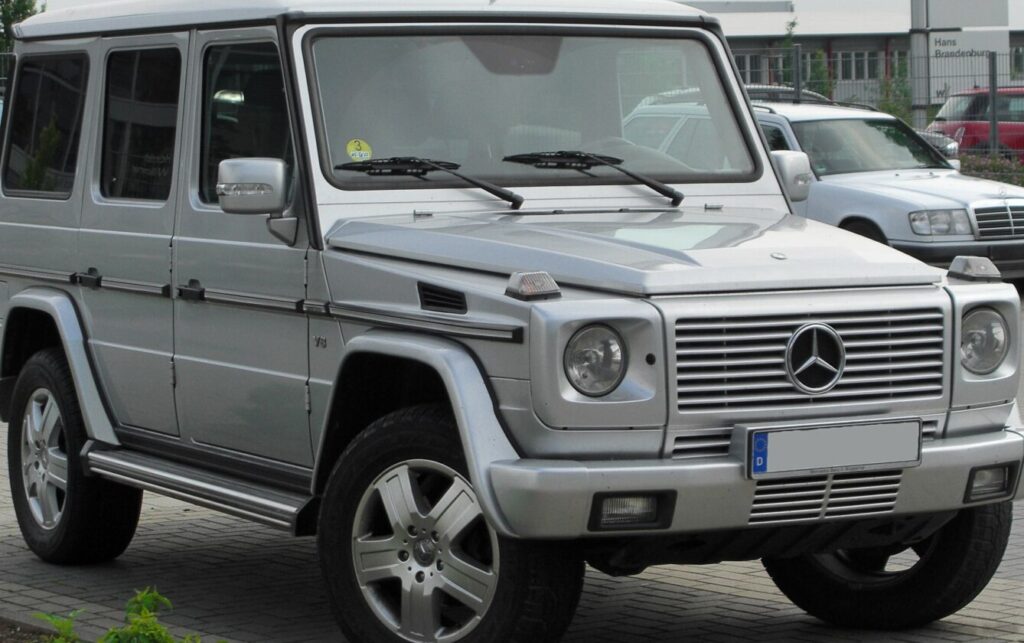
The Mercedes-Benz G 500 V8 4MATIC, produced from November 2000 to March 2007, represents a significant iteration of the long-wheelbase (W463) G-Class following its 2000 facelift. Positioned as a premium offering within the G-Class range, the G 500 bridged the gap between the more utilitarian base models and the high-performance AMG variants. This model catered to buyers seeking a blend of off-road capability, luxury, and substantial power, primarily in European and select international markets. The “Long” designation refers to the extended wheelbase, providing increased rear passenger space compared to the standard G-Wagen.
Technical Specifications
| Brand | Mercedes-Benz |
| Model | G-class |
| Generation | G-class Long (W463, facelift 2000) |
| Type (Engine) | G 500 V8 (296 Hp) 4MATIC Automatic |
| Start of production | November, 2000 |
| End of production | March, 2007 |
| Powertrain Architecture | Internal Combustion engine |
| Body type | Off-road vehicle |
| Seats | 5 |
| Doors | 5 |
| Fuel consumption (economy) – urban (NEDC) | 21.8 l/100 km (10.8 US mpg, 13 UK mpg, 4.6 km/l) |
| Fuel consumption (economy) – extra urban (NEDC) | 13.7 l/100 km (17.2 US mpg, 20.6 UK mpg, 7.3 km/l) |
| Fuel consumption (economy) – combined (NEDC) | 16.7 l/100 km (14.1 US mpg, 16.9 UK mpg, 6 km/l) |
| CO2 emissions (NEDC) | 400 g/km |
| Fuel Type | Petrol (Gasoline) |
| Acceleration 0 – 100 km/h | 10.2 sec |
| Acceleration 0 – 62 mph | 10.2 sec |
| Acceleration 0 – 60 mph | 9.7 sec |
| Maximum speed | 190 km/h (118.06 mph) |
| Emission standard | Euro 4 |
| Weight-to-power ratio | 8.4 kg/Hp, 119.1 Hp/tonne |
| Weight-to-torque ratio | 5.4 kg/Nm, 183.5 Nm/tonne |
| Power | 296 Hp @ 5500 rpm |
| Power per litre | 59.6 Hp/l |
| Torque | 456 Nm @ 2800-4000 rpm (336.33 lb.-ft. @ 2800-4000 rpm) |
| Engine layout | Front, Longitudinal |
| Engine Model/Code | M 113.962 |
| Engine displacement | 4966 cm3 (303.04 cu. in.) |
| Number of cylinders | 8 |
| Engine configuration | V-engine |
| Cylinder Bore | 97 mm (3.82 in.) |
| Piston Stroke | 84 mm (3.31 in.) |
| Compression ratio | 10:1 |
| Number of valves per cylinder | 3 |
| Fuel injection system | Multi-port manifold injection |
| Engine aspiration | Naturally aspirated engine |
| Valvetrain | SOHC |
| Engine oil capacity | 8 l (8.45 US qt | 7.04 UK qt) |
| Coolant | 12 l (12.68 US qt | 10.56 UK qt) |
| Kerb Weight | 2485 kg (5478.49 lbs.) |
| Max. weight | 3200 kg (7054.79 lbs.) |
| Max load | 715 kg (1576.31 lbs.) |
| Trunk (boot) space – minimum | 480 l (16.95 cu. ft.) |
| Trunk (boot) space – maximum | 2250 l (79.46 cu. ft.) |
| Fuel tank capacity | 96 l (25.36 US gal | 21.12 UK gal) |
| Max. roof load | 200 kg (440.92 lbs.) |
| Permitted trailer load with brakes (12%) | 3500 kg (7716.18 lbs.) |
| Permitted trailer load without brakes | 750 kg (1653.47 lbs.) |
| Length | 4680 mm (184.25 in.) |
| Width | 1760 mm (69.29 in.) |
| Width including mirrors | 2007 mm (79.02 in.) |
| Height | 1936 mm (76.22 in.) |
| Wheelbase | 2850 mm (112.2 in.) |
| Front track | 1475 mm (58.07 in.) |
| Rear (Back) track | 1475 mm (58.07 in.) |
| Ride height (ground clearance) | 205 mm (8.07 in.) |
| Drag coefficient (Cd) | 0.54 |
| Minimum turning circle (turning diameter) | 13.3 m (43.64 ft.) |
| Approach angle | 37° |
| Departure angle | 31° |
| Ramp-over (brakeover) angle | 23° |
| Climb angle | 38.7° |
| Wading depth | 500 mm (19.69 in.) |
| Drivetrain Architecture | The Internal combustion engine (ICE) drives permanently the four wheels of the vehicle. |
| Drive wheel | All wheel drive (4×4) |
| Number of gears and type of gearbox | 5 gears, automatic transmission |
| Front suspension | Coil spring, Rigid axle suspension, Trailing arm |
| Rear suspension | Rigid axle suspension, Trailing arm, Coil spring |
| Front brakes | Ventilated discs |
| Rear brakes | Disc |
| Assisting systems | ABS (Anti-lock braking system) |
| Steering type | Cone worm with recirculation balls |
| Power steering | Hydraulic Steering |
| Tires size | 265/60 R 18 |
| Wheel rims size | 7.5 J x 18 |
Powertrain & Engine Architecture
The heart of the G 500 V8 is the M 113.962 engine, a 4.966-liter (303.04 cubic inch) naturally aspirated V8. This engine, a staple of Mercedes-Benz performance models during the period, features a single overhead camshaft (SOHC) design per cylinder bank and three valves per cylinder (two intake, one exhaust). Fuel delivery is managed by a multi-port fuel injection system. The M113 engine family was known for its robust construction and smooth power delivery. The engine produces 296 horsepower at 5500 rpm and 456 Nm (336.33 lb-ft) of torque between 2800 and 4000 rpm. Paired with the engine is a 5-speed automatic transmission, providing a balance between comfort and responsiveness. This transmission was a conventional torque converter automatic, optimized for both on-road driving and the demands of off-road conditions.
Driving Characteristics
The G 500 V8 Automatic offered a unique driving experience. While possessing considerable power for its time, the vehicle’s substantial weight (2485 kg / 5478.49 lbs) meant that acceleration was respectable rather than exhilarating, taking approximately 10.2 seconds to reach 62 mph. The automatic transmission, while smooth, wasn’t particularly quick-shifting compared to modern transmissions. Compared to the manual transmission options available in other G-Class models, the automatic prioritized ease of use over outright performance. The 5-speed automatic’s gear ratios were tuned for a blend of torque multiplication for off-road crawling and comfortable highway cruising. The permanent all-wheel-drive system, combined with the V8’s torque, provided excellent traction in a variety of conditions.
Equipment & Trim Levels
The G 500 V8 typically came well-equipped, reflecting its position as a premium model. Standard features included leather upholstery, wood trim, automatic climate control, power-adjustable front seats, and an upgraded audio system. Optional extras included a sunroof, navigation system, upgraded leather options, and various off-road packages that added features like a locking differential and skid plates. The long wheelbase provided significantly more rear legroom than the standard G-Class, enhancing passenger comfort. Interior appointments were generally luxurious, though the G-Class retained a utilitarian aesthetic reflecting its origins as a military vehicle.
Chassis & Braking
The G 500 V8 utilized a robust ladder-frame chassis, a hallmark of the G-Class design. Suspension consisted of coil springs and rigid axles with trailing arms, providing excellent articulation for off-road capability. Front brakes were ventilated discs, while rear brakes were solid discs. Anti-lock braking system (ABS) was standard. The suspension was tuned to balance on-road comfort with off-road performance, resulting in a ride that was firm but not overly harsh. Stabilizer bars were fitted to reduce body roll during cornering.
Market Reception & Comparison
The G 500 V8 was generally well-received by automotive critics, who praised its combination of luxury, performance, and off-road capability. However, its high price and substantial fuel consumption (16.7 l/100 km combined) were noted drawbacks. Compared to the G 320, the G 500 offered significantly more power and a more refined driving experience, but at a higher cost. The G 500 also differed from the diesel-powered G 300 TDI and G 400 CDI models, offering a smoother, more responsive engine but with lower fuel economy. Reliability was generally good, though maintenance costs could be high due to the vehicle’s complexity and the cost of parts.
Legacy
The G 500 V8 (W463) remains a desirable vehicle in the used car market, particularly among enthusiasts who appreciate its unique character and robust construction. The M 113 V8 engine is known for its durability, although regular maintenance is essential. Parts availability can be a concern, and repair costs can be significant. The G 500 V8 represents a transitional period for the G-Class, bridging the gap between its utilitarian past and its modern, luxury-focused present. It continues to be valued for its blend of off-road prowess, comfortable interior, and distinctive styling.