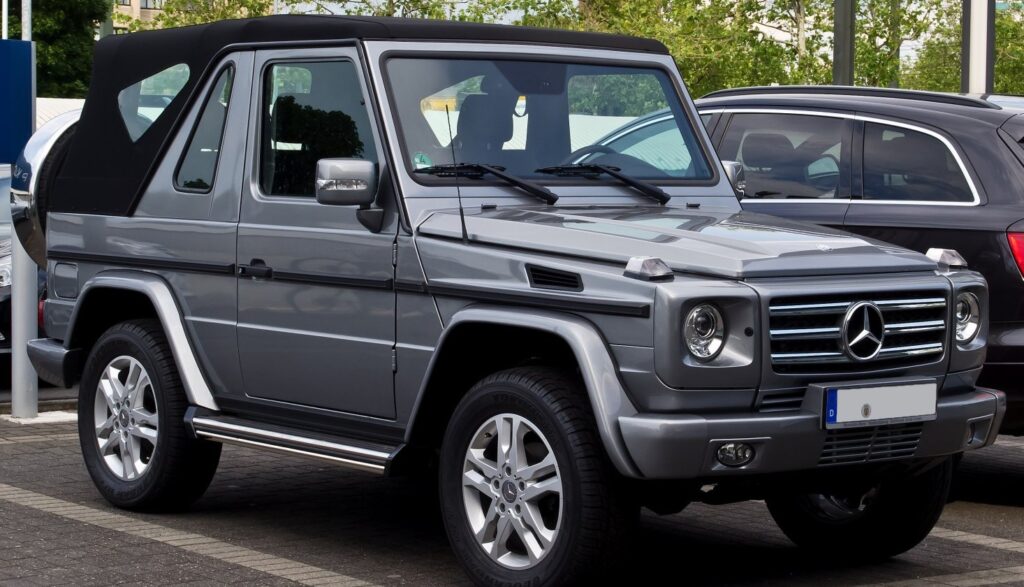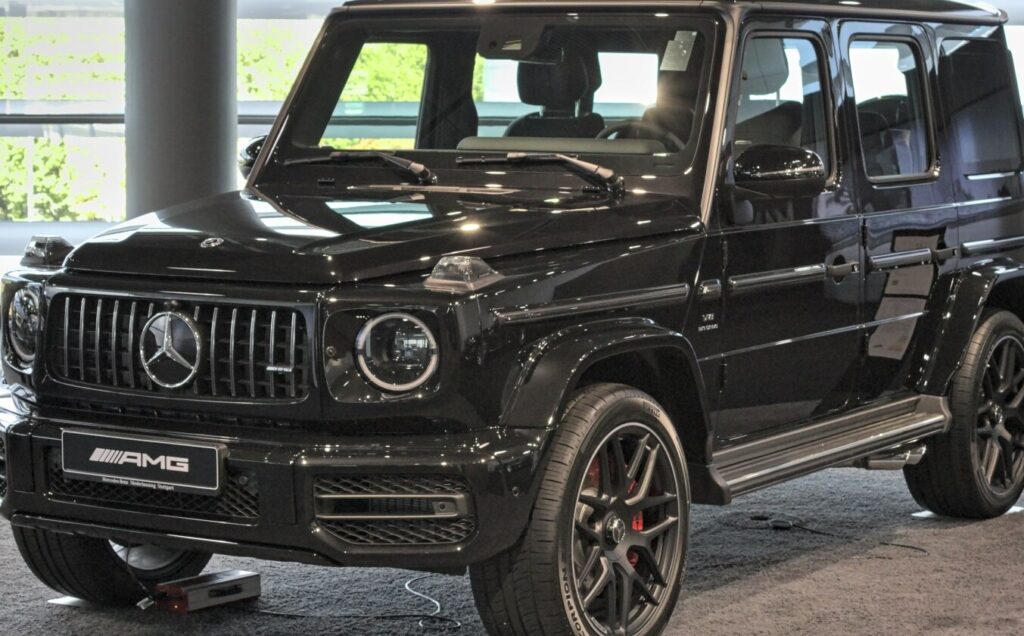
The Mercedes-Benz G 500 V8 4MATIC, part of the long-wheelbase (W463) G-Class facelift introduced in 2018, represents a significant iteration of the iconic off-road vehicle. Produced through 2020, this variant combined the G-Class’s legendary capability with a powerful, modern V8 engine and a sophisticated nine-speed automatic transmission. Positioned as a premium offering within the G-Class lineup, it catered to buyers seeking both luxurious appointments and robust performance, both on and off-road. The W463 facelift brought substantial modernization to the G-Class, improving refinement and technology while retaining its signature boxy aesthetic and exceptional off-road prowess.
Technical Specifications
| Brand | Mercedes-Benz |
| Model | G-class |
| Generation | G-class Long (W463, facelift 2018) |
| Type (Engine) | G 500 V8 (422 Hp) 4MATIC 9G-TRONIC |
| Start of production | 2018 |
| End of production | 2020 |
| Powertrain Architecture | Internal Combustion engine |
| Body type | Off-road vehicle |
| Seats | 5 |
| Doors | 5 |
| Fuel consumption (economy) – urban (NEDC) | 13.4-14.1 l/100 km (17.6 – 16.7 US mpg, 21.1 – 20 UK mpg, 7.5 – 7.1 km/l) |
| Fuel consumption (economy) – extra urban (NEDC) | 10.3-10.8 l/100 km (22.8 – 21.8 US mpg, 27.4 – 26.2 UK mpg, 9.7 – 9.3 km/l) |
| Fuel consumption (economy) – combined (NEDC) | 11.5-12.1 l/100 km (20.5 – 19.4 US mpg, 24.6 – 23.3 UK mpg, 8.7 – 8.3 km/l) |
| CO2 emissions (NEDC) | 263-276 g/km |
| Fuel Type | Petrol (Gasoline) |
| Acceleration 0 – 100 km/h | 5.9 sec |
| Acceleration 0 – 62 mph | 5.9 sec |
| Acceleration 0 – 60 mph | 5.6 sec |
| Maximum speed | 210 km/h (130.49 mph) – Electronically limited |
| Emission standard | Euro 6 |
| Weight-to-power ratio | 5.6 kg/Hp, 179.3 Hp/tonne |
| Weight-to-torque ratio | 3.9 kg/Nm, 259.1 Nm/tonne |
| Power | 422 Hp @ 5250-5500 rpm |
| Power per litre | 106 Hp/l |
| Torque | 610 Nm @ 2000-4750 rpm (449.91 lb.-ft. @ 2000-4750 rpm) |
| Engine layout | Front, Longitudinal |
| Engine Model/Code | M 176.980 |
| Engine displacement | 3982 cm3 (243 cu. in.) |
| Number of cylinders | 8 |
| Engine configuration | V-engine |
| Cylinder Bore | 83 mm (3.27 in.) |
| Piston Stroke | 92 mm (3.62 in.) |
| Compression ratio | 10.5:1 |
| Number of valves per cylinder | 4 |
| Fuel injection system | Direct injection |
| Engine aspiration | BiTurbo, Intercooler |
| Valvetrain | DOHC |
| Engine oil capacity | 9.5 l (10.04 US qt | 8.36 UK qt) |
| Kerb Weight | 2354 kg (5189.68 lbs.) |
| Max. weight | 3150 kg (6944.56 lbs.) |
| Max load | 796 kg (1754.88 lbs.) |
| Trunk (boot) space – minimum | 667 l (23.55 cu. ft.) |
| Trunk (boot) space – maximum | 1941 l (68.55 cu. ft.) |
| Fuel tank capacity | 75 l (19.81 US gal | 16.5 UK gal) |
| Max. roof load | 150 kg (330.69 lbs.) |
| Permitted trailer load with brakes (12%) | 3500 kg (7716.18 lbs.) |
| Permitted trailer load without brakes | 750 kg (1653.47 lbs.) |
| Permitted towbar download | 140 kg (308.65 lbs.) |
| Length | 4825 mm (189.96 in.) |
| Width | 1931 mm (76.02 in.) |
| Width including mirrors | 2187 mm (86.1 in.) |
| Height | 1969 mm (77.52 in.) |
| Wheelbase | 2890 mm (113.78 in.) |
| Front track | 1638 mm (64.49 in.) |
| Rear (Back) track | 1638 mm (64.49 in.) |
| Front overhang | 877 mm (34.53 in.) |
| Rear overhang | 839 mm (33.03 in.) |
| Ride height (ground clearance) | 241 mm (9.49 in.) |
| Drag coefficient (Cd) | 0.54 |
| Minimum turning circle (turning diameter) | 13.6 m (44.62 ft.) |
| Approach angle | 30.9° |
| Departure angle | 29.9° |
| Ramp-over (brakeover) angle | 25.7° |
| Climb angle | 45° |
| Wading depth | 700 mm (27.56 in.) |
| Drivetrain Architecture | The Internal combustion engine (ICE) drives permanently the four wheels of the vehicle. |
| Drive wheel | All wheel drive (4×4) |
| Number of gears and type of gearbox | 9 gears, automatic transmission G-TRONIC |
| Front suspension | Double wishbone |
| Rear suspension | Rigid axle suspension |
| Front brakes | Ventilated discs |
| Rear brakes | Ventilated discs |
| Assisting systems | ABS (Anti-lock braking system) |
| Steering type | Steering rack and pinion |
| Power steering | Electric Steering |
| Tires size | 265/60 R18; 275/55 R19; 275/50 R20 |
| Wheel rims size | 8J x 18; 8.5J x 19; 8.5J x 20 |
INTRODUCTION
The G 500 V8 4MATIC, launched as part of the W463 facelift in 2018, continued the G-Class’s tradition of combining uncompromising off-road capability with a luxurious interior. This iteration represented a significant step up in performance and refinement compared to earlier G-Class models, largely due to the adoption of the M176 4.0-liter twin-turbocharged V8 engine and the 9G-TRONIC nine-speed automatic transmission. The long-wheelbase configuration offered increased rear passenger space, further enhancing its appeal as a high-end, versatile vehicle. The W463 facelift, and specifically the G 500, aimed to broaden the G-Class’s appeal beyond its core enthusiast base, attracting buyers seeking a unique and capable luxury SUV.
Powertrain & Engine Architecture
At the heart of the G 500 V8 lies the M176.980 4.0-liter V8 engine. This engine utilizes direct fuel injection and employs two turbochargers, one per cylinder bank, to deliver substantial power and torque. The engine’s architecture features a hot-side-inside configuration, placing the turbochargers within the V of the engine, resulting in a more compact design and improved responsiveness. The 9G-TRONIC nine-speed automatic transmission, a staple of modern Mercedes-Benz vehicles, provides smooth and efficient gear changes. This transmission is designed to optimize fuel economy and enhance driving comfort while providing quick and precise shifts when needed. The transmission’s wide gear ratio spread allows the engine to operate in its most efficient range more often. The engine produces 422 horsepower at 5250-5500 rpm and 610 Nm (449.91 lb.-ft.) of torque between 2000 and 4750 rpm.
Driving Characteristics
The G 500 V8 4MATIC delivers a driving experience that is both refined and powerful. The twin-turbo V8 provides ample acceleration, with a 0-60 mph time of around 5.6 seconds. The nine-speed automatic transmission contributes to smooth and seamless gear changes, enhancing both on-road comfort and off-road control. While the G-Class’s boxy shape and high center of gravity don’t lend themselves to sporty handling, the G 500 offers a surprisingly composed ride on paved roads. Off-road, the G 500 truly shines. Its robust four-wheel-drive system, three locking differentials, and high ground clearance allow it to tackle extremely challenging terrain. The engine’s substantial torque output provides excellent low-end grunt, making it easy to navigate obstacles. Compared to the G 350d, the G 500 offers significantly more power and a more responsive driving experience, albeit with higher fuel consumption.
Equipment & Trim Levels
The G 500 V8 4MATIC came standard with a high level of equipment, reflecting its premium positioning. Standard features typically included leather upholstery, heated and ventilated front seats, a premium sound system, a sunroof, and a comprehensive suite of driver-assistance systems. Optional extras included a variety of interior trim options, upgraded leather packages, and advanced technology features such as a head-up display and adaptive cruise control. The long-wheelbase configuration provided increased legroom for rear passengers, making it a more comfortable option for families or those who frequently travel with passengers.
Chassis & Braking
The G 500 V8 4MATIC features a robust ladder-frame chassis, a hallmark of the G-Class design. This chassis provides exceptional rigidity and durability, essential for off-road performance. The suspension consists of a double-wishbone front suspension and a rigid axle rear suspension. The braking system utilizes ventilated discs on all four wheels, providing ample stopping power. Anti-lock brakes (ABS) are standard, along with other electronic stability control systems. The G 500’s weight (2354 kg / 5189.68 lbs) necessitates a strong braking system to ensure safe and controlled deceleration.
Market Reception & Comparison
The G 500 V8 4MATIC was generally well-received by automotive critics, who praised its powerful engine, luxurious interior, and exceptional off-road capability. However, its high price tag and relatively poor fuel economy were often cited as drawbacks. Compared to the G 350d, the G 500 offered a more exhilarating driving experience but at the cost of increased fuel consumption. The G 500 also faced competition from other high-end luxury SUVs, such as the Range Rover and the Porsche Cayenne, but its unique combination of off-road prowess and iconic styling set it apart.
Legacy
The M176 V8 engine and 9G-TRONIC transmission pairing in the G 500 V8 4MATIC have proven to be relatively reliable, although maintenance costs can be high due to the vehicle’s complexity and premium components. On the used car market, the G 500 V8 4MATIC commands a premium price, reflecting its desirability and limited production numbers. These vehicles are often sought after by collectors and enthusiasts who appreciate the G-Class’s unique heritage and capabilities. The 2018-2020 G 500 represents a pivotal moment in the G-Class’s evolution, bridging the gap between its utilitarian past and its modern luxury SUV present.