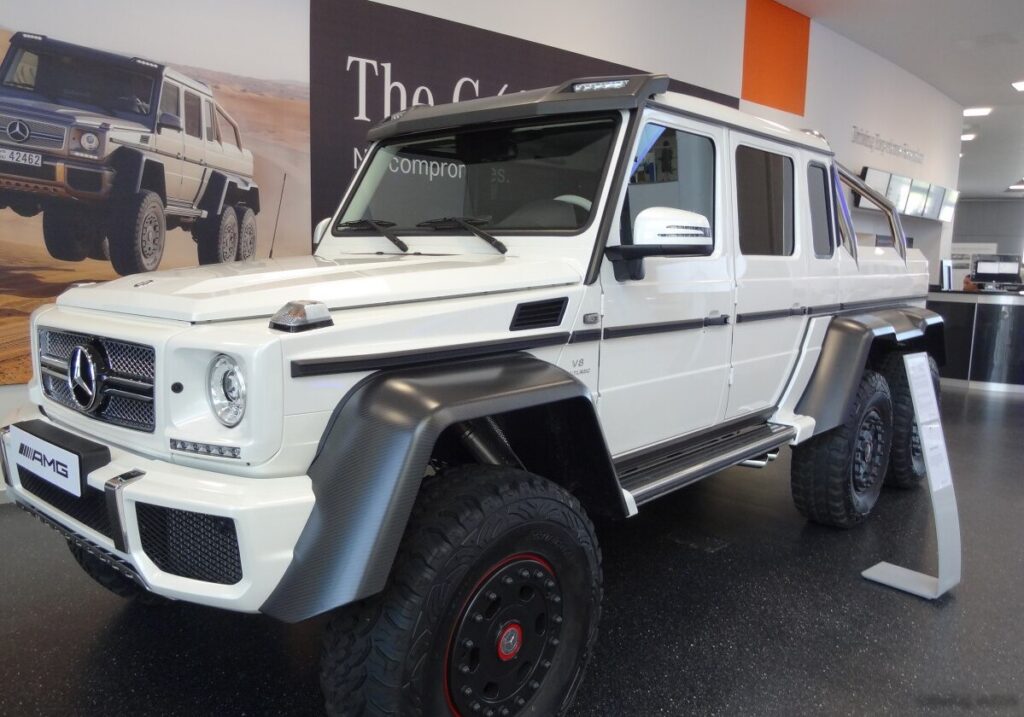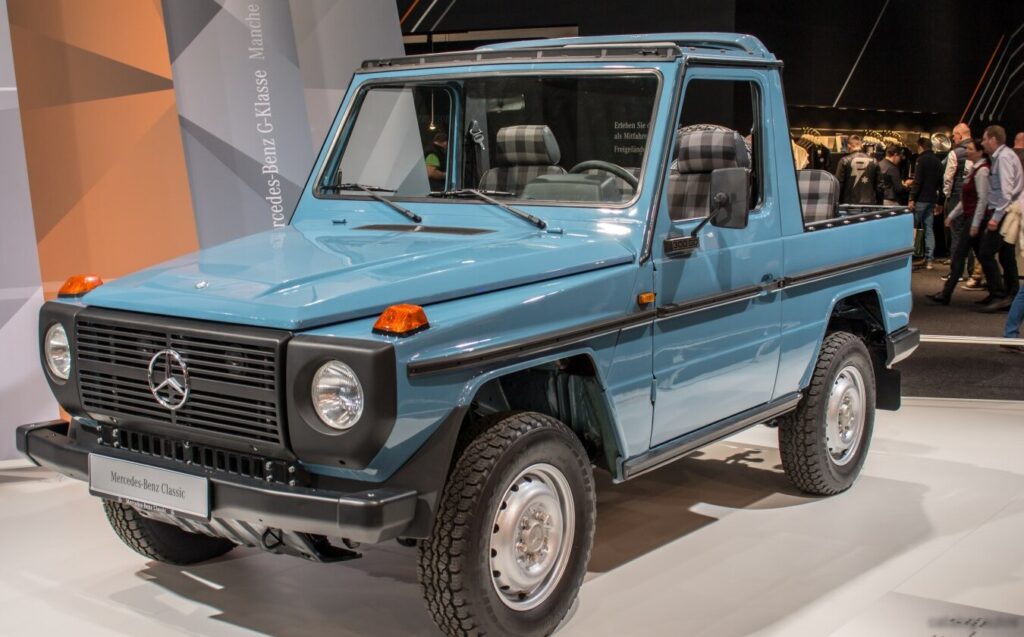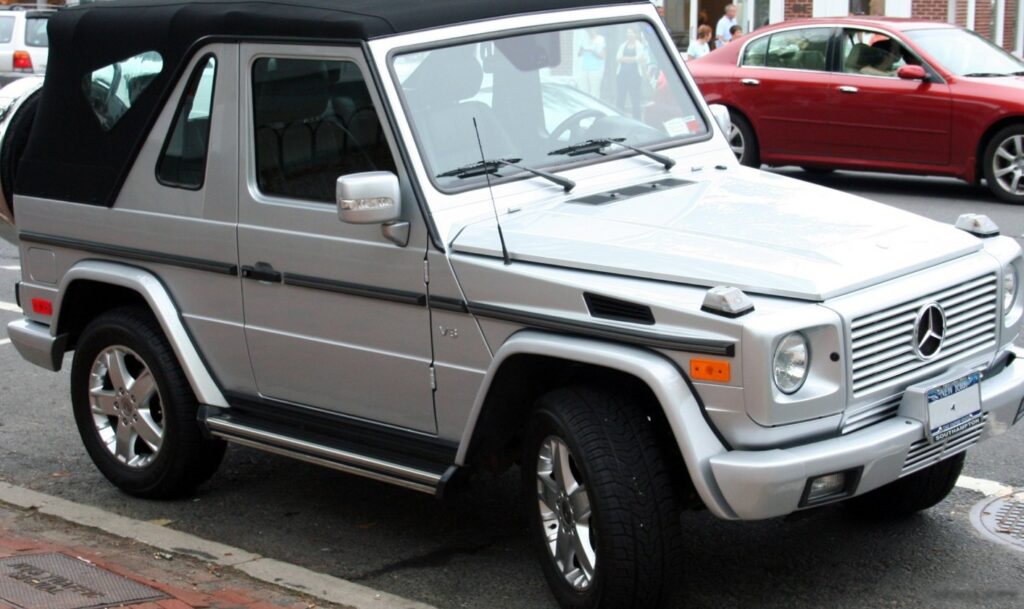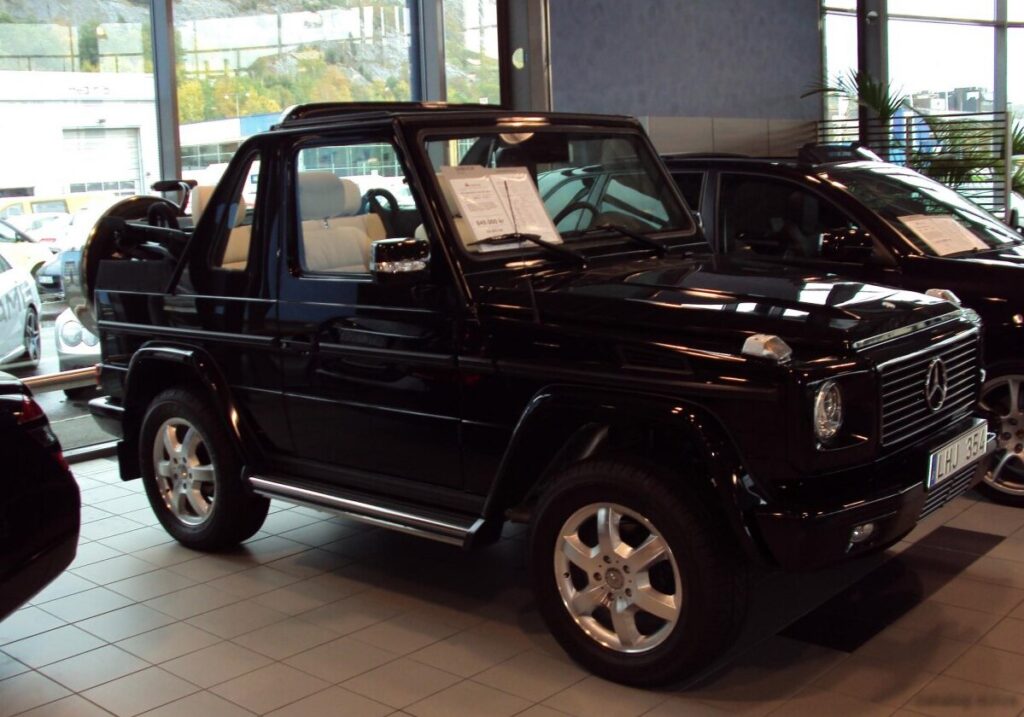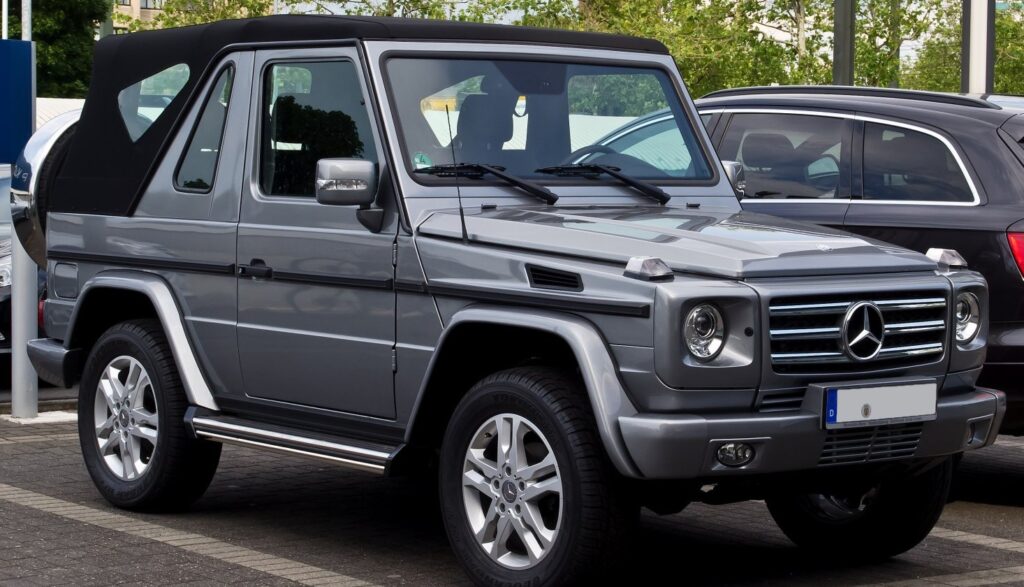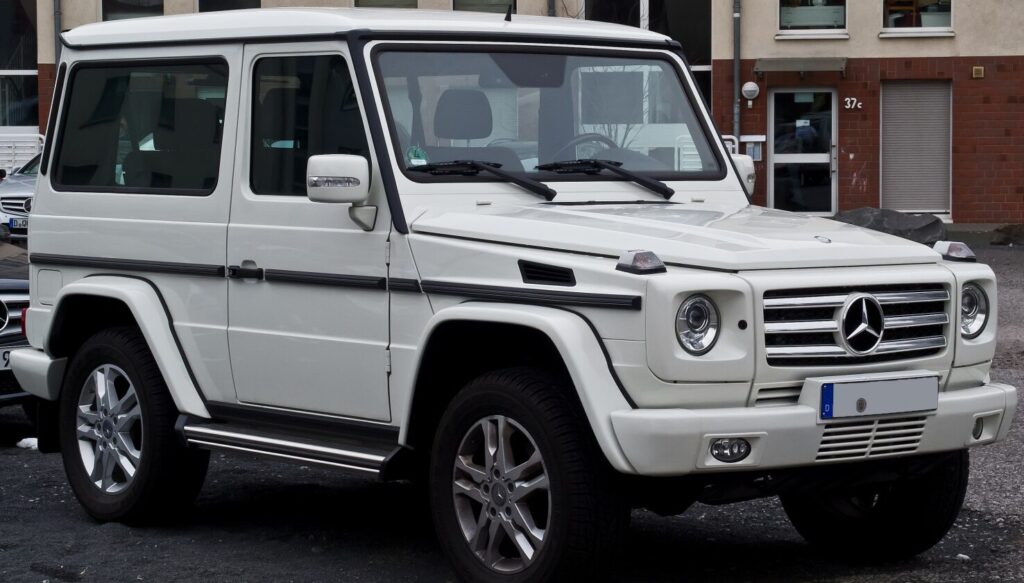
The Mercedes-Benz G 500 V8 (388 Hp) 4MATIC, produced between 2008 and 2010, represents a significant iteration of the iconic G-Class (W463) following its 2006 facelift. This variant occupied a premium position within the G-Class lineup, offering a substantial increase in performance and luxury compared to the base models. Built upon the robust ladder-frame chassis that defined the G-Wagen, the G 500 aimed to blend off-road capability with a more refined on-road driving experience. It was primarily marketed in Europe and other international markets, appealing to buyers seeking a powerful and exclusive all-terrain vehicle.
Technical Specifications
| Brand | Mercedes-Benz |
| Model | G-class |
| Generation | G-class (W463, facelift 2008) |
| Type (Engine) | G 500 V8 (388 Hp) 4MATIC 7G-TRONIC |
| Start of production | 2008 |
| End of production | 2010 |
| Powertrain Architecture | Internal Combustion engine |
| Body type | Off-road vehicle |
| Seats | 5 |
| Doors | 3 |
| Fuel consumption (economy) – urban (NEDC) | 19.3 l/100 km (12.2 US mpg, 14.6 UK mpg, 5.2 km/l) |
| Fuel consumption (economy) – extra urban (NEDC) | 12 l/100 km (19.6 US mpg, 23.5 UK mpg, 8.3 km/l) |
| Fuel consumption (economy) – combined (NEDC) | 14.7 l/100 km (16 US mpg, 19.2 UK mpg, 6.8 km/l) |
| CO2 emissions (NEDC) | 351 g/km |
| Fuel Type | Petrol (Gasoline) |
| Acceleration 0 – 100 km/h | 5.9 sec |
| Acceleration 0 – 62 mph | 5.9 sec |
| Acceleration 0 – 60 mph | 5.6 sec |
| Maximum speed | 210 km/h (130.49 mph) |
| Emission standard | Euro 4 |
| Weight-to-power ratio | 5.6 kg/Hp, 178.8 Hp/tonne |
| Weight-to-torque ratio | 4.1 kg/Nm, 244.2 Nm/tonne |
| Power | 388 Hp @ 6000 rpm |
| Power per litre | 71 Hp/l |
| Torque | 530 Nm @ 2800-4800 rpm (390.91 lb.-ft. @ 2800-4800 rpm) |
| Engine layout | Front, Longitudinal |
| Engine Model/Code | M 273.963 |
| Engine displacement | 5461 cm3 (333.25 cu. in.) |
| Number of cylinders | 8 |
| Engine configuration | V-engine |
| Cylinder Bore | 98 mm (3.86 in.) |
| Piston Stroke | 90.5 mm (3.56 in.) |
| Number of valves per cylinder | 4 |
| Fuel injection system | Multi-port manifold injection |
| Engine aspiration | Naturally aspirated engine |
| Valvetrain | DOHC |
| Engine oil capacity | 9 l (9.51 US qt | 7.92 UK qt) |
| Kerb Weight | 2170 kg (4784.03 lbs.) |
| Max. weight | 2850 kg (6283.17 lbs.) |
| Max load | 680 kg (1499.14 lbs.) |
| Trunk (boot) space – minimum | 250 l (8.83 cu. ft.) |
| Trunk (boot) space – maximum | 1580 l (55.8 cu. ft.) |
| Fuel tank capacity | 96 l (25.36 US gal | 21.12 UK gal) |
| Max. roof load | 150 kg (330.69 lbs.) |
| Permitted trailer load with brakes (12%) | 2850 kg (6283.17 lbs.) |
| Permitted trailer load without brakes | 750 kg (1653.47 lbs.) |
| Permitted towbar download | 115 kg (253.53 lbs.) |
| Length | 4212 mm (165.83 in.) |
| Width | 1760 mm (69.29 in.) |
| Width including mirrors | 2007 mm (79.02 in.) |
| Height | 1931 mm (76.02 in.) |
| Wheelbase | 2400 mm (94.49 in.) |
| Front track | 1475 mm (58.07 in.) |
| Rear (Back) track | 1475 mm (58.07 in.) |
| Front overhang | 783 mm (30.83 in.) |
| Rear overhang | 820 mm (32.28 in.) |
| Ride height (ground clearance) | 205 mm (8.07 in.) |
| Minimum turning circle (turning diameter) | 11.3 m (37.07 ft.) |
| Approach angle | 36° |
| Departure angle | 27° |
| Ramp-over (brakeover) angle | 23° |
| Climb angle | 38.7° |
| Wading depth | 500 mm (19.69 in.) |
| Drivetrain Architecture | The Internal combustion engine (ICE) drives permanently the four wheels of the vehicle. |
| Drive wheel | All wheel drive (4×4) |
| Number of gears and type of gearbox | 7 gears, automatic transmission G-TRONIC |
| Front suspension | Coil spring, Rigid axle suspension |
| Rear suspension | Rigid axle suspension, Coil spring |
| Front brakes | Ventilated discs |
| Rear brakes | Ventilated discs |
| Assisting systems | ABS (Anti-lock braking system) |
| Steering type | Cone worm with recirculation balls |
| Power steering | Hydraulic Steering |
| Tires size | 265/60 R18 |
| Wheel rims size | 7.5J x 18 |
Powertrain & Engine Architecture
The heart of the G 500 V8 is the M 273.963 engine, a 5.461-liter (333.25 cubic inches) naturally aspirated V8. This engine, a cornerstone of Mercedes-Benz’s engine lineup during this period, features a three-valve per cylinder (two intake, one exhaust) DOHC valvetrain and multi-port fuel injection. The engine produces 388 horsepower at 6000 rpm and 530 Nm (390.91 lb-ft) of torque between 2800 and 4800 rpm. The M 273 engine is known for its smooth power delivery and relatively high refinement. Paired with the engine is the 7G-TRONIC automatic transmission, a seven-speed automatic gearbox that offered smoother shifts and improved fuel efficiency compared to earlier five-speed automatics. The 7G-TRONIC’s gear ratios were optimized for both on-road cruising and off-road crawling, providing a balance between performance and usability.
Driving Characteristics
The G 500 V8 delivers a markedly different driving experience than lower-powered G-Class variants. The substantial torque output of the V8 engine provides effortless acceleration, with a 0-60 mph time of around 5.6 seconds. The 7G-TRONIC transmission contributes to a refined driving experience, offering smooth and quick gear changes. While the G-Class’s boxy shape and high center of gravity limit its cornering ability, the V8 engine provides ample power for overtaking and maintaining speed on highways. Off-road, the G 500 excels, leveraging its four-wheel-drive system, robust chassis, and ample ground clearance to tackle challenging terrain. The automatic transmission, while generally smooth, can sometimes hunt for gears in demanding off-road situations, requiring manual intervention via the Tiptronic function.
Equipment & Trim Levels
The G 500 V8 came standard with a high level of equipment, reflecting its premium positioning. Standard features typically included leather upholstery, heated front seats, automatic climate control, a premium audio system, and parking sensors. Optional extras included a sunroof, upgraded leather packages, and various off-road enhancements such as a locking differential. The interior design, while functional, was relatively spartan compared to other luxury SUVs of the time, emphasizing durability and practicality over outright opulence. The dashboard layout was straightforward, with clearly labeled controls and a focus on providing the driver with essential information.
Chassis & Braking
The G 500 V8 retains the traditional G-Class ladder-frame chassis, providing exceptional strength and durability. The suspension consists of coil springs and rigid axles front and rear, offering a comfortable ride on paved roads while maintaining excellent off-road articulation. Braking duties are handled by ventilated disc brakes on all four wheels, coupled with an Anti-lock Braking System (ABS). The steering system utilizes a recirculating ball mechanism, providing a direct and precise feel, although it requires more effort than modern rack-and-pinion systems.
Market Reception & Comparison
The G 500 V8 was generally well-received by automotive critics, who praised its powerful engine, refined transmission, and exceptional off-road capability. However, its high price tag and relatively crude interior were often cited as drawbacks. Compared to the G 320 CDI diesel variant, the G 500 offered significantly more power and a more responsive driving experience, but at the cost of considerably lower fuel economy. The G 500 also differed from the supercharged G 55 AMG, which provided even greater performance but came with a substantially higher price and a more aggressive character.
Legacy
The G 500 V8 (2008-2010) represents a sweet spot in the G-Class lineage, offering a compelling blend of performance, luxury, and off-road capability. The M 273 engine, while not the most fuel-efficient, is generally considered reliable, and the 7G-TRONIC transmission has proven to be durable. Today, well-maintained examples of the G 500 V8 are highly sought after by collectors and enthusiasts, commanding premium prices in the used car market. Its enduring appeal lies in its unique combination of iconic styling, robust construction, and powerful V8 engine, making it a true automotive icon.