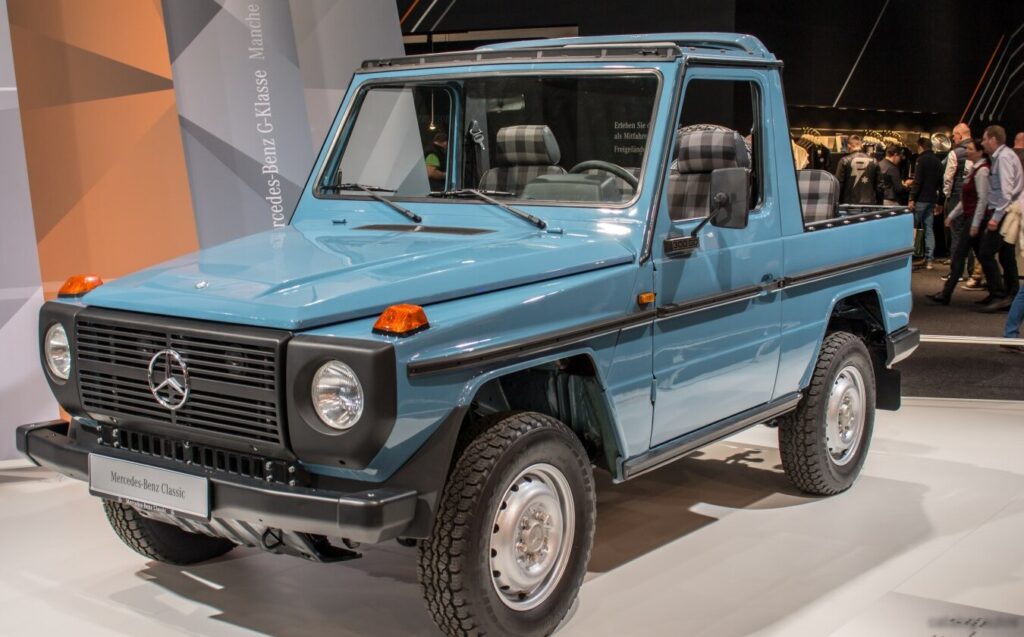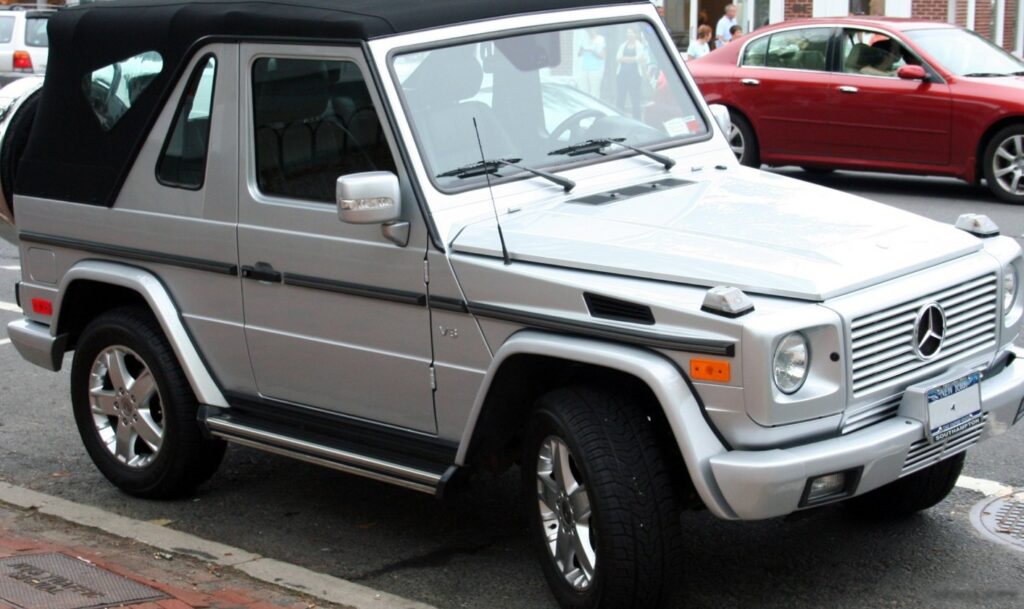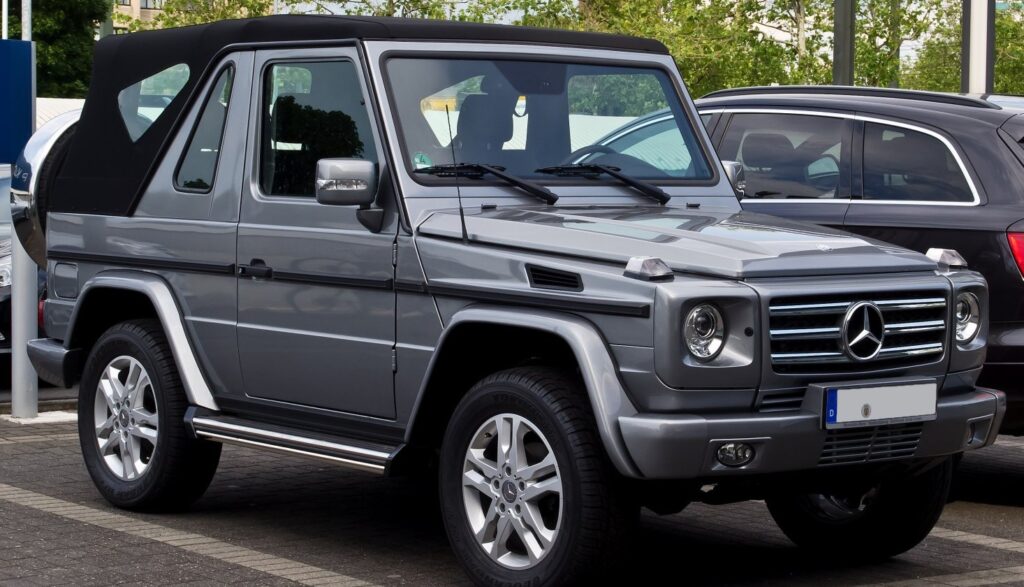
The Mercedes-Benz G 230 4MATIC, produced from September 1993 to July 1994, represents a significant iteration within the W463 G-Class series. Positioned as a more accessible entry point into the G-Wagen lineup, it offered the iconic off-road capability and robust construction of its siblings, but with a smaller displacement engine and automatic transmission. This variant aimed to broaden the G-Class’s appeal beyond specialized off-road enthusiasts and military applications, offering a more practical, though still undeniably luxurious, option for everyday use. It sat below the G 300 and G 360 models in terms of performance and price, targeting buyers who prioritized the G-Class’s image and durability over outright speed.
Technical Specifications
| Brand | Mercedes-Benz |
| Model | G-class |
| Generation | G-class (W463) |
| Type | G 230 (126 Hp) 4MATIC Automatic |
| Start of production | September, 1993 |
| End of production | July, 1994 |
| Powertrain Architecture | Internal Combustion engine |
| Body type | Off-road vehicle |
| Seats | 5 |
| Doors | 3 |
| Fuel consumption (urban) | 16.4 l/100 km (14.3 US mpg, 17.2 UK mpg, 6.1 km/l) |
| Fuel consumption (extra urban) | 12.7 l/100 km (18.5 US mpg, 22.2 UK mpg, 7.9 km/l) |
| Fuel Type | Petrol (Gasoline) |
| Acceleration 0 – 100 km/h | 18.4 sec |
| Acceleration 0 – 62 mph | 18.4 sec |
| Acceleration 0 – 60 mph | 17.5 sec |
| Maximum speed | 145 km/h (90.1 mph) |
| Weight-to-power ratio | 16.3 kg/Hp, 61.2 Hp/tonne |
| Weight-to-torque ratio | 10.8 kg/Nm, 92.2 Nm/tonne |
| Power | 126 Hp @ 5000 rpm |
| Power per litre | 54.8 Hp/l |
| Torque | 190 Nm @ 4000 rpm (140.14 lb.-ft. @ 4000 rpm) |
| Engine layout | Front, Longitudinal |
| Engine Model/Code | M 102.989 |
| Engine displacement | 2298 cm3 (140.23 cu. in.) |
| Number of cylinders | 4 |
| Engine configuration | Inline |
| Cylinder Bore | 95.5 mm (3.76 in.) |
| Piston Stroke | 80.2 mm (3.16 in.) |
| Compression ratio | 9:1 |
| Number of valves per cylinder | 2 |
| Fuel injection system | Multi-port manifold injection |
| Engine aspiration | Naturally aspirated engine |
| Valvetrain | SOHC |
| Engine oil capacity | 6 l (6.34 US qt | 5.28 UK qt) |
| Coolant | 5 l (5.28 US qt | 4.4 UK qt) |
| Kerb Weight | 2060 kg (4541.52 lbs.) |
| Max. weight | 2620 kg (5776.11 lbs.) |
| Max load | 560 kg (1234.59 lbs.) |
| Fuel tank capacity | 96 l (25.36 US gal | 21.12 UK gal) |
| Length | 4185 mm (164.76 in.) |
| Width | 1690 mm (66.54 in.) |
| Height | 1908 mm (75.12 in.) |
| Wheelbase | 2400 mm (94.49 in.) |
| Front track | 1425 mm (56.1 in.) |
| Rear track | 1425 mm (56.1 in.) |
| Drivetrain Architecture | All wheel drive (4×4). ICE drives permanently the four wheels. |
| Number of gears | 4 |
| Gearbox type | Automatic transmission |
| Front suspension | Coil spring, Rigid axle, Trailing arm |
| Rear suspension | Rigid axle, Trailing arm, Coil spring |
| Front brakes | Disc |
| Rear brakes | Drum |
| Assisting systems | ABS (Anti-lock braking system) |
| Steering type | Cone worm with recirculation balls |
| Power steering | Hydraulic |
| Tires size | 205/80 R16 |
| Wheel rims size | 6J x 16 |
INTRODUCTION
The G 230 4MATIC, introduced in 1993, represented a strategic move by Mercedes-Benz to make the G-Class more accessible to a wider audience. The W463 platform, launched in 1979, had initially been conceived as a rugged, utilitarian vehicle for military use, but gradually evolved into a luxury off-roader. The G 230 offered a balance between the G-Class’s legendary capability and a more manageable price point, appealing to buyers who desired the vehicle’s iconic styling and robust build quality without the expense of the larger-engined models. Production lasted only until 1994, making it a relatively rare variant within the W463 lineage.
Powertrain & Engine Architecture
At the heart of the G 230 lies the M 102.989, a 2.3-liter inline-four cylinder gasoline engine. This engine, a descendant of the well-regarded M102 family, produced 126 horsepower at 5000 rpm and 190 Nm (140 lb-ft) of torque at 4000 rpm. It featured a single overhead camshaft (SOHC) valvetrain and multi-port fuel injection, a relatively advanced system for its time. The engine’s longitudinal mounting within the chassis contributed to the G-Class’s balanced weight distribution. Paired with the engine was a four-speed automatic transmission, providing relatively smooth, if not particularly sporty, gear changes. This transmission was chosen to enhance the G 230’s ease of use and appeal to a broader range of drivers. The automatic transmission, while offering convenience, did impact acceleration compared to the available manual transmission options in other G-Class models.
Driving Characteristics
The G 230 4MATIC’s driving experience was defined by its robust build and off-road prowess, rather than outright performance. Acceleration was leisurely, taking approximately 18.4 seconds to reach 62 mph (100 km/h). The automatic transmission, while smooth, didn’t offer the responsiveness of a manual gearbox, and the engine felt strained when pushed hard. However, in its intended environment – challenging terrain – the G 230 excelled. The permanent four-wheel drive system, coupled with a low-range transfer case, provided exceptional traction and control. The relatively light weight (for a G-Class) compared to the larger engine variants contributed to its agility off-road. The gear ratios were optimized for low-speed crawling and tackling steep inclines, rather than highway cruising.
Equipment & Trim Levels
The G 230 4MATIC, while positioned as an entry-level G-Class, still offered a respectable level of equipment. Standard features typically included power windows, central locking, and a basic audio system. The interior was typically trimmed with durable cloth upholstery, although leather was available as an option. Dashboard configuration was relatively simple and functional, reflecting the vehicle’s utilitarian origins. Optional extras included air conditioning, a sunroof, and upgraded audio systems. The G 230’s trim level was generally consistent, with limited customization options compared to the higher-end models.
Chassis & Braking
The G 230 4MATIC retained the W463’s robust ladder-frame chassis, providing exceptional strength and durability. Suspension consisted of coil springs and rigid axles front and rear, offering considerable wheel articulation for off-road use. Front brakes were discs, providing adequate stopping power, while rear brakes were drums, a cost-saving measure for this variant. ABS (Anti-lock Braking System) was standard, enhancing safety on paved roads. The steering system utilized a cone worm and recirculation balls mechanism, providing a direct, if somewhat heavy, steering feel. The G 230’s suspension was tuned for a balance between on-road comfort and off-road capability, resulting in a firm but controlled ride.
Market Reception & Comparison
The G 230 4MATIC received mixed reviews. Critics acknowledged its off-road capability and iconic styling, but often criticized its lack of performance and relatively high price (even as an entry-level model). Compared to the G 300 and G 360, the G 230 offered significantly less power and acceleration. However, it did offer improved fuel economy, although still relatively poor by modern standards (around 16.4 l/100km urban, 12.7 l/100km extra urban). The G 230 appealed to buyers who prioritized the G-Class’s image and off-road credentials over outright speed and refinement. It was seen as a more practical and affordable alternative to the larger-engined models, particularly for those who didn’t require the extra power for serious off-roading.
Legacy
The G 230 4MATIC, despite its short production run, has become a sought-after model among G-Class enthusiasts. Its relative rarity and unique position within the W463 lineup contribute to its collectibility. The M 102 engine, while not known for its blistering performance, is generally considered to be reliable and relatively easy to maintain. However, as with any classic Mercedes-Benz, preventative maintenance and regular servicing are crucial to ensure long-term reliability. Today, well-maintained G 230s command a premium in the used car market, appealing to collectors and enthusiasts who appreciate the vehicle’s unique character and iconic status. The G 230 represents a fascinating chapter in the G-Class’s evolution, bridging the gap between its utilitarian origins and its current status as a luxury icon.