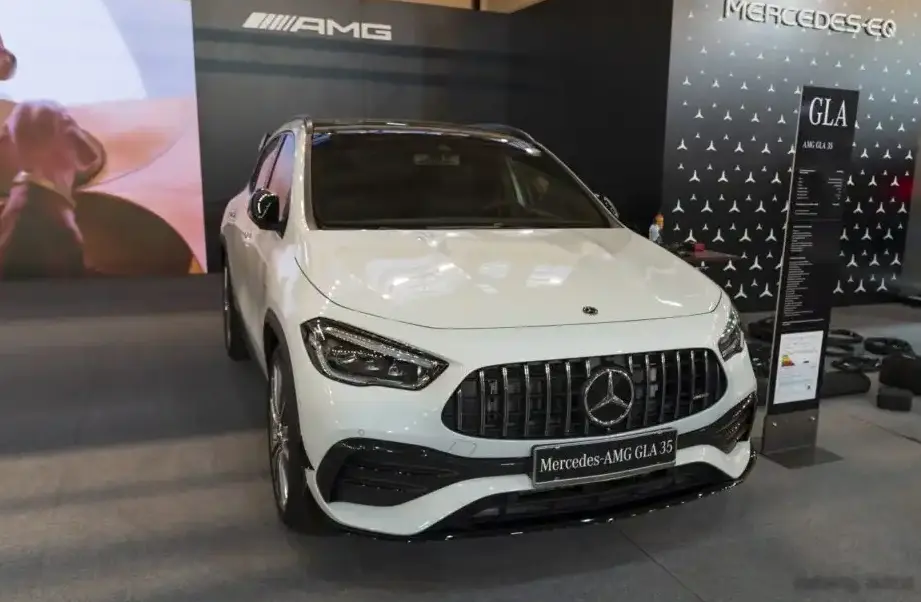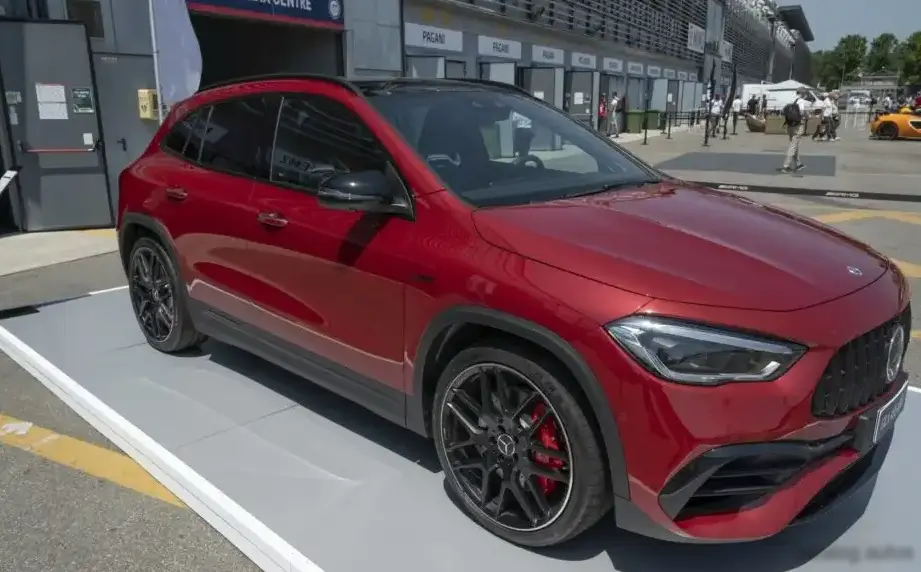
The Mercedes-Benz GLA 200d 4MATIC, produced from January 2017 to October 2019, represents a key variant within the X156 GLA facelift generation. Positioned as a mid-range offering, this model combined a diesel engine with all-wheel drive and a dual-clutch transmission, appealing to buyers seeking efficiency and all-weather capability in a compact luxury SUV. It was a significant player in the European market, where diesel engines remained popular, and offered a more economical alternative to the higher-performance gasoline variants. The GLA itself was Mercedes-Benz’s entry-level SUV, designed to attract a younger demographic and expand the brand’s reach in the burgeoning compact crossover segment.
Technical Specifications
| Brand | Mercedes-Benz |
| Model | GLA |
| Generation | GLA (X156, facelift 2017) |
| Type (Engine) | GLA 200d (136 Hp) 4MATIC 7G-DCT |
| Start of production | January, 2017 |
| End of production | October, 2019 |
| Powertrain Architecture | Internal Combustion engine |
| Body type | SUV |
| Seats | 5 |
| Doors | 5 |
| Fuel consumption (economy) – urban (NEDC) | 5.8-5.9 l/100 km (40.6 – 39.9 US mpg, 48.7 – 47.9 UK mpg, 17.2 – 16.9 km/l) |
| Fuel consumption (economy) – extra urban (NEDC) | 4.3-4.4 l/100 km (54.7 – 53.5 US mpg, 65.7 – 64.2 UK mpg, 23.3 – 22.7 km/l) |
| Fuel consumption (economy) – combined (NEDC) | 4.8-5.0 l/100 km (49 – 47 US mpg, 58.9 – 56.5 UK mpg, 20.8 – 20 km/l) |
| CO2 emissions (NEDC) | 127-130 g/km |
| Fuel Type | Diesel |
| Acceleration 0 – 100 km/h | 9.1 sec |
| Acceleration 0 – 62 mph | 9.1 sec |
| Acceleration 0 – 60 mph | 8.6 sec |
| Maximum speed | 200 km/h (124.27 mph) |
| Emission standard | Euro 6 |
| Weight-to-power ratio | 11.2 kg/Hp, 89.5 Hp/tonne |
| Weight-to-torque ratio | 5.1 kg/Nm, 197.4 Nm/tonne |
| Power | 136 Hp @ 3400-4400 rpm |
| Power per litre | 63.5 Hp/l |
| Torque | 300 Nm @ 1400-3000 rpm (221.27 lb.-ft. @ 1400-3000 rpm) |
| Engine layout | Front, Transverse |
| Engine Model/Code | OM 651.930 |
| Engine displacement | 2143 cm3 (130.77 cu. in.) |
| Number of cylinders | 4 |
| Engine configuration | Inline |
| Cylinder Bore | 83 mm (3.27 in.) |
| Piston Stroke | 99 mm (3.9 in.) |
| Compression ratio | 16.2:1 |
| Number of valves per cylinder | 4 |
| Fuel injection system | Diesel Commonrail |
| Engine aspiration | Turbocharger, Intercooler |
| Valvetrain | DOHC |
| Engine oil capacity | 6.5 l (6.87 US qt | 5.72 UK qt) |
| Kerb Weight | 1520 kg (3351.03 lbs.) |
| Max. weight | 2090 kg (4607.66 lbs.) |
| Max load | 570 kg (1256.63 lbs.) |
| Trunk (boot) space – minimum | 421 l (14.87 cu. ft.) |
| Trunk (boot) space – maximum | 1235 l (43.61 cu. ft.) |
| Fuel tank capacity | 56 l (14.79 US gal | 12.32 UK gal) |
| Max. roof load | 75 kg (165.35 lbs.) |
| Permitted trailer load with brakes (12%) | 1800 kg (3968.32 lbs.) |
| Permitted trailer load without brakes | 750 kg (1653.47 lbs.) |
| Permitted towbar download | 75 kg (165.35 lbs.) |
| Length | 4424 mm (174.17 in.) |
| Width | 1804 mm (71.02 in.) |
| Width including mirrors | 2022 mm (79.61 in.) |
| Height | 1494 mm (58.82 in.) |
| Wheelbase | 2699 mm (106.26 in.) |
| Front track | 1569 mm (61.77 in.) |
| Rear (Back) track | 1560 mm (61.42 in.) |
| Front overhang | 913 mm (35.94 in.) |
| Rear overhang | 812 mm (31.97 in.) |
| Drag coefficient (Cd) | 0.31 |
| Minimum turning circle (turning diameter) | 11.84 m (38.85 ft.) |
| Approach angle | 15.8° |
| Departure angle | 21.5° |
| Ramp-over (brakeover) angle | 13.3° |
| Drivetrain Architecture | The Internal combustion engine (ICE) drives the front wheels permanently, and the rear wheels are driven through an electrically or mechanically operated clutch if necessary. |
| Drive wheel | All wheel drive (4×4) |
| Number of gears and type of gearbox | 7 gears, automatic transmission G-DCT |
| Front suspension | Independent, type McPherson with coil spring and anti-roll bar |
| Rear suspension | Wishbone, Transverse stabilizer, Trailing arm |
| Front brakes | Ventilated discs |
| Rear brakes | Disc |
| Assisting systems | ABS (Anti-lock braking system) |
| Steering type | Steering rack and pinion |
| Power steering | Electric Steering |
| Tires size | 215/60 R17; 215/55 R18; 235/50 R18; 235/45 R19 |
| Wheel rims size | 6.5J x 17; 6.5J x 18; 7J x 18; 8J x 19 |
INTRODUCTION
The Mercedes-Benz GLA 200d 4MATIC, part of the X156 facelift released in 2017, was a crucial component of Mercedes-Benz’s compact SUV strategy. Building upon the original GLA launched in 2014, the facelift brought styling revisions, updated technology, and refined engine options. The 200d variant, powered by a 2.1-liter four-cylinder diesel engine producing 136 horsepower, was specifically tailored for markets prioritizing fuel efficiency and lower running costs. The 4MATIC all-wheel-drive system provided enhanced traction and stability, making it a practical choice for diverse weather conditions. This model occupied a middle ground in the GLA lineup, offering a balance between affordability and capability, slotting below the more powerful GLA 250 and above the base GLA 180.
Powertrain & Engine Architecture
The heart of the GLA 200d 4MATIC is the OM 651.930 2.1-liter inline-four cylinder diesel engine. This engine, a mainstay in the Mercedes-Benz lineup, is known for its durability and efficiency. It utilizes a second-generation common rail direct injection system, delivering fuel at pressures up to 2,000 bar for optimized combustion. A turbocharger with an intercooler further enhances performance. The engine produces 300 Nm (221 lb-ft) of torque between 1400 and 3000 rpm, providing strong low-end and mid-range pull. The engine features a double overhead camshaft (DOHC) valvetrain with four valves per cylinder. Paired with the engine is the 7G-DCT (7-speed dual-clutch transmission). This transmission offers quick and smooth gear changes, contributing to both performance and fuel economy. The 7G-DCT is a wet dual-clutch system, known for its reliability and efficiency. It allows for both fully automatic operation and manual gear selection via steering wheel-mounted paddles.
Driving Characteristics
The GLA 200d 4MATIC delivers a comfortable and refined driving experience. While not overtly sporty, the 136 horsepower and 300 Nm of torque provide adequate performance for everyday driving. Acceleration from 0 to 100 km/h (0-62 mph) takes approximately 9.1 seconds. The 7G-DCT transmission contributes to seamless gear changes, and the 4MATIC all-wheel-drive system provides excellent traction, particularly in slippery conditions. Compared to the more powerful GLA 250, the 200d feels less eager to accelerate, but its lower weight and efficient engine contribute to better fuel economy. The gear ratios are tuned for efficiency, with taller gearing in higher gears to reduce engine speed at cruising speeds. The steering is precise and well-weighted, providing a confident feel on the road. The suspension is tuned for comfort, absorbing bumps and imperfections in the road surface effectively.
Equipment & Trim Levels
The GLA 200d 4MATIC typically came equipped with a generous array of standard features. These included automatic climate control, a multimedia system with a 7-inch display screen, Bluetooth connectivity, and a suite of safety features such as ABS, ESP, and multiple airbags. Interior upholstery was typically Artico leatherette, with options for genuine leather available. Common optional extras included a larger 8-inch display screen, navigation system, panoramic sunroof, and a premium sound system. Trim levels varied slightly depending on the market, but generally offered packages that bundled together popular options. The overall interior design was modern and upscale, reflecting Mercedes-Benz’s commitment to quality and refinement.
Chassis & Braking
The GLA 200d 4MATIC utilizes a McPherson strut front suspension with a coil spring and anti-roll bar. The rear suspension employs a multi-link setup with a transverse stabilizer and trailing arm. This configuration provides a good balance between ride comfort and handling. The braking system consists of ventilated discs at the front and solid discs at the rear. ABS (Anti-lock Braking System) and ESP (Electronic Stability Program) are standard features, enhancing safety and control. The 4MATIC all-wheel-drive system is a full-time system, distributing torque between the front and rear axles as needed to optimize traction. The system utilizes a multi-plate clutch to engage and disengage the rear wheels.
Market Reception & Comparison
The GLA 200d 4MATIC was generally well-received by automotive critics. It was praised for its fuel efficiency, comfortable ride, and practical interior. However, some reviewers noted that the engine could feel underpowered, particularly when fully loaded or driving uphill. Compared to the gasoline-powered GLA 250, the 200d offered significantly better fuel economy, but at the expense of performance. Against competitors such as the Audi Q3 and BMW X1, the GLA 200d 4MATIC held its own in terms of refinement and features, but its diesel engine was a distinguishing factor in markets where diesel was favored. Reliability reports suggest that the OM 651 engine is generally robust, but regular maintenance is crucial to ensure longevity.
Legacy
The GLA 200d 4MATIC remains a popular choice in the used car market, particularly for buyers seeking a fuel-efficient and reliable compact SUV. The OM 651 diesel engine is known for its durability, and with proper maintenance, it can provide many years of trouble-free service. The 7G-DCT transmission has also proven to be relatively reliable. However, potential buyers should be aware of the potential for diesel particulate filter (DPF) issues, particularly if the vehicle has been primarily used for short trips. Overall, the GLA 200d 4MATIC represents a well-rounded and practical option in the compact luxury SUV segment, offering a compelling combination of efficiency, capability, and refinement.