
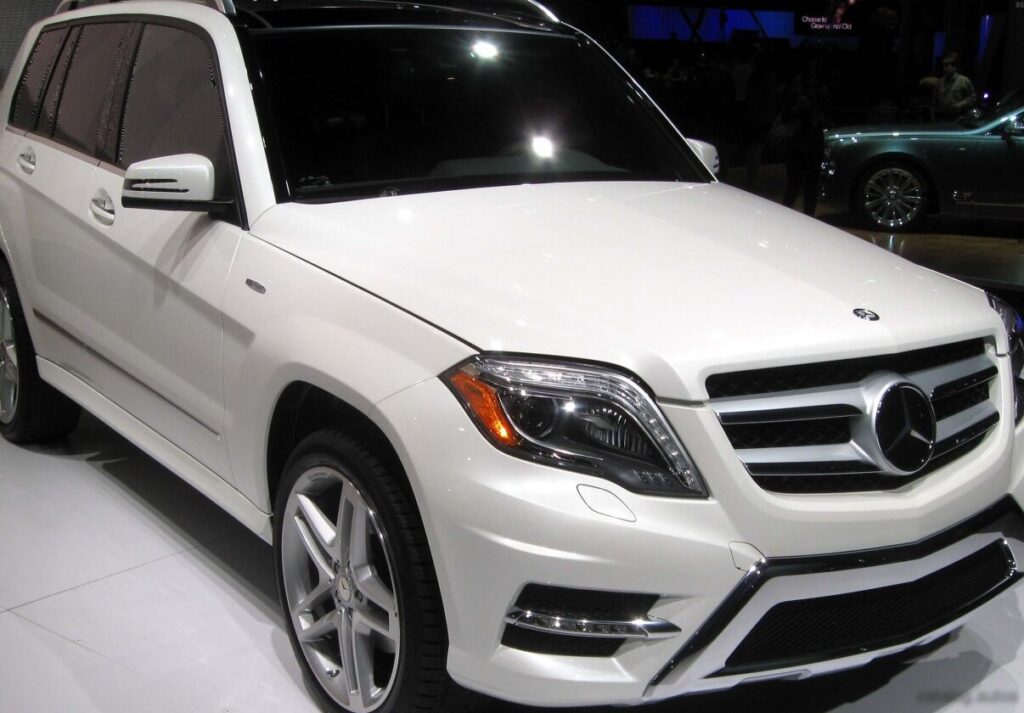
The Mercedes-Benz GLK 200, produced from December 2013 to June 2015, represents a key variant within the X204 facelift generation of the GLK-Class compact luxury SUV. Positioned as the entry-level model in many markets, the GLK 200 offered a balance of Mercedes-Benz refinement and relatively accessible pricing. It served as a stepping stone into the GLK range, appealing to buyers prioritizing fuel efficiency and comfort over outright performance. This model was primarily sold in Europe and other markets outside of North America, where the GLK was not initially offered. The facelift brought styling updates and technological improvements to the X204 platform, enhancing its appeal in a competitive segment.
Technical Specifications
| Brand | Mercedes-Benz |
| Model | GLK |
| Generation | GLK (X204, facelift 2012) |
| Type (Engine) | GLK 200 (184 Hp) |
| Start of production | December, 2013 |
| End of production | June, 2015 |
| Powertrain Architecture | Internal Combustion engine |
| Body type | SUV |
| Seats | 5 |
| Doors | 5 |
| Fuel consumption (economy) – urban (NEDC) | 9.1-9.2 l/100 km (25.8 – 25.6 US mpg, 31 – 30.7 UK mpg, 11 – 10.9 km/l) |
| Fuel consumption (economy) – extra urban (NEDC) | 6.1-6.2 l/100 km (38.6 – 37.9 US mpg, 46.3 – 45.6 UK mpg, 16.4 – 16.1 km/l) |
| Fuel consumption (economy) – combined (NEDC) | 7.2-7.3 l/100 km (32.7 – 32.2 US mpg, 39.2 – 38.7 UK mpg, 13.9 – 13.7 km/l) |
| CO2 emissions (NEDC) | 168-170 g/km |
| Fuel Type | Petrol (Gasoline) |
| Acceleration 0 – 100 km/h | 8.8 sec |
| Acceleration 0 – 62 mph | 8.8 sec |
| Acceleration 0 – 60 mph | 8.4 sec |
| Maximum speed | 210 km/h (130.49 mph) |
| Emission standard | Euro 6 |
| Weight-to-power ratio | 9 kg/Hp, 110.8 Hp/tonne |
| Weight-to-torque ratio | 5.5 kg/Nm, 180.7 Nm/tonne |
| Power | 184 Hp @ 5500 rpm |
| Power per litre | 92.4 Hp/l |
| Torque | 300 Nm @ 1200-4000 rpm (221.27 lb.-ft. @ 1200-4000 rpm) |
| Engine layout | Front, Longitudinal |
| Engine Model/Code | M 274.920 |
| Engine displacement | 1991 cm3 (121.5 cu. in.) |
| Number of cylinders | 4 |
| Engine configuration | Inline |
| Cylinder Bore | 83 mm (3.27 in.) |
| Piston Stroke | 92 mm (3.62 in.) |
| Compression ratio | 9.8:1 |
| Number of valves per cylinder | 4 |
| Fuel injection system | Direct injection |
| Engine aspiration | Turbocharger, Intercooler |
| Valvetrain | DOHC |
| Engine oil capacity | 5.7 l (6.02 US qt | 5.02 UK qt) |
| Coolant | 8.5 l (8.98 US qt | 7.48 UK qt) |
| Kerb Weight | 1660 kg (3659.67 lbs.) |
| Max. weight | 2310 kg (5092.68 lbs.) |
| Max load | 650 kg (1433 lbs.) |
| Trunk (boot) space – minimum | 450 l (15.89 cu. ft.) |
| Trunk (boot) space – maximum | 1550 l (54.74 cu. ft.) |
| Fuel tank capacity | 66 l (17.44 US gal | 14.52 UK gal) |
| Max. roof load | 75 kg (165.35 lbs.) |
| Permitted trailer load with brakes (12%) | 2000 kg (4409.25 lbs.) |
| Permitted trailer load without brakes | 750 kg (1653.47 lbs.) |
| Permitted towbar download | 100 kg (220.46 lbs.) |
| Length | 4536 mm (178.58 in.) |
| Width | 1840 mm (72.44 in.) |
| Width including mirrors | 2016 mm (79.37 in.) |
| Height | 1669 mm (65.71 in.) |
| Wheelbase | 2755 mm (108.46 in.) |
| Front track | 1574 mm (61.97 in.) |
| Rear (Back) track | 1597 mm (62.87 in.) |
| Front overhang | 824 mm (32.44 in.) |
| Rear overhang | 957 mm (37.68 in.) |
| Ride height (ground clearance) | 182 mm (7.17 in.) |
| Drag coefficient (Cd) | 0.36 |
| Minimum turning circle (turning diameter) | 11.65 m (38.22 ft.) |
| Approach angle | 22.8° |
| Departure angle | 24.6° |
| Wading depth | 300 mm (11.81 in.) |
| Drivetrain Architecture | The Internal combustion engine (ICE) drives the rear wheels of the vehicle. |
| Drive wheel | Rear wheel drive |
| Number of gears and type of gearbox | 6 gears, manual transmission |
| Front suspension | Independent, type McPherson with coil spring and anti-roll bar |
| Rear suspension | Independent multi-link spring suspension with stabilizer |
| Front brakes | Ventilated discs, 330 mm |
| Rear brakes | Ventilated discs, 300 mm |
| Assisting systems | ABS (Anti-lock braking system) |
| Steering type | Steering rack and pinion |
| Power steering | Electric Steering |
| Tires size | Front wheel tires: 235/60 R17; 235/50 R19; 235/45 R20; Rear wheel tires: 235/60 R17; 255/55 R17; 235/50 R19; 255/45 R19; 255/40 R20 |
| Wheel rims size | Front wheel rims: 7.5J x 17; 7.5J x 19; 8J x 20; 8.5J x 20; Rear wheel rims: 7.5J x 17; 8J x 17; 7.5J x 19; 8.5J x 19; 9J x 20; 9.5J x 20 |
Powertrain & Engine Architecture
The GLK 200 is powered by the M274.920 2.0-liter inline-four cylinder gasoline engine. This engine is a member of Mercedes-Benz’s modular engine family, known for its efficiency and refinement. It features direct fuel injection and is turbocharged, allowing it to produce 184 horsepower at 5500 rpm and 300 Nm (221 lb-ft) of torque between 1200 and 4000 rpm. The turbocharger provides a broad torque curve, enhancing drivability. The engine utilizes a double overhead camshaft (DOHC) valvetrain with four valves per cylinder. The M274 engine also incorporates features like an aluminum engine block and cylinder head to reduce weight. The GLK 200 was typically paired with a 6-speed manual transmission, although an optional 7G-TRONIC PLUS automatic transmission was also available. The automatic transmission offered smoother shifts and enhanced convenience, but at the expense of some fuel economy.
Driving Characteristics
The GLK 200, with its 184 hp and 300 Nm of torque, offered adequate performance for everyday driving. Acceleration from 0 to 100 km/h (0-62 mph) took approximately 8.8 seconds. While not a sports SUV, the engine provided sufficient power for merging onto highways and overtaking slower vehicles. The turbocharger helped to mitigate turbo lag, delivering a responsive feel. Compared to the more powerful GLK 250 or GLK 350 models, the GLK 200 felt less energetic, particularly when fully loaded or climbing hills. The manual transmission allowed for greater driver control, while the automatic transmission prioritized comfort and ease of use. The rear-wheel drive configuration contributed to a balanced handling feel, although it wasn’t ideal for driving in inclement weather without appropriate tires.
Equipment & Trim Levels
The GLK 200 typically came standard with features such as air conditioning, power windows, power mirrors, a multi-function steering wheel, and an audio system with a CD player. Safety features included ABS, ESP (Electronic Stability Program), and multiple airbags. Higher trim levels offered options like leather upholstery, a sunroof, navigation system, parking sensors, and a premium sound system. Interior materials were generally of good quality, reflecting Mercedes-Benz’s standards. The dashboard layout was functional and well-organized, with intuitive controls. The GLK 200 aimed to provide a comfortable and refined interior experience, albeit with fewer luxury features than its more expensive siblings.
Chassis & Braking
The GLK 200 featured a McPherson strut front suspension and a multi-link rear suspension, providing a comfortable ride and good handling characteristics. Stabilizer bars were fitted to both axles to reduce body roll during cornering. The braking system consisted of ventilated disc brakes on all four wheels, providing ample stopping power. ABS (Anti-lock Braking System) was standard, enhancing safety during emergency braking situations. The GLK 200’s suspension was tuned to prioritize comfort over sporty handling, making it well-suited for long-distance driving. The vehicle’s relatively modest weight, at 1660 kg (3659.67 lbs), contributed to its manageable handling.
Market Reception & Comparison
The GLK 200 was generally well-received by automotive critics as an entry-level luxury SUV that offered a good balance of features, fuel efficiency, and comfort. It was often praised for its refined interior and comfortable ride. However, some critics noted that its performance was not as exhilarating as that of its more powerful counterparts. Compared to the GLK 250, the GLK 200 offered lower running costs but less performance. The GLK 200’s fuel economy was competitive within its segment, with combined fuel consumption ranging from 7.2 to 7.3 l/100 km (32.7 – 32.2 US mpg). Reliability was generally good, although some owners reported minor issues with the electronic systems.
Legacy
The Mercedes-Benz GLK 200, while not as widely recognized as some of its more powerful siblings, remains a popular choice in the used car market. The M274 engine has proven to be relatively reliable, although regular maintenance is essential. The GLK 200’s combination of Mercedes-Benz luxury, fuel efficiency, and affordability has made it an attractive option for buyers seeking a compact luxury SUV. Its relatively simple mechanical design compared to newer models also makes it easier and less expensive to maintain. Today, well-maintained examples of the GLK 200 can still provide years of reliable service.
