
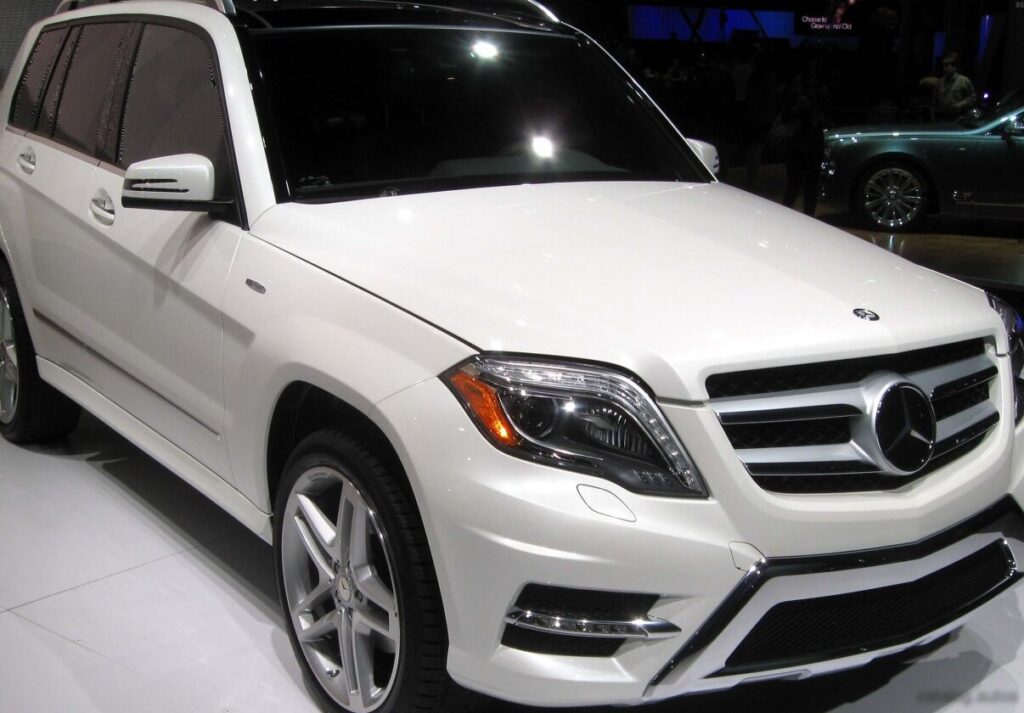
The Mercedes-Benz GLK 200 CDI, produced from June 2012 to June 2015, was a diesel-powered variant of the X204 GLK-Class compact luxury SUV. Positioned as an entry-level offering within the GLK range, it aimed to provide a more fuel-efficient and accessible option compared to the higher-powered gasoline models like the GLK 350. The facelifted X204 generation, introduced in 2012, brought styling updates and technological improvements to the GLK, solidifying its position in the burgeoning compact luxury SUV segment. This model played a significant role in Mercedes-Benz’s strategy to offer a wider range of choices to customers, particularly in European markets where diesel engines were highly favored.
Technical Specifications
| Brand | Mercedes-Benz |
| Model | GLK |
| Generation | GLK (X204, facelift 2012) |
| Type (Engine) | GLK 200 CDI (143 Hp) |
| Start of production | June, 2012 |
| End of production | June, 2015 |
| Powertrain Architecture | Internal Combustion engine |
| Body type | SUV |
| Seats | 5 |
| Doors | 5 |
| Fuel consumption (economy) – urban (NEDC) | 6.5 l/100 km (36.2 US mpg, 43.5 UK mpg, 15.4 km/l) |
| Fuel consumption (economy) – extra urban (NEDC) | 4.9-5.1 l/100 km (48 – 46.1 US mpg, 57.6 – 55.4 UK mpg, 20.4 – 19.6 km/l) |
| Fuel consumption (economy) – combined (NEDC) | 5.5-5.6 l/100 km (42.8 – 42 US mpg, 51.4 – 50.4 UK mpg, 18.2 – 17.9 km/l) |
| CO2 emissions (NEDC) | 143-147 g/km |
| Fuel Type | Diesel |
| Acceleration 0 – 100 km/h | 10.3 sec |
| Acceleration 0 – 62 mph | 10.3 sec |
| Acceleration 0 – 60 mph | 9.8 sec |
| Maximum speed | 195 km/h (121.17 mph) |
| Emission standard | Euro 5 |
| Weight-to-power ratio | 12.2 kg/Hp, 81.7 Hp/tonne |
| Weight-to-torque ratio | 5 kg/Nm, 200 Nm/tonne |
| Power | 143 Hp @ 3200-4600 rpm |
| Power per litre | 66.7 Hp/l |
| Torque | 350 Nm @ 1200-2800 rpm (258.15 lb.-ft. @ 1200-2800 rpm) |
| Engine layout | Front, Longitudinal |
| Engine Model/Code | OM 651.916 |
| Engine displacement | 2143 cm3 (130.77 cu. in.) |
| Number of cylinders | 4 |
| Engine configuration | Inline |
| Cylinder Bore | 83 mm (3.27 in.) |
| Piston Stroke | 99 mm (3.9 in.) |
| Compression ratio | 16.2:1 |
| Number of valves per cylinder | 4 |
| Fuel injection system | Diesel Commonrail |
| Engine aspiration | Turbocharger, Intercooler |
| Valvetrain | DOHC |
| Engine oil capacity | 6.5 l (6.87 US qt | 5.72 UK qt) |
| Coolant | 10 l (10.57 US qt | 8.8 UK qt) |
| Kerb Weight | 1750 kg (3858.09 lbs.) |
| Max. weight | 2400 kg (5291.09 lbs.) |
| Max load | 650 kg (1433 lbs.) |
| Trunk (boot) space – minimum | 450 l (15.89 cu. ft.) |
| Trunk (boot) space – maximum | 1550 l (54.74 cu. ft.) |
| Fuel tank capacity | 59 l (15.59 US gal | 12.98 UK gal) |
| Max. roof load | 75 kg (165.35 lbs.) |
| Permitted trailer load with brakes (12%) | 2000 kg (4409.25 lbs.) |
| Permitted trailer load without brakes | 750 kg (1653.47 lbs.) |
| Permitted towbar download | 80 kg (176.37 lbs.) |
| Length | 4536 mm (178.58 in.) |
| Width | 1840 mm (72.44 in.) |
| Width including mirrors | 2016 mm (79.37 in.) |
| Height | 1669 mm (65.71 in.) |
| Wheelbase | 2755 mm (108.46 in.) |
| Front track | 1574 mm (61.97 in.) |
| Rear (Back) track | 1597 mm (62.87 in.) |
| Front overhang | 824 mm (32.44 in.) |
| Rear overhang | 957 mm (37.68 in.) |
| Ride height (ground clearance) | 188 mm (7.4 in.) |
| Drag coefficient (Cd) | 0.34 |
| Minimum turning circle (turning diameter) | 11.65 m (38.22 ft.) |
| Approach angle | 22.8° |
| Departure angle | 24.6° |
| Wading depth | 300 mm (11.81 in.) |
| Drivetrain Architecture | The Internal combustion engine (ICE) drives the rear wheels of the vehicle. |
| Drive wheel | Rear wheel drive |
| Number of gears and type of gearbox | 6 gears, manual transmission |
| Front suspension | Independent, type McPherson with coil spring and anti-roll bar |
| Rear suspension | Independent multi-link spring suspension with stabilizer |
| Front brakes | Ventilated discs, 330 mm |
| Rear brakes | Ventilated discs, 300 mm |
| Assisting systems | ABS (Anti-lock braking system) |
| Steering type | Steering rack and pinion |
| Power steering | Electric Steering |
| Tires size | Front wheel tires: 235/60 R17; 235/50 R19; 235/45 R20; Rear wheel tires: 235/60 R17; 255/55 R17; 235/50 R19; 255/45 R19; 255/40 R20 |
| Wheel rims size | Front wheel rims: 7.5J x 17; 7.5J x 19; 8J x 20; 8.5J x 20; Rear wheel rims: 7.5J x 17; 8J x 17; 7.5J x 19; 8.5J x 19; 9J x 20; 9.5J x 20 |
INTRODUCTION
The Mercedes-Benz GLK 200 CDI, part of the X204 facelift released in 2012, represented a key offering in the compact luxury SUV segment. Built on the W204 C-Class platform (internally designated as 204), the GLK aimed to blend the practicality of an SUV with the refinement expected of a Mercedes-Benz. The 200 CDI variant, powered by a 2.1-liter four-cylinder diesel engine, was specifically tailored for markets prioritizing fuel efficiency and lower running costs, particularly in Europe. It served as the entry point to the GLK range, offering a more affordable alternative to the more powerful GLK 350 models.
Powertrain & Engine Architecture
At the heart of the GLK 200 CDI lies the OM651.916 2.1-liter inline-four cylinder diesel engine. This engine is a highly refined unit, featuring common-rail direct injection and a variable geometry turbocharger with an intercooler. The common-rail system, operating at extremely high pressures, ensures precise fuel delivery for optimal combustion and reduced emissions. The engine utilizes a double overhead camshaft (DOHC) valvetrain with four valves per cylinder, enhancing breathing and contributing to its power output. The 200 CDI was typically paired with a six-speed manual transmission, although a seven-speed automatic transmission (7G-TRONIC) was also available as an option. The automatic transmission offered smoother shifts and enhanced convenience, but at the expense of some fuel economy. The engine’s design prioritized low-end torque, making it well-suited for everyday driving and towing.
Driving Characteristics
The GLK 200 CDI, with its 143 horsepower and 350 Nm (258 lb-ft) of torque, provided adequate performance for most driving situations. Acceleration from 0-60 mph took around 9.8 seconds, and it reached a top speed of 195 km/h (121 mph). While not particularly sporty, the engine’s strong low-end torque made it feel responsive in city driving and provided sufficient power for overtaking maneuvers. Compared to the GLK 350 with its V6 engine, the 200 CDI felt noticeably slower, especially at higher speeds. The manual transmission offered a more engaging driving experience, while the automatic provided greater ease of use. The gear ratios were optimized for fuel efficiency, resulting in a relaxed cruising experience on the highway. The rear-wheel drive configuration contributed to a balanced feel, although it lacked the all-weather capability of the optional 4MATIC all-wheel drive system.
Equipment & Trim Levels
The GLK 200 CDI typically came standard with features such as automatic climate control, a multi-function steering wheel, power windows and mirrors, and a basic audio system. Upholstery was generally cloth, although leather options were available. Optional extras included a sunroof, navigation system, upgraded audio system, parking sensors, and heated seats. Trim levels varied depending on the market, but generally offered packages that bundled together popular options. The interior design was functional and well-built, reflecting Mercedes-Benz’s commitment to quality. The dashboard layout was straightforward and easy to use, with logically placed controls.
Chassis & Braking
The GLK 200 CDI featured a McPherson strut front suspension and a multi-link rear suspension, providing a comfortable and controlled ride. Stabilizer bars were fitted to both axles to reduce body roll during cornering. The braking system consisted of ventilated disc brakes on all four wheels, providing ample stopping power. Anti-lock braking system (ABS) was standard, enhancing safety and stability. The suspension was tuned to prioritize comfort over outright sportiness, resulting in a smooth ride even on rough roads. The steering was precise and responsive, providing good feedback to the driver.
Market Reception & Comparison
The GLK 200 CDI was generally well-received by critics for its fuel efficiency and comfortable ride. It was seen as a practical and sensible choice for buyers who prioritized economy over performance. Compared to other trims in the GLK lineup, the 200 CDI offered the best fuel economy, making it an attractive option for those who drove long distances. However, some critics noted that its performance was somewhat underwhelming compared to the more powerful GLK 350. In terms of reliability, the OM651 engine proved to be a robust and durable unit, although regular maintenance was essential to ensure its longevity. Competitors in the compact luxury SUV segment included the Audi Q5, BMW X3, and Volvo XC60.
Legacy
The Mercedes-Benz GLK 200 CDI, and the X204 generation as a whole, laid the groundwork for the current GLC-Class. The OM651 engine continued to be used in various Mercedes-Benz models for several years, earning a reputation for reliability and fuel efficiency. On the used car market today, the GLK 200 CDI represents a relatively affordable entry point into the Mercedes-Benz brand. Well-maintained examples can still provide years of reliable service, making them a popular choice for budget-conscious buyers seeking a comfortable and refined SUV. However, potential buyers should be aware of the importance of regular maintenance, particularly regarding the diesel particulate filter and fuel injection system.
