
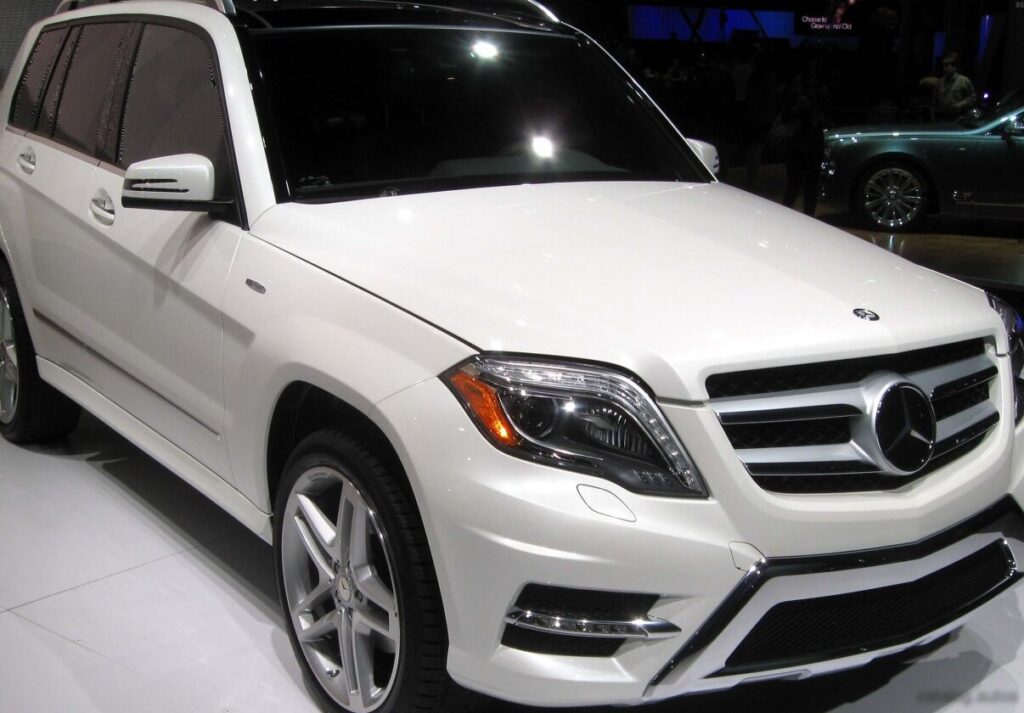
The Mercedes-Benz GLK 350 V6, part of the X204 facelift generation produced from June 2012 to June 2015, represented a significant offering in the entry-level luxury SUV segment. Positioned as the performance-oriented variant within the GLK lineup, it bridged the gap between the base GLK 250 and the eventual GLK 280. This model aimed to deliver a more engaging driving experience while maintaining the practicality and comfort expected of a Mercedes-Benz SUV. The X204 GLK was Mercedes’ attempt to enter the burgeoning compact luxury crossover market, competing with vehicles like the BMW X3 and Audi Q5.
Technical Specifications
| Brand | Mercedes-Benz |
| Model | GLK |
| Generation | GLK (X204, facelift 2012) |
| Type (Engine) | GLK 350 V6 (302 Hp) 7G-TRONIC PLUS |
| Start of production | June, 2012 |
| End of production | June, 2015 |
| Powertrain Architecture | Internal Combustion engine |
| Body type | SUV |
| Seats | 5 |
| Doors | 5 |
| Fuel consumption (economy) – urban (EPA) | 12.4 l/100 km (19 US mpg, 22.8 UK mpg, 8.1 km/l) |
| Fuel consumption (economy) – extra urban (EPA) | 9.4 l/100 km (25 US mpg, 30.1 UK mpg, 10.6 km/l) |
| Fuel consumption (economy) – combined (EPA) | 11.2 l/100 km (21 US mpg, 25.2 UK mpg, 8.9 km/l) |
| Fuel Type | Petrol (Gasoline) |
| Acceleration 0 – 60 mph | 6.5 sec |
| Maximum speed | 210 km/h (130.49 mph) – Electronically limited |
| Power | 302 Hp @ 6500 rpm |
| Power per litre | 86.3 Hp/l |
| Torque | 370 Nm @ 3500-5250 rpm (272.9 lb.-ft. @ 3500-5250 rpm) |
| Maximum engine speed | 6800 rpm |
| Engine layout | Front, Longitudinal |
| Engine Model/Code | M 276.957, M 276.987 |
| Engine displacement | 3498 cm3 (213.46 cu. in.) |
| Number of cylinders | 6 |
| Engine configuration | V-engine |
| Cylinder Bore | 92.9 mm (3.66 in.) |
| Piston Stroke | 86 mm (3.39 in.) |
| Compression ratio | 12:1 |
| Number of valves per cylinder | 4 |
| Fuel injection system | Direct injection |
| Engine aspiration | Naturally aspirated engine |
| Valvetrain | DOHC |
| Engine oil capacity | 6.5 l (6.87 US qt | 5.72 UK qt) |
| Coolant | 9 l (9.51 US qt | 7.92 UK qt) |
| Max. weight | 2420 kg (5335.19 lbs.) |
| Trunk (boot) space – minimum | 450 l (15.89 cu. ft.) |
| Trunk (boot) space – maximum | 1550 l (54.74 cu. ft.) |
| Fuel tank capacity | 66 l (17.44 US gal | 14.52 UK gal) |
| Max. roof load | 75 kg (165.35 lbs.) |
| Permitted trailer load with brakes (12%) | 1588 kg (3500.94 lbs.) |
| Length | 4529 mm (178.31 in.) |
| Width | 1886 mm (74.25 in.) |
| Width including mirrors | 2016 mm (79.37 in.) |
| Height | 1699 mm (66.89 in.) |
| Wheelbase | 2755 mm (108.46 in.) |
| Front track | 1574 mm (61.97 in.) |
| Rear (Back) track | 1597 mm (62.87 in.) |
| Minimum turning circle (turning diameter) | 11.5 m (37.73 ft.) |
| Drivetrain Architecture | The Internal combustion engine (ICE) drives the rear wheels of the vehicle. |
| Drive wheel | Rear wheel drive |
| Number of gears and type of gearbox | 7 gears, automatic transmission G-TRONIC PLUS |
| Front suspension | Independent, type McPherson with coil spring and anti-roll bar |
| Rear suspension | Independent multi-link spring suspension with stabilizer |
| Front brakes | Ventilated discs, 330×32 mm |
| Rear brakes | Ventilated discs, 300×22 mm |
| Assisting systems | ABS (Anti-lock braking system) |
| Steering type | Steering rack and pinion |
| Power steering | Electric Steering |
| Tires size | 235/50 R19 |
| Wheel rims size | 7.5J x 19 |
Powertrain & Engine Architecture
The GLK 350 V6 was powered by the M276 engine family, specifically the 3.5-liter naturally aspirated V6. This engine, designated M 276.957 or M 276.987 depending on minor variations, featured direct fuel injection and a double overhead camshaft (DOHC) valvetrain with four valves per cylinder. The engine produced 302 horsepower at 6500 rpm and 273 lb-ft of torque between 3500 and 5250 rpm. The M276 was known for its smooth operation and relatively high output for a naturally aspirated engine of its size. It utilized a multi-spark ignition system for improved combustion efficiency. Paired with the engine was Mercedes’ 7G-TRONIC PLUS seven-speed automatic transmission. This transmission offered smooth shifts and a wide range of gear ratios, contributing to both performance and fuel economy. The 7G-TRONIC PLUS also featured a manual shift mode for more driver control.
Driving Characteristics
The GLK 350 V6 offered a noticeable step up in performance compared to the base GLK 250. Acceleration from 0 to 60 mph took approximately 6.5 seconds, making it competitive within its class. The 7G-TRONIC PLUS transmission was well-tuned, providing quick and seamless gear changes. While not a sports SUV, the GLK 350 V6 offered a confident and composed driving experience. The rear-wheel-drive configuration contributed to a balanced feel, although all-wheel drive (4MATIC) was a popular option. Compared to a hypothetical GLK with a manual transmission (not offered in this configuration), the automatic provided greater convenience and ease of use, particularly in urban driving. However, some enthusiasts might have preferred the more direct engagement of a manual gearbox.
Equipment & Trim Levels
The GLK 350 V6 typically came standard with features such as leather upholstery, dual-zone automatic climate control, a power liftgate, and a rearview camera. Optional extras included a panoramic sunroof, navigation system, premium sound system, and driver assistance packages featuring blind-spot monitoring and lane-keeping assist. Interior trim options ranged from wood veneers to aluminum accents. The dashboard layout was typical of Mercedes-Benz at the time, with a focus on functionality and a premium feel. The GLK 350 V6 often served as a base for customers who then added various packages to customize their vehicle.
Chassis & Braking
The GLK 350 V6 utilized an independent suspension system at all four wheels. The front suspension employed a McPherson strut design, while the rear featured a multi-link setup. This configuration provided a comfortable ride while maintaining good handling characteristics. Brakes consisted of ventilated discs all around, with larger front rotors (330x32mm) than the rear (300x22mm). Anti-lock braking system (ABS) was standard. The GLK’s chassis was designed to balance ride comfort with handling precision, making it suitable for both daily commuting and longer journeys.
Market Reception & Comparison
The GLK 350 V6 was generally well-received by automotive critics. It was praised for its refined engine, comfortable ride, and upscale interior. However, some reviewers noted that its handling wasn’t as sporty as some of its competitors, such as the BMW X3. Fuel economy was considered average for its class, with combined EPA estimates around 21 mpg. Compared to the GLK 250, the 350 offered a significant performance boost, justifying the higher price tag for buyers prioritizing power. The GLK 350 also offered a more luxurious experience than some of the more basic trims.
Legacy
The M276 engine family, including the 3.5-liter V6 used in the GLK 350, proved to be relatively reliable. While some owners have reported minor issues with oil leaks or sensor failures, these were not widespread. The 7G-TRONIC PLUS transmission also had a good reputation for durability. Today, used GLK 350 V6 models represent a relatively affordable entry point into the Mercedes-Benz luxury SUV market. They are often sought after by buyers who appreciate the combination of performance, comfort, and build quality. Maintenance costs are generally in line with other German luxury vehicles, requiring regular servicing to maintain optimal performance.
