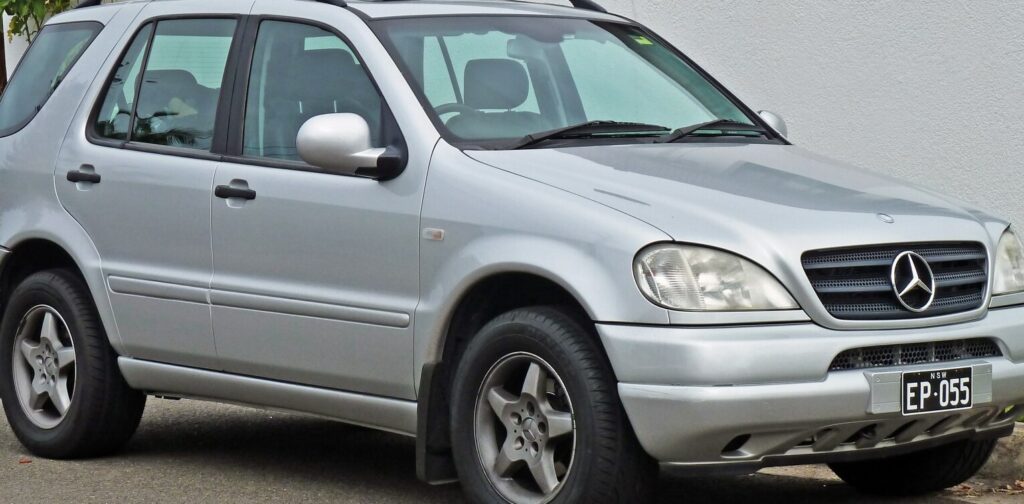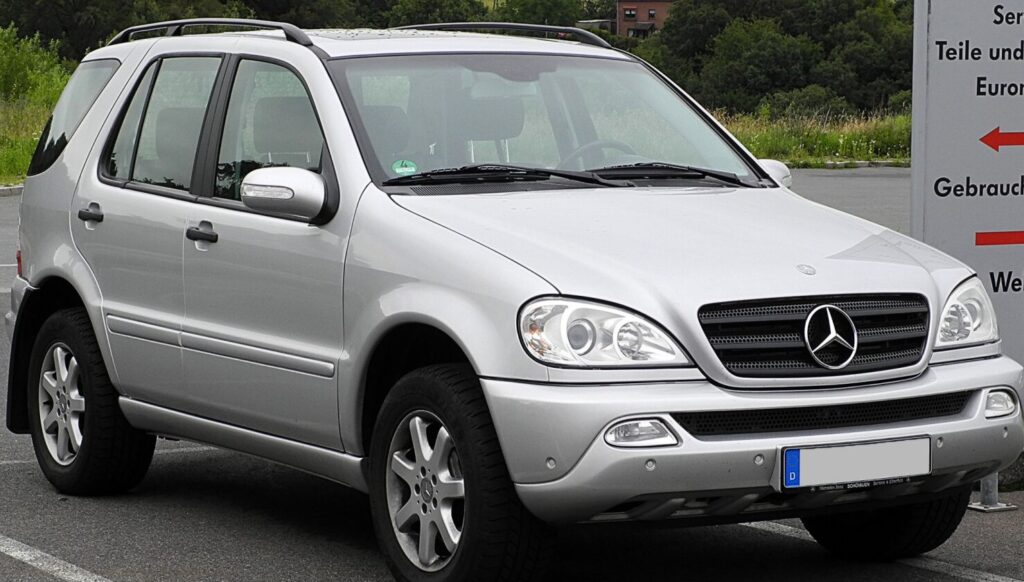
The Mercedes-Benz M-Class (W163) ML 270 CDI 4MATIC, produced from August 2001 to December 2004, represented a key offering in the first generation of Mercedes’ mid-size SUV. Positioned as a more economical and accessible entry point into the M-Class range, the ML 270 CDI utilized a five-cylinder diesel engine paired with a five-speed automatic transmission and the brand’s 4MATIC all-wheel-drive system. This variant aimed to balance the M-Class’s luxury and capability with improved fuel efficiency, appealing to European buyers seeking a practical and refined SUV. It was a significant model in establishing Mercedes-Benz as a competitor in the burgeoning luxury SUV segment.
Technical Specifications
| Brand | Mercedes-Benz |
| Model | M-Class |
| Generation | M-Class (W163, facelift 2001) |
| Type (Engine) | ML 270 CDI (163 Hp) 4MATIC 5G-TRONIC |
| Start of production | August, 2001 |
| End of production | December, 2004 |
| Powertrain Architecture | Internal Combustion engine |
| Body type | SUV |
| Seats | 5 |
| Doors | 5 |
| Fuel consumption (economy) – urban (NEDC) | 12.4 l/100 km (19 US mpg, 22.8 UK mpg, 8.1 km/l) |
| Fuel consumption (economy) – extra urban (NEDC) | 8 l/100 km (29.4 US mpg, 35.3 UK mpg, 12.5 km/l) |
| Fuel consumption (economy) – combined (NEDC) | 9.5 l/100 km (24.8 US mpg, 29.7 UK mpg, 10.5 km/l) |
| CO2 emissions (NEDC) | 250 g/km |
| Fuel Type | Diesel |
| Acceleration 0 – 100 km/h | 11.4 sec |
| Acceleration 0 – 62 mph | 11.4 sec |
| Acceleration 0 – 60 mph | 10.8 sec |
| Maximum speed | 183 km/h (113.71 mph) |
| Emission standard | Euro 3 |
| Weight-to-power ratio | 12.9 kg/Hp, 77.6 Hp/tonne |
| Weight-to-torque ratio | 5.3 kg/Nm, 190.5 Nm/tonne |
| Power | 163 Hp @ 4200 rpm |
| Power per litre | 60.7 Hp/l |
| Torque | 400 Nm @ 1800-2600 rpm (295.02 lb.-ft. @ 1800-2600 rpm) |
| Maximum engine speed | 4600 rpm |
| Engine layout | Front, Longitudinal |
| Engine Model/Code | OM 612.963 |
| Engine displacement | 2685 cm3 (163.85 cu. in.) |
| Number of cylinders | 5 |
| Engine configuration | Inline |
| Cylinder Bore | 88 mm (3.46 in.) |
| Piston Stroke | 88.3 mm (3.48 in.) |
| Compression ratio | 18:1 |
| Number of valves per cylinder | 4 |
| Fuel injection system | Diesel Commonrail |
| Engine aspiration | Turbocharger, Intercooler |
| Valvetrain | DOHC |
| Engine oil capacity | 7.5 l (7.93 US qt, 6.6 UK qt) |
| Coolant | 11 l (11.62 US qt, 9.68 UK qt) |
| Kerb Weight | 2100 kg (4629.71 lbs.) |
| Max. weight | 2870 kg (6327.27 lbs.) |
| Max load | 770 kg (1697.56 lbs.) |
| Trunk (boot) space – minimum | 633 l (22.35 cu. ft.) |
| Trunk (boot) space – maximum | 2020 l (71.34 cu. ft.) |
| Fuel tank capacity | 83 l (21.93 US gal, 18.26 UK gal) |
| Permitted trailer load with brakes (12%) | 3500 kg (7716.18 lbs.) |
| Permitted trailer load without brakes | 750 kg (1653.47 lbs.) |
| Permitted towbar download | 135 kg (297.62 lbs.) |
| Length | 4638 mm (182.6 in.) |
| Width | 1840 mm (72.44 in.) |
| Width including mirrors | 2126 mm (83.7 in.) |
| Height | 1820 mm (71.65 in.) |
| Wheelbase | 2820 mm (111.02 in.) |
| Front track | 1555 mm (61.22 in.) |
| Rear (Back) track | 1555 mm (61.22 in.) |
| Front overhang | 874 mm (34.41 in.) |
| Rear overhang | 944 mm (37.17 in.) |
| Ride height (ground clearance) | 205 mm (8.07 in.) |
| Drag coefficient (Cd) | 0.39 |
| Minimum turning circle (turning diameter) | 11.9 m (39.04 ft.) |
| Approach angle | 30° |
| Departure angle | 30° |
| Climb angle | 38° |
| Wading depth | 500 mm (19.69 in.) |
| Drivetrain Architecture | The Internal combustion engine (ICE) drives permanently the four wheels of the vehicle. |
| Drive wheel | All wheel drive (4×4) |
| Number of gears and type of gearbox | 5 gears, automatic transmission G-TRONIC |
| Front suspension | Coil spring, Double wishbone, Transverse stabilizer |
| Rear suspension | Double wishbone, Transverse stabilizer, Coil spring |
| Front brakes | Ventilated discs |
| Rear brakes | Disc |
| Assisting systems | ABS (Anti-lock braking system) |
| Steering type | Steering rack and pinion |
| Power steering | Hydraulic Steering |
| Tires size | 255/60 R17 |
| Wheel rims size | 8J x 17 |
INTRODUCTION
The Mercedes-Benz W163 M-Class, launched in 1997, was the brand’s first foray into the mid-size SUV market. The facelifted version, introduced in 2001, brought styling updates and mechanical refinements. The ML 270 CDI 4MATIC, produced between 2001 and 2004, was a diesel-powered variant designed to offer a balance of performance, economy, and luxury. It occupied a middle ground in the M-Class lineup, positioned below the more powerful ML 320 and ML 500 models, but above any potential base-level offerings. It was primarily aimed at the European market, where diesel engines were – and continue to be – highly popular.
Powertrain & Engine Architecture
The heart of the ML 270 CDI is the OM 612.963, a 2.7-liter inline five-cylinder diesel engine. This engine was a significant development for Mercedes-Benz, utilizing common rail direct injection technology to improve efficiency and reduce emissions. The common rail system, supplied by Bosch, allowed for precise control of fuel delivery, resulting in smoother operation and increased power output. The engine featured a turbocharger with an intercooler to further enhance performance. The DOHC (Double Overhead Camshaft) valvetrain, with four valves per cylinder, contributed to the engine’s breathing efficiency. The ML 270 CDI was exclusively paired with the 5G-TRONIC automatic transmission, a five-speed unit known for its smooth shifting and adaptability. This transmission was designed to work seamlessly with the engine’s torque characteristics, providing comfortable and efficient cruising.
Driving Characteristics
The ML 270 CDI 4MATIC offered a comfortable and capable driving experience. While not overtly sporty, the 163 horsepower and 400 Nm (295 lb-ft) of torque provided adequate performance for everyday driving and highway cruising. Acceleration from 0-60 mph took around 10.8 seconds, and the top speed was 113.71 mph. The 5G-TRONIC transmission was programmed for smooth shifts, prioritizing comfort over aggressive downshifts. The all-wheel-drive system provided excellent traction in various conditions, making it a capable vehicle for inclement weather or light off-road use. Compared to the more powerful ML 320, the 270 CDI felt less urgent in its acceleration, but the difference was often negligible in real-world driving. The manual transmission options available on other M-Class models were not offered with the 270 CDI, focusing solely on the convenience of the automatic.
Equipment & Trim Levels
The ML 270 CDI 4MATIC came reasonably well-equipped as standard. Typical features included automatic climate control, power windows and locks, a multi-function steering wheel, and a basic audio system. Upholstery was generally cloth, although leather was available as an option. Optional extras included a premium audio system, sunroof, navigation system, and heated seats. The interior design was typical of Mercedes-Benz at the time, emphasizing quality materials and a functional layout. Trim levels were relatively limited, with most customization coming through the selection of optional packages.
Chassis & Braking
The W163 M-Class utilized a robust chassis designed for both on-road comfort and off-road capability. The front suspension featured coil springs and double wishbones with a transverse stabilizer, while the rear suspension employed a similar setup. This configuration provided a comfortable ride and good handling characteristics. The ML 270 CDI was equipped with ventilated disc brakes at the front and solid discs at the rear. Anti-lock braking system (ABS) was standard, enhancing safety and control during braking. The 4MATIC all-wheel-drive system distributed power between the front and rear axles as needed, optimizing traction in various conditions.
Market Reception & Comparison
The ML 270 CDI 4MATIC was generally well-received by automotive critics, particularly in Europe. It was praised for its fuel efficiency, comfortable ride, and spacious interior. However, some reviewers noted that the engine could feel strained when pushed hard, and the overall driving experience lacked the sportiness of some competitors. Compared to the ML 320, the 270 CDI offered significantly better fuel economy, making it a more practical choice for drivers covering long distances. The ML 320, with its larger engine, provided more power but at the expense of fuel efficiency. The ML 500, the range-topping model, offered even more performance but was considerably more expensive.
Legacy
The OM 612 engine family, including the 2.7-liter unit found in the ML 270 CDI, proved to be relatively reliable, although common rail diesel engines can be susceptible to injector issues and fuel system contamination. The 5G-TRONIC transmission is also generally durable, but regular fluid changes are essential for long-term reliability. Today, the ML 270 CDI 4MATIC represents an affordable entry point into Mercedes-Benz ownership. Well-maintained examples are still relatively common on the used car market, offering a blend of luxury, practicality, and all-weather capability. However, potential buyers should be aware of the age-related issues common to older vehicles, such as corrosion and wear and tear on suspension components.