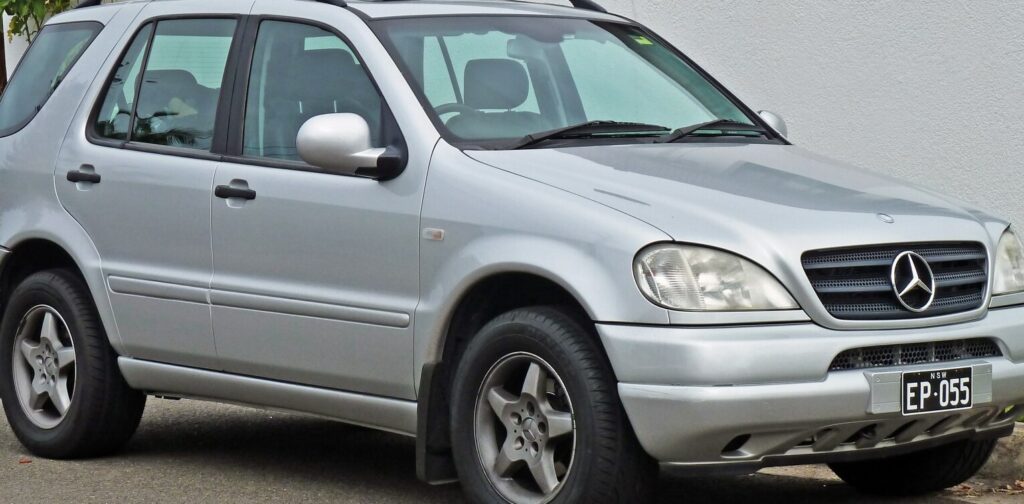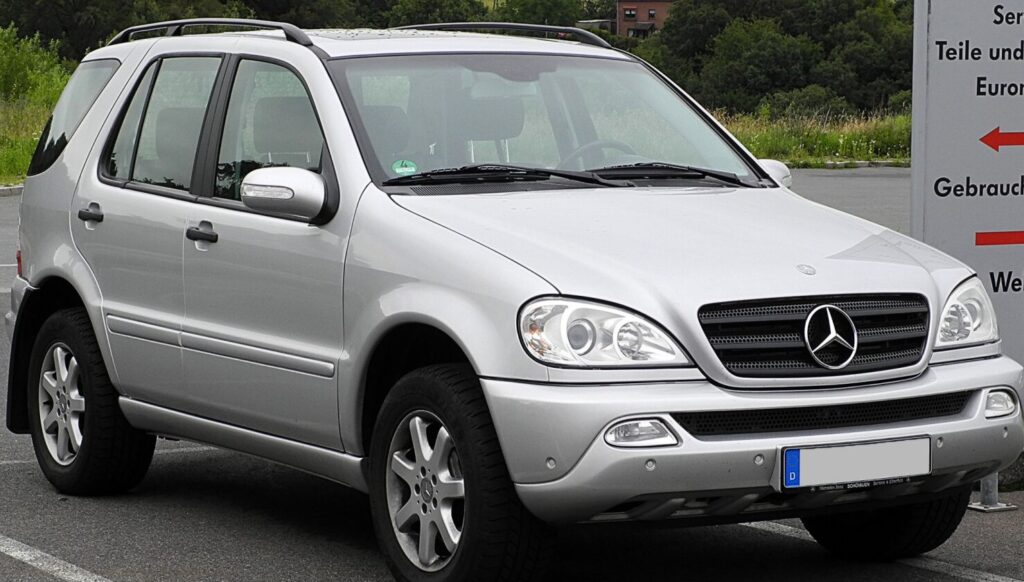
The Mercedes-Benz M-Class (W163), particularly the facelifted version introduced in 2001, represented a pivotal moment for the German automaker. It was Mercedes-Benz’s first foray into the mid-size luxury SUV segment, a market rapidly gaining popularity in the United States and globally. The ML 320 V6 4MATIC, produced from August 2001 to November 2002, occupied a central position within the W163 lineup, offering a balance of performance, luxury, and capability. This variant aimed to appeal to buyers seeking a refined SUV experience with the added security of all-wheel drive, without the higher price tag of the flagship ML 500.
Technical Specifications
| Brand | Mercedes-Benz |
| Model | M-Class |
| Generation | M-Class (W163, facelift 2001) |
| Type (Engine) | ML 320 V6 (218 Hp) 4MATIC 5G-TRONIC |
| Start of production | August, 2001 |
| End of production | November, 2002 |
| Powertrain Architecture | Internal Combustion engine |
| Body type | SUV |
| Seats | 5 |
| Doors | 5 |
| Fuel consumption (urban) | 18.6 l/100 km (12.6 US mpg) |
| Fuel consumption (extra urban) | 10.7 l/100 km (22 US mpg) |
| Fuel consumption (combined) | 13.5 l/100 km (17.4 US mpg) |
| CO2 emissions | 324 g/km |
| Fuel Type | Petrol (Gasoline) |
| Acceleration 0 – 100 km/h | 9 sec |
| Acceleration 0 – 60 mph | 8.6 sec |
| Maximum speed | 195 km/h (121.17 mph) |
| Emission standard | Euro 3 |
| Weight-to-power ratio | 9.6 kg/Hp |
| Weight-to-torque ratio | 6.8 kg/Nm |
| Power | 218 Hp @ 5600 rpm |
| Torque | 310 Nm @ 3000-4800 rpm (228.64 lb.-ft.) |
| Maximum engine speed | 6000 rpm |
| Engine layout | Front, Longitudinal |
| Engine Model/Code | M 112.942 |
| Engine displacement | 3199 cm3 (195.21 cu. in.) |
| Number of cylinders | 6 |
| Engine configuration | V-engine |
| Cylinder Bore | 89.9 mm (3.54 in.) |
| Piston Stroke | 84 mm (3.31 in.) |
| Compression ratio | 10:1 |
| Number of valves per cylinder | 3 |
| Fuel injection system | Multi-port manifold injection |
| Engine aspiration | Naturally aspirated |
| Valvetrain | SOHC |
| Engine oil capacity | 8 l (8.45 US qt | 7.04 UK qt) |
| Coolant capacity | 11 l (11.62 US qt | 9.68 UK qt) |
| Kerb Weight | 2095 kg (4618.68 lbs.) |
| Max. weight | 2870 kg (6327.27 lbs.) |
| Max load | 775 kg (1708.58 lbs.) |
| Trunk (boot) space – minimum | 633 l (22.35 cu. ft.) |
| Trunk (boot) space – maximum | 2020 l (71.34 cu. ft.) |
| Fuel tank capacity | 83 l (21.93 US gal | 18.26 UK gal) |
| Permitted trailer load (braked) | 3500 kg (7716.18 lbs.) |
| Permitted trailer load (unbraked) | 750 kg (1653.47 lbs.) |
| Length | 4638 mm (182.6 in.) |
| Width | 1840 mm (72.44 in.) |
| Width including mirrors | 2126 mm (83.7 in.) |
| Height | 1820 mm (71.65 in.) |
| Wheelbase | 2820 mm (111.02 in.) |
| Front track | 1555 mm (61.22 in.) |
| Rear track | 1555 mm (61.22 in.) |
| Front overhang | 874 mm (34.41 in.) |
| Rear overhang | 944 mm (37.17 in.) |
| Ride height (ground clearance) | 204 mm (8.03 in.) |
| Drag coefficient (Cd) | 0.39 |
| Minimum turning circle | 11.9 m (39.04 ft.) |
| Approach angle | 30° |
| Departure angle | 30° |
| Drivetrain Architecture | All wheel drive (4×4) |
| Number of gears | 5 |
| Gearbox type | Automatic transmission G-TRONIC |
| Front suspension | Coil spring, Double wishbone, Transverse stabilizer |
| Rear suspension | Double wishbone, Transverse stabilizer, Coil spring |
| Front brakes | Ventilated discs |
| Rear brakes | Disc |
Powertrain & Engine Architecture
The ML 320 4MATIC was powered by the M112.942 3.2-liter V6 engine. This engine, a naturally aspirated powerplant, featured a 60-degree V-angle and utilized a single overhead camshaft (SOHC) design per cylinder bank. The M112 engine family was known for its smooth operation and relatively high specific output. Fuel delivery was handled by a multi-port fuel injection system, providing precise fuel metering for optimal combustion. The engine produced 218 horsepower at 5600 rpm and 310 Nm (228.64 lb-ft) of torque between 3000 and 4800 rpm. This power was channeled through a five-speed 5G-TRONIC automatic transmission, a sophisticated unit for its time, offering smooth shifts and adaptive shift programming. The 5G-TRONIC transmission was designed to balance fuel efficiency with performance, adjusting shift points based on driving style and conditions.
Driving Characteristics
The ML 320 Automatic offered a comfortable and capable driving experience. While not overtly sporty, the 3.2-liter V6 provided adequate power for everyday driving and highway cruising. Acceleration from 0-60 mph took approximately 8.6 seconds, and top speed was limited to 195 km/h (121.17 mph). The automatic transmission, while smooth, did contribute to a slight reduction in responsiveness compared to the available manual transmission. The 5G-TRONIC’s gear ratios were tuned for a balance of acceleration and fuel economy, with a relatively tall final drive. The 4MATIC all-wheel-drive system provided enhanced traction in various weather conditions, making the ML 320 a confident performer on slippery surfaces. However, the vehicle’s weight (over 2000 kg) was noticeable, particularly during spirited driving or when fully loaded.
Equipment & Trim Levels
The ML 320 4MATIC came standard with a respectable array of features, including automatic climate control, power windows and locks, a premium audio system, and leather upholstery. Safety features included ABS brakes, traction control, and multiple airbags. Optional extras included a sunroof, navigation system, heated seats, and upgraded audio options. The interior design was typical of Mercedes-Benz at the time, emphasizing luxury and comfort. The dashboard layout was straightforward and functional, with easy-to-read gauges and intuitive controls. The ML 320’s trim level generally fell in the mid-range of the M-Class lineup, offering a step up in features and refinement compared to the base ML 230, but lacking some of the more exclusive options available on the ML 500.
Chassis & Braking
The W163 M-Class featured an independent suspension system all around, utilizing coil springs, double wishbones, and transverse stabilizers. This setup provided a comfortable ride and good handling characteristics. The front suspension geometry was designed to minimize body roll during cornering, while the rear suspension focused on maintaining stability. Braking duties were handled by ventilated discs at the front and solid discs at the rear. The ABS anti-lock braking system helped to maintain control during emergency braking situations. The steering system was a hydraulic power-assisted rack and pinion setup, providing precise steering feel and responsiveness.
Market Reception & Comparison
The ML 320 4MATIC was generally well-received by automotive critics. It was praised for its comfortable ride, spacious interior, and capable all-wheel-drive system. However, some reviewers noted the vehicle’s relatively high fuel consumption and its somewhat ponderous handling. Compared to the ML 230, the ML 320 offered a significant performance boost, making it a more enjoyable driving experience. In contrast to the range-topping ML 500, the ML 320 provided a more sensible balance of performance and price. The ML 320’s fuel economy, while not exceptional, was better than that of the ML 500’s V8 engine. Reliability was generally good, although some owners reported issues with the automatic transmission and various electronic components.
Legacy
The Mercedes-Benz M-Class (W163) ML 320 4MATIC holds a significant place in automotive history as a pioneering luxury SUV. While later iterations of the M-Class (and subsequent GLE models) have surpassed it in terms of technology and refinement, the W163 remains a popular choice among enthusiasts and collectors. The M112 engine, in particular, is regarded as a durable and reliable powerplant. Today, well-maintained examples of the ML 320 4MATIC can be found on the used car market, offering a relatively affordable entry point into the world of Mercedes-Benz luxury. However, potential buyers should be aware of potential maintenance issues associated with older vehicles, such as worn suspension components and potential transmission problems. Overall, the ML 320 4MATIC represents a solid and capable SUV that continues to offer a comfortable and rewarding driving experience.