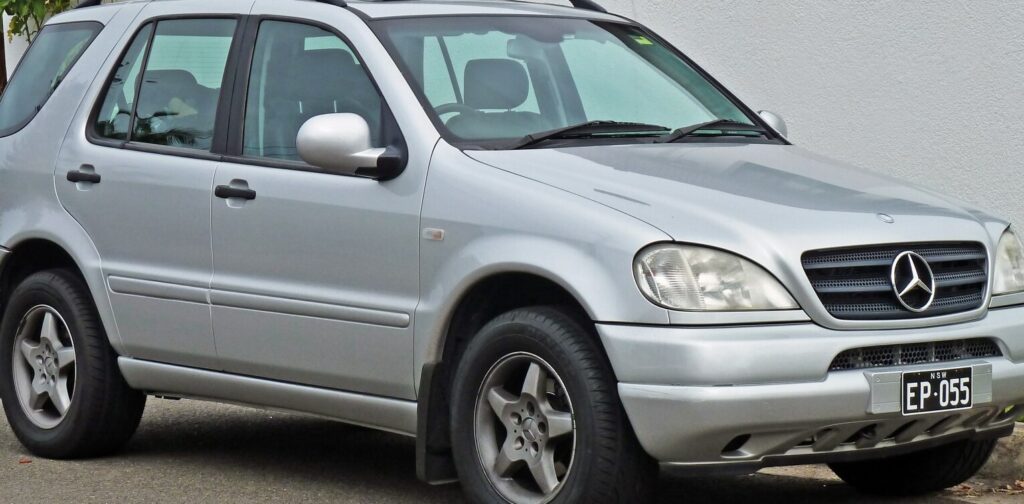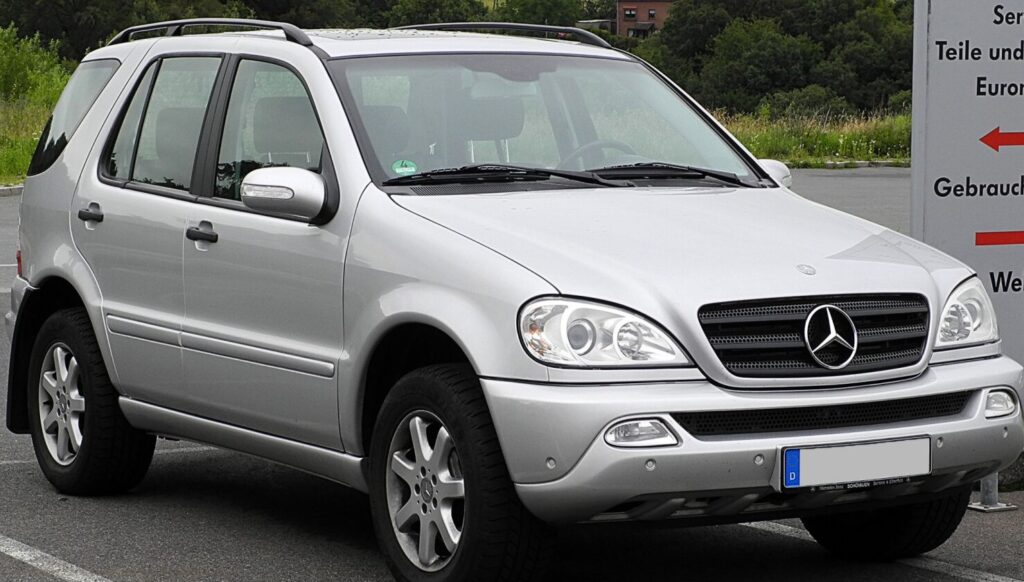
The Mercedes-Benz M-Class (W163), particularly the facelifted version introduced in 2001, represented a pivotal moment for the German automaker. It was Mercedes-Benz’s first foray into the mid-size luxury SUV segment, aiming to capture market share from established players like the Jeep Grand Cherokee and the BMW X5. Production of the ML 400 CDI V8 4MATIC, equipped with the 5G-TRONIC automatic transmission, spanned from 2002 to 2005. This variant occupied the upper echelon of the W163 lineup, offering a blend of performance, luxury, and off-road capability, though at a significant price point and with notable fuel consumption. It was positioned as the flagship diesel offering, appealing to buyers prioritizing torque and long-distance cruising over outright fuel efficiency.
Technical Specifications
| Brand | Mercedes-Benz |
| Model | M-Class |
| Generation | M-Class (W163, facelift 2001) |
| Type (Engine) | ML 400 CDI V8 (250 Hp) 4MATIC 5G-TRONIC |
| Start of production | 2002 |
| End of production | 2005 |
| Powertrain Architecture | Internal Combustion engine |
| Body type | SUV |
| Seats | 5 |
| Doors | 5 |
| Fuel consumption (economy) – urban (NEDC) | 14.7 l/100 km (16 US mpg, 19.2 UK mpg, 6.8 km/l) |
| Fuel consumption (economy) – extra urban (NEDC) | 8.8 l/100 km (26.7 US mpg, 32.1 UK mpg, 11.4 km/l) |
| Fuel consumption (economy) – combined (NEDC) | 10.9 l/100 km (21.6 US mpg, 25.9 UK mpg, 9.2 km/l) |
| CO2 emissions (NEDC) | 288 g/km |
| Fuel Type | Diesel |
| Acceleration 0 – 100 km/h | 8.1 sec |
| Acceleration 0 – 62 mph | 8.1 sec |
| Acceleration 0 – 60 mph | 7.7 sec |
| Maximum speed | 213 km/h (132.35 mph) |
| Emission standard | Euro 3 |
| Weight-to-power ratio | 9 kg/Hp, 110.6 Hp/tonne |
| Weight-to-torque ratio | 4 kg/Nm, 247.8 Nm/tonne |
| Power | 250 Hp @ 4000 rpm |
| Power per litre | 62.6 Hp/l |
| Torque | 560 Nm @ 1700-2600 rpm (413.03 lb.-ft. @ 1700-2600 rpm) |
| Maximum engine speed | 4600 rpm |
| Engine layout | Front, Longitudinal |
| Engine Model/Code | OM 628.963 |
| Engine displacement | 3996 cm3 (243.85 cu. in.) |
| Number of cylinders | 8 |
| Engine configuration | V-engine |
| Cylinder Bore | 86 mm (3.39 in.) |
| Piston Stroke | 86 mm (3.39 in.) |
| Compression ratio | 18.5:1 |
| Number of valves per cylinder | 4 |
| Fuel injection system | Diesel Commonrail |
| Engine aspiration | BiTurbo, Intercooler |
| Valvetrain | DOHC |
| Engine oil capacity | 10 l (10.57 US qt, 8.8 UK qt) |
| Coolant | 12 l (12.68 US qt, 10.56 UK qt) |
| Kerb Weight | 2260 kg (4982.45 lbs.) |
| Max. weight | 2870 kg (6327.27 lbs.) |
| Max load | 610 kg (1344.82 lbs.) |
| Trunk (boot) space – minimum | 633 l (22.35 cu. ft.) |
| Trunk (boot) space – maximum | 2020 l (71.34 cu. ft.) |
| Fuel tank capacity | 83 l (21.93 US gal, 18.26 UK gal) |
| Permitted trailer load with brakes (12%) | 3500 kg (7716.18 lbs.) |
| Permitted trailer load without brakes | 750 kg (1653.47 lbs.) |
| Permitted towbar download | 135 kg (297.62 lbs.) |
| Length | 4638 mm (182.6 in.) |
| Width | 1840 mm (72.44 in.) |
| Width including mirrors | 2126 mm (83.7 in.) |
| Height | 1820 mm (71.65 in.) |
| Wheelbase | 2820 mm (111.02 in.) |
| Front track | 1555 mm (61.22 in.) |
| Rear (Back) track | 1555 mm (61.22 in.) |
| Front overhang | 874 mm (34.41 in.) |
| Rear overhang | 944 mm (37.17 in.) |
| Ride height (ground clearance) | 204 mm (8.03 in.) |
| Drag coefficient (Cd) | 0.39 |
| Minimum turning circle (turning diameter) | 11.9 m (39.04 ft.) |
| Approach angle | 30° |
| Departure angle | 30° |
| Climb angle | 31° |
| Wading depth | 500 mm (19.69 in.) |
| Drivetrain Architecture | The Internal combustion engine (ICE) drives permanently the four wheels of the vehicle. |
| Drive wheel | All wheel drive (4×4) |
| Number of gears and type of gearbox | 5 gears, automatic transmission G-TRONIC |
| Front suspension | Double wishbone, Transverse stabilizer |
| Rear suspension | Double wishbone, Transverse stabilizer |
| Front brakes | Ventilated discs |
| Rear brakes | Disc |
| Assisting systems | ABS (Anti-lock braking system) |
| Steering type | Steering rack and pinion |
| Power steering | Hydraulic Steering |
| Tires size | 275/55 R17 |
| Wheel rims size | 8.5J x 17 |
Powertrain & Engine Architecture
The heart of the ML 400 CDI was the OM 628.963, a 4.0-liter V8 diesel engine. This engine utilized a sophisticated common rail direct injection system, delivering fuel at extremely high pressures for optimized combustion. Crucially, it employed twin turbochargers with an intercooler, boosting power and mitigating turbo lag. The engine featured a double overhead camshaft (DOHC) valvetrain with four valves per cylinder, contributing to its strong performance across the rev range. The high compression ratio of 18.5:1 was typical for diesel engines of the era, maximizing efficiency. Paired with the engine was the 5G-TRONIC automatic transmission, a five-speed unit known for its smooth shifts and adaptability. This transmission was electronically controlled, offering selectable driving modes for comfort or performance.
Driving Characteristics
The ML 400 CDI offered a distinctly different driving experience compared to its gasoline-powered siblings. The substantial 560 Nm (413 lb-ft) of torque, available from a low 1700 rpm, provided effortless acceleration and strong pulling power, particularly useful for towing. While the 0-60 mph time of around 7.7 seconds was respectable for an SUV of its size, the focus wasn’t on outright speed but on relaxed, confident cruising. The 5G-TRONIC transmission, while smooth, wasn’t as quick to downshift as more modern gearboxes. Compared to the ML 500 with its V8 gasoline engine, the 400 CDI lacked the high-end power but offered significantly better fuel economy and a more manageable power delivery. The manual transmission options available on other M-Class models provided a more engaging driving experience, but the automatic was favored by buyers prioritizing comfort and ease of use.
Equipment & Trim Levels
The ML 400 CDI typically came well-equipped, reflecting its position as a premium model. Standard features included leather upholstery, automatic climate control, power-adjustable front seats with memory function, a premium sound system, and alloy wheels. The exterior featured chrome accents and distinctive badging. Optional extras included a sunroof, navigation system, upgraded audio, and parking sensors. Interior trim options allowed for some personalization, with choices in wood veneers and leather colors. The overall interior ambiance was luxurious and well-appointed, typical of Mercedes-Benz vehicles of the period.
Chassis & Braking
The W163 M-Class featured a robust chassis designed for both on-road comfort and off-road capability. It utilized a fully independent suspension system with double wishbones at both the front and rear, incorporating transverse stabilizers to reduce body roll. The 4MATIC all-wheel-drive system provided excellent traction in various conditions. Braking duties were handled by ventilated discs at the front and solid discs at the rear, assisted by an Anti-lock Braking System (ABS). The suspension was tuned to provide a comfortable ride, but it could feel somewhat soft and wallowy during aggressive cornering compared to more sport-oriented SUVs.
Market Reception & Comparison
The ML 400 CDI was generally well-received by automotive critics, who praised its powerful engine, comfortable ride, and luxurious interior. However, its high price and relatively poor fuel economy (compared to smaller diesel SUVs) were noted drawbacks. Compared to the ML 500, the 400 CDI offered a more practical and economical option for buyers who didn’t require the ultimate in performance. Against competitors like the BMW X5 and the Porsche Cayenne, the ML 400 CDI offered a more traditional luxury experience, prioritizing comfort and refinement over sporty handling.
Legacy
The OM 628 engine, while robust, is known to require diligent maintenance, particularly regarding the fuel injection system and turbochargers. Finding qualified mechanics familiar with these systems can be challenging today. The 5G-TRONIC transmission is generally reliable but can exhibit issues with valve body wear over time. Despite these potential maintenance concerns, the ML 400 CDI remains a desirable vehicle in the used car market, particularly among those seeking a capable and luxurious diesel SUV. Its unique combination of power, comfort, and all-wheel-drive capability continues to appeal to enthusiasts and buyers looking for a distinctive vehicle.