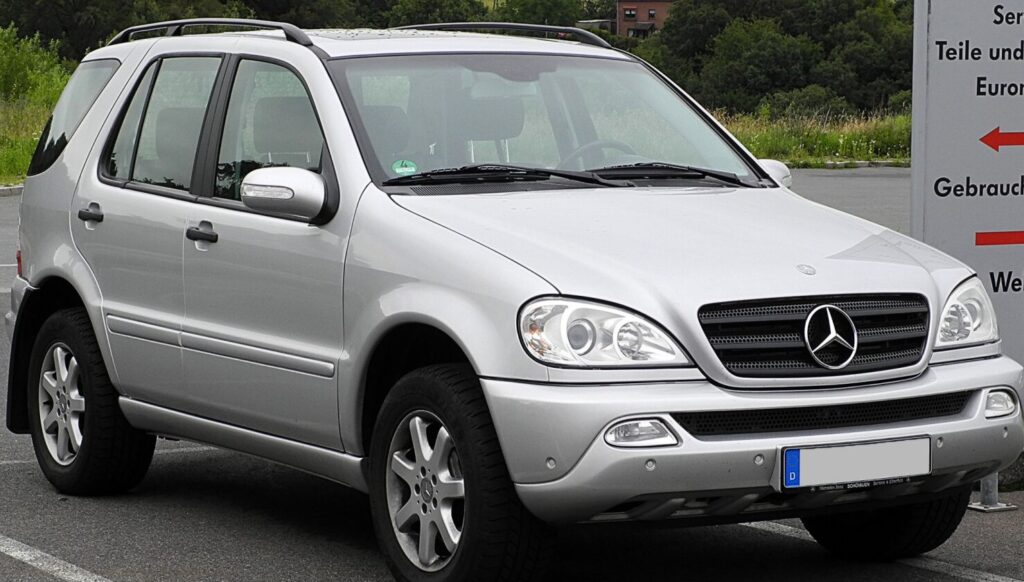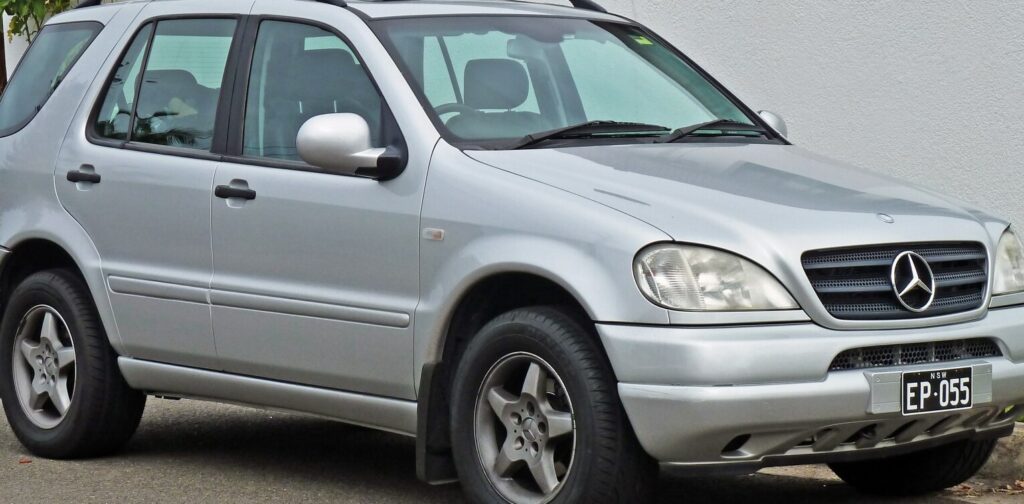
The Mercedes-Benz M-Class (W163) ML 320 V6 4MATIC, produced from 1997 to 2001, represented a pivotal moment for the German automaker. It was Mercedes-Benz’s first foray into the mid-size SUV segment, designed to compete with established American and Japanese offerings like the Jeep Grand Cherokee and Toyota 4Runner. Built on the W163 platform, the ML 320 aimed to deliver a blend of luxury, performance, and all-weather capability, appealing to a growing market segment seeking a more refined SUV experience. This particular variant, equipped with the M112 V6 engine and a 5G-TRONIC automatic transmission, occupied a middle ground in the M-Class lineup, offering a balance between price, power, and fuel efficiency.
Technical Specifications
| Brand | Mercedes-Benz |
| Model | M-Class |
| Generation | M-Class (W163) |
| Type | ML 320 V6 (218 Hp) 4MATIC 5G-TRONIC |
| Start of production | 1997 |
| End of production | 2001 |
| Powertrain Architecture | Internal Combustion engine |
| Body type | SUV |
| Seats | 5 |
| Doors | 5 |
| Fuel consumption (urban) | 18.2 l/100 km (12.9 US mpg, 15.5 UK mpg, 5.5 km/l) |
| Fuel consumption (extra urban) | 11.2 l/100 km (21 US mpg, 25.2 UK mpg, 8.9 km/l) |
| Fuel consumption (combined) | 13.8 l/100 km (17 US mpg, 20.5 UK mpg, 7.2 km/l) |
| Fuel Type | Petrol (Gasoline) |
| Acceleration 0 – 100 km/h | 9.5 sec |
| Acceleration 0 – 62 mph | 9.5 sec |
| Acceleration 0 – 60 mph | 9 sec |
| Maximum speed | 195 km/h (121.17 mph) |
| Emission standard | Euro 3 |
| Weight-to-power ratio | 9.1 kg/Hp, 109.5 Hp/tonne |
| Weight-to-torque ratio | 6.4 kg/Nm, 155.8 Nm/tonne |
| Power | 218 Hp @ 5600 rpm |
| Power per litre | 68.1 Hp/l |
| Torque | 310 Nm @ 3000 rpm (228.64 lb.-ft. @ 3000 rpm) |
| Engine layout | Front, Longitudinal |
| Engine Model/Code | M 112.942 |
| Engine displacement | 3199 cm3 (195.21 cu. in.) |
| Number of cylinders | 6 |
| Engine configuration | V-engine |
| Cylinder Bore | 89.9 mm (3.54 in.) |
| Piston Stroke | 84 mm (3.31 in.) |
| Compression ratio | 10:1 |
| Number of valves per cylinder | 3 |
| Fuel injection system | Multi-port manifold injection |
| Engine aspiration | Naturally aspirated engine |
| Valvetrain | OHC |
| Engine oil capacity | 8 l (8.45 US qt | 7.04 UK qt) |
| Coolant | 11 l (11.62 US qt | 9.68 UK qt) |
| Kerb Weight | 1990 kg (4387.2 lbs.) |
| Max. weight | 2750 kg (6062.71 lbs.) |
| Max load | 760 kg (1675.51 lbs.) |
| Trunk (boot) space – minimum | 633 l (22.35 cu. ft.) |
| Trunk (boot) space – maximum | 2020 l (71.34 cu. ft.) |
| Fuel tank capacity | 83 l (21.93 US gal | 18.26 UK gal) |
| Length | 4587 mm (180.59 in.) |
| Width | 1833 mm (72.17 in.) |
| Height | 1820 mm (71.65 in.) |
| Wheelbase | 2820 mm (111.02 in.) |
| Front track | 1565 mm (61.61 in.) |
| Rear (Back) track | 1565 mm (61.61 in.) |
| Drag coefficient (Cd) | 0.39 |
| Drive wheel | All wheel drive (4×4) |
| Number of gears and type of gearbox | 5 gears, automatic transmission |
| Front suspension | Double wishbone |
| Rear suspension | Double wishbone |
| Front brakes | Disc |
| Rear brakes | Disc |
| Assisting systems | ABS (Anti-lock braking system) |
| Steering type | Steering rack and pinion |
| Power steering | Hydraulic Steering |
| Tires size | 225/75 R16 |
| Wheel rims size | 6.5J |
INTRODUCTION
The W163 M-Class, and specifically the ML 320 variant, was a significant departure for Mercedes-Benz. Prior to its introduction, the brand was largely associated with sedans and coupes. The ML 320, produced between 1997 and 2001, aimed to capture a share of the burgeoning SUV market. It featured a unibody construction, a relatively sophisticated independent suspension, and a luxurious interior, setting it apart from more rugged, body-on-frame SUVs of the era. The ML 320 4MATIC, with its full-time all-wheel-drive system, was particularly well-suited to climates with inclement weather, enhancing its appeal in regions like the Northeastern United States and parts of Europe.
Powertrain & Engine Architecture
The heart of the ML 320 is the M112.942 3.2-liter V6 engine. This engine, part of Mercedes-Benz’s new V-engine family, featured all-aluminum construction, three valves per cylinder, and a double overhead camshaft (DOHC) design. It utilized a multi-port fuel injection system, delivering fuel directly into the intake ports. The engine produced 218 horsepower at 5600 rpm and 310 Nm (228.64 lb-ft) of torque at 3000 rpm. Paired with the engine was the 5G-TRONIC automatic transmission, a five-speed unit known for its smooth shifting and adaptability. The transmission was electronically controlled, optimizing gear selection based on driving conditions and throttle input. The engine code, M112.942, is crucial for identifying specific parts and maintenance requirements.
Driving Characteristics
The ML 320 4MATIC offered a comfortable and composed driving experience. While not a performance-oriented SUV, the 3.2-liter V6 provided adequate power for everyday driving and highway cruising. Acceleration from 0 to 60 mph took approximately 9 seconds, and the top speed was limited to 195 km/h (121.17 mph). The 5G-TRONIC transmission contributed to a refined driving experience, with smooth and almost imperceptible gear changes. Compared to the base ML 230 Kompressor, the ML 320 offered noticeably more power and torque, resulting in improved acceleration and towing capacity. However, it lacked the sporty character of the later ML 430 and ML 55 AMG models. The all-wheel-drive system provided excellent traction in various conditions, enhancing stability and control.
Equipment & Trim Levels
The ML 320 came standard with a respectable array of features, including automatic climate control, power windows and locks, a premium sound system, and leather upholstery. Safety features included ABS brakes, traction control, and multiple airbags. Optional extras included a sunroof, heated seats, a navigation system, and upgraded audio options. The interior design was typical of Mercedes-Benz at the time, emphasizing luxury and comfort. The dashboard layout was straightforward and functional, with easy-to-read gauges and intuitive controls. Trim levels were relatively limited, with most customization options available through individual selections.
Chassis & Braking
The W163 M-Class featured a fully independent suspension system, with double wishbones at both the front and rear. This setup provided a comfortable ride and good handling characteristics. The ML 320 was equipped with disc brakes on all four wheels, providing ample stopping power. The ABS (Anti-lock Braking System) helped to maintain control during emergency braking situations. Stabilizer bars were fitted to both the front and rear axles to reduce body roll during cornering. The suspension was tuned to prioritize comfort over outright sportiness, making it well-suited for long-distance driving.
Market Reception & Comparison
The M-Class was generally well-received by critics, who praised its luxurious interior, comfortable ride, and capable all-wheel-drive system. However, some reviewers noted its relatively high price and somewhat lackluster fuel economy. The ML 320, in particular, was seen as a good compromise between performance and affordability. Compared to the ML 230 Kompressor, the ML 320 offered a significant power boost, making it a more enjoyable vehicle to drive. However, the ML 320’s fuel consumption was higher than that of the supercharged four-cylinder engine. Against competitors like the Jeep Grand Cherokee and BMW X5, the M-Class offered a more refined and luxurious experience, but often at a higher price point.
Legacy
The W163 M-Class paved the way for Mercedes-Benz’s successful expansion into the SUV market. While early models experienced some reliability issues, particularly with the automatic transmission and electrical systems, the M112 V6 engine proved to be relatively durable. Today, well-maintained ML 320s can still be found on the used car market, offering a relatively affordable entry point into Mercedes-Benz ownership. The 5G-TRONIC transmission, while generally reliable, may require occasional servicing. Overall, the ML 320 remains a popular choice for those seeking a comfortable, capable, and relatively luxurious SUV from the late 1990s and early 2000s.