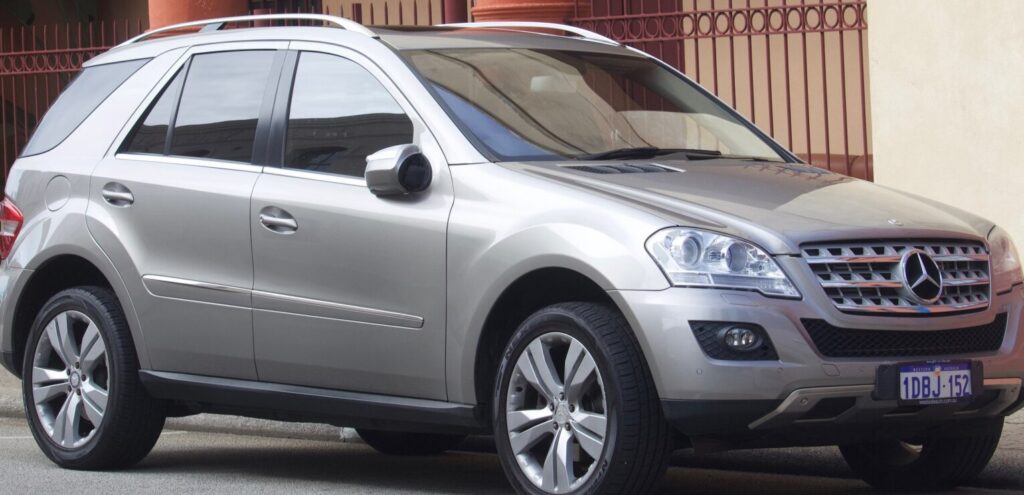
The Mercedes-Benz M-Class (W164), particularly the facelifted version introduced in 2008, represented a significant step forward for the German automaker in the burgeoning mid-size luxury SUV segment. The ML 350 CDI 4MATIC, produced from February 2010 to July 2011, was a key variant, offering a blend of diesel efficiency, respectable performance, and the all-weather capability of Mercedes-Benz’s 4MATIC all-wheel-drive system. This model sat within the W164 range, positioned as a strong contender against rivals like the BMW X5 and Audi Q7, appealing to buyers seeking a practical yet luxurious SUV. It was a crucial model for Mercedes-Benz in Europe and increasingly in North America, where diesel SUVs were gaining traction.
Technical Specifications
| Brand | Mercedes-Benz |
| Model | M-Class |
| Generation | M-Class (W164, facelift 2008) |
| Type (Engine) | ML 350 CDI V6 (231 Hp) 4MATIC 7G-TRONIC |
| Start of production | February, 2010 |
| End of production | July, 2011 |
| Powertrain Architecture | Internal Combustion engine |
| Body type | SUV |
| Seats | 5 |
| Doors | 5 |
| Fuel consumption (urban) | 11.1-11.6 l/100 km (21.2 – 20.3 US mpg) |
| Fuel consumption (extra urban) | 7.6-8.1 l/100 km (30.9 – 29 US mpg) |
| Fuel consumption (combined) | 8.9-9.4 l/100 km (26.4 – 25 US mpg) |
| CO2 emissions | 235-246 g/km |
| Fuel Type | Diesel |
| Acceleration 0 – 100 km/h | 7.6 sec |
| Acceleration 0 – 62 mph | 7.6 sec |
| Acceleration 0 – 60 mph | 7.2 sec |
| Maximum speed | 220 km/h (136.7 mph) |
| Emission standard | Euro 5 |
| Weight-to-power ratio | 9.1 kg/Hp |
| Weight-to-torque ratio | 3.9 kg/Nm |
| Power | 231 Hp @ 3800 rpm |
| Torque | 540 Nm @ 1600-2400 rpm (398.28 lb.-ft. @ 1600-2400 rpm) |
| Engine layout | Front, Longitudinal |
| Engine Model/Code | OM 642.820 |
| Engine displacement | 2987 cm3 (182.28 cu. in.) |
| Number of cylinders | 6 |
| Engine configuration | V-engine |
| Cylinder Bore | 83 mm (3.27 in.) |
| Piston Stroke | 92 mm (3.62 in.) |
| Compression ratio | 17.7:1 |
| Number of valves per cylinder | 4 |
| Fuel injection system | Diesel Commonrail |
| Engine aspiration | Turbocharger, Intercooler |
| Valvetrain | DOHC |
| Engine oil capacity | 8.5 l (8.98 US qt | 7.48 UK qt) |
| Coolant | 9.5 l (10.04 US qt | 8.36 UK qt) |
| Kerb Weight | 2110 kg (4651.75 lbs.) |
| Max. weight | 2910 kg (6415.45 lbs.) |
| Max load | 800 kg (1763.7 lbs.) |
| Trunk (boot) space – minimum | 833 l (29.42 cu. ft.) |
| Trunk (boot) space – maximum | 2050 l (72.4 cu. ft.) |
| Fuel tank capacity | 95 l (25.1 US gal | 20.9 UK gal) |
| Max. roof load | 100 kg (220.46 lbs.) |
| Permitted trailer load with brakes (12%) | 3500 kg (7716.18 lbs.) |
| Permitted trailer load without brakes | 750 kg (1653.47 lbs.) |
| Length | 4781 mm (188.23 in.) |
| Width | 1911 mm (75.24 in.) |
| Width including mirrors | 2170 mm (85.43 in.) |
| Height | 1815 mm (71.46 in.) |
| Wheelbase | 2915 mm (114.76 in.) |
| Front track | 1627 mm (64.06 in.) |
| Rear track | 1629 mm (64.13 in.) |
| Front overhang | 866 mm (34.09 in.) |
| Rear overhang | 1000 mm (39.37 in.) |
| Ride height (ground clearance) | 210 mm (8.27 in.) |
| Drag coefficient (Cd) | 0.34 |
| Minimum turning circle | 11.6 m (38.06 ft.) |
| Approach angle | 27° |
| Departure angle | 26° |
| Ramp-over angle | 17° |
| Climb angle | 45° |
| Wading depth | 500 mm (19.69 in.) |
| Drivetrain Architecture | All wheel drive (4×4). Internal Combustion engine. |
| Number of gears and type of gearbox | 7 gears, automatic transmission G-TRONIC |
| Front suspension | Double wishbone, Transverse stabilizer |
| Rear suspension | Independent multi-link suspension, Transverse stabilizer |
| Front brakes | Ventilated discs |
| Rear brakes | Disc |
INTRODUCTION
The ML 350 CDI 4MATIC, part of the W164 M-Class facelift, was introduced to address the growing demand for a fuel-efficient yet capable luxury SUV. The W164 generation, launched in 2005, received a significant refresh in 2008, incorporating updated styling, improved interior materials, and enhanced technology. The ML 350 CDI, powered by the OM 642.820 V6 diesel engine, became a popular choice, particularly in Europe, where diesel engines dominated the SUV market. It offered a compelling alternative to gasoline-powered models, providing superior fuel economy and strong low-end torque. The 7G-TRONIC automatic transmission further enhanced the driving experience, offering smooth and efficient gear changes.
Powertrain & Engine Architecture
At the heart of the ML 350 CDI lies the OM 642.820 3.0-liter V6 diesel engine. This engine is a robust and well-regarded unit, known for its durability and refinement. It features a common rail direct injection system, delivering fuel at extremely high pressure for optimized combustion. The engine also incorporates a variable geometry turbocharger (VGT) and an intercooler, boosting power and torque. The V6 configuration provides inherent smoothness, while the diesel engine’s high compression ratio (17.7:1) contributes to its efficiency. The 7G-TRONIC automatic transmission, a seven-speed unit, was a key component of the ML 350 CDI’s appeal. It offered a wide range of gear ratios, allowing the engine to operate in its optimal power band for both acceleration and fuel economy. The transmission featured a torque converter lock-up clutch, further improving efficiency at cruising speeds.
Driving Characteristics
The ML 350 CDI 4MATIC delivered a refined and comfortable driving experience. The 231 horsepower and 540 Nm (398 lb-ft) of torque provided ample power for everyday driving and effortless highway cruising. While not a sports SUV, the ML 350 CDI offered respectable acceleration, achieving 0-60 mph in around 7.2 seconds. The 7G-TRONIC transmission contributed to smooth and seamless gear changes, enhancing the overall driving experience. The 4MATIC all-wheel-drive system provided excellent traction in all weather conditions, making it a capable vehicle for both on-road and light off-road use. Compared to the higher-output ML 500 with its V8 engine, the ML 350 CDI prioritized fuel efficiency and torque over outright horsepower. It also offered a more relaxed and refined driving experience compared to the sportier handling of some of its competitors.
Equipment & Trim Levels
The ML 350 CDI 4MATIC came well-equipped as standard. Typical features included leather upholstery, dual-zone automatic climate control, a premium audio system, power-adjustable front seats with memory function, and a sunroof. Safety features were also comprehensive, including ABS, ESP, multiple airbags, and traction control. Optional extras included navigation system, rear-seat entertainment system, parking assist, and upgraded interior trim options. The interior design was typical of Mercedes-Benz, emphasizing luxury and comfort with high-quality materials and a well-laid-out dashboard.
Chassis & Braking
The W164 M-Class featured a robust chassis designed to provide a comfortable ride and good handling. The front suspension utilized a double wishbone setup with a transverse stabilizer, while the rear suspension employed an independent multi-link design, also with a stabilizer bar. This configuration helped to minimize body roll and provide a stable and controlled ride. The ML 350 CDI was equipped with ventilated disc brakes at the front and solid discs at the rear. ABS (Anti-lock Braking System) and ESP (Electronic Stability Program) were standard, enhancing braking performance and stability.
Market Reception & Comparison
The ML 350 CDI 4MATIC was generally well-received by automotive critics. It was praised for its fuel efficiency, strong torque, comfortable ride, and luxurious interior. However, some critics noted that its acceleration was not as brisk as some of its competitors. Compared to the ML 320 CDI, the ML 350 CDI offered a modest power increase. Against the gasoline-powered ML 350, the CDI variant offered significantly better fuel economy, making it a more practical choice for drivers covering long distances. The ML 350 CDI’s fuel economy figures of around 26.4-25 US mpg combined were competitive within its class.
Legacy
The OM 642.820 engine, found in the ML 350 CDI, has proven to be a durable and reliable powerplant when properly maintained. These engines are known to be capable of high mileage. On the used car market, the W164 ML 350 CDI 4MATIC remains a popular choice, offering a good balance of luxury, capability, and fuel efficiency. However, potential buyers should be aware of the potential for diesel particulate filter (DPF) issues, particularly on vehicles that have primarily been used for short trips. Regular maintenance, including oil changes and DPF regeneration, is crucial for ensuring the long-term reliability of this vehicle.