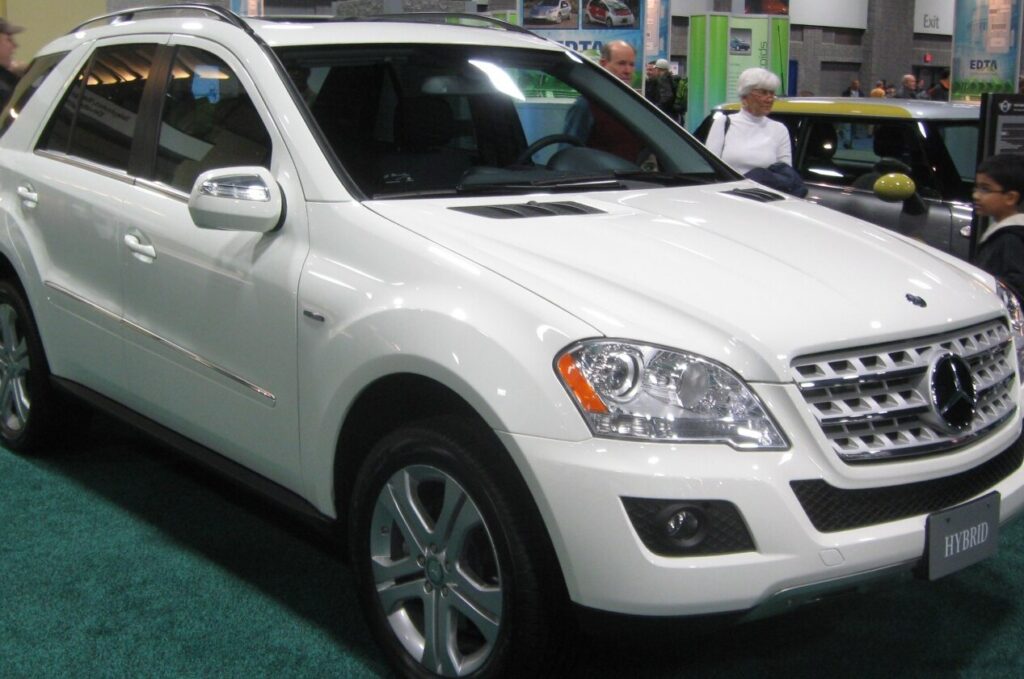
The Mercedes-Benz ML 450 Hybrid, produced between 2009 and 2011, represented a significant step for the German automaker into the burgeoning hybrid SUV market. Part of the second-generation M-Class (W164, post-facelift), the ML 450 Hybrid combined a 3.5-liter V6 gasoline engine with a two-motor full hybrid system, offering a blend of performance and improved fuel efficiency compared to its conventionally powered siblings. Positioned as a premium offering within the M-Class range, it aimed to appeal to environmentally conscious buyers who didn’t want to compromise on luxury or capability. This model was primarily targeted towards the North American market, where demand for larger vehicles and fuel efficiency was growing.
Technical Specifications
| Brand | Mercedes-Benz |
| Model | M-Class |
| Generation | M-Class (W164, facelift 2008) |
| Type (Engine) | ML 450 HYBRID V6 (340 Hp) 4MATIC CVT |
| Start of production | 2009 |
| End of production | 2011 |
| Powertrain Architecture | FHEV (Full Hybrid Electric Vehicle) |
| Body type | SUV |
| Seats | 5 |
| Doors | 5 |
| Fuel consumption (urban) | 11.2 l/100 km (21 US mpg, 25.2 UK mpg, 8.9 km/l) |
| Fuel consumption (extra urban) | 9.8 l/100 km (24 US mpg, 28.8 UK mpg, 10.2 km/l) |
| Fuel consumption (combined) | 10.7 l/100 km (22 US mpg, 26.4 UK mpg, 9.3 km/l) |
| Fuel Type | Petrol (Gasoline) |
| Acceleration 0 – 60 mph | 7.8 sec |
| Maximum speed | 211 km/h (131.11 mph) |
| Emission standard | SULEV |
| Gross battery capacity | 2.4 kWh |
| Battery voltage | 288 V |
| Battery technology | Nickel-metal hydride (NiMH) |
| Battery weight | 83 kg (182.98 lbs) |
| Max speed (electric) | 50 km/h (31.07 mph) |
| Electric motor power (1) | 84 Hp |
| Electric motor Torque (1) | 235 Nm (173.33 lb.-ft.) |
| Electric motor location (1) | Integrated into the transmission |
| Electric motor power (2) | 82 Hp |
| Electric motor Torque (2) | 260 Nm (191.77 lb.-ft.) |
| Electric motor location (2) | Integrated into the transmission |
| System power | 340 Hp |
| System torque | 517 Nm (381.32 lb.-ft.) |
| Power | 279 Hp @ 6000 rpm |
| Torque | 350 Nm @ 3000-5000 rpm (258.15 lb.-ft. @ 3000-5000 rpm) |
| Maximum engine speed | 6000 rpm |
| Engine layout | Front, Longitudinal |
| Engine Model/Code | M 272 |
| Engine displacement | 3498 cm3 (213.46 cu. in.) |
| Number of cylinders | 6 |
| Engine configuration | V-engine |
| Cylinder Bore | 92.9 mm (3.66 in.) |
| Piston Stroke | 86 mm (3.39 in.) |
| Compression ratio | 11.5:1 |
| Number of valves per cylinder | 4 |
| Fuel injection system | Multi-port manifold injection |
| Engine aspiration | Naturally aspirated engine |
| Valvetrain | DOHC |
| Engine oil capacity | 8 l (8.45 US qt | 7.04 UK qt) |
| Fuel tank capacity | 90 l (23.78 US gal | 19.8 UK gal) |
| Max. roof load | 100 kg (220.46 lbs) |
| Length | 4788 mm (188.5 in.) |
| Width including mirrors | 2124 mm (83.62 in.) |
| Height | 1774-1854 mm (69.84 – 72.99 in.) |
| Wheelbase | 2915 mm (114.76 in.) |
| Front track | 1644 mm (64.72 in.) |
| Rear track | 1647 mm (64.84 in.) |
| Ride height (ground clearance) | 186-261 mm (7.32 – 10.28 in.) |
| Minimum turning circle | 11.6 m (38.06 ft.) |
| Drivetrain Architecture | The Internal combustion engine (ICE) and Two electric motors permanently drive the four wheels of the car with the ability to work in full electric or mixed mode. |
| Drive wheel | All wheel drive (4×4) |
| Number of gears and type of gearbox | automatic transmission CVT |
| Front suspension | Air suspension |
| Rear suspension | Air suspension |
| Tires size | 235/65 R17; 255/55 R18; 255/50 R19 |
| Wheel rims size | 7.5J x 17; 8J x 18; 8J x 19 |
Powertrain & Engine Architecture
The ML 450 Hybrid’s powertrain is a complex system centered around the Mercedes-Benz M272 3.5-liter V6 engine. This engine, producing 279 horsepower and 258 lb-ft of torque, is paired with a sophisticated two-motor hybrid system developed in partnership with General Motors. The system utilizes a nickel-metal hydride (NiMH) battery pack with a gross capacity of 2.4 kWh. One electric motor (84 hp, 173 lb-ft torque) is integrated into the transmission housing, acting as both a motor and a generator, while the second electric motor (82 hp, 191 lb-ft torque) provides additional power and assists in regenerative braking. The combined system output reaches 340 horsepower and 381 lb-ft of torque. The transmission is a continuously variable transmission (CVT), optimized for efficiency and smooth power delivery. The M272 engine features multi-port fuel injection and a double overhead camshaft (DOHC) valvetrain. A Start & Stop system further enhances fuel economy by automatically shutting off the engine when the vehicle is stationary.
Driving Characteristics
The ML 450 Hybrid offered a noticeably different driving experience compared to the standard M-Class models. The electric motors provide instant torque, resulting in brisk acceleration – 0 to 60 mph in 7.8 seconds. The CVT transmission, while contributing to fuel efficiency, lacked the direct feel of a traditional automatic. In electric-only mode, the vehicle could travel short distances at speeds up to 31 mph, offering near-silent operation. The hybrid system seamlessly blended power from the gasoline engine and electric motors, providing a smooth and refined driving experience. Compared to the more powerful ML 550, the 450 Hybrid prioritized efficiency over outright performance. Against the diesel-powered ML 350 BlueTEC, the hybrid offered a different character, trading some low-end torque for a more refined and technologically advanced driving experience.
Equipment & Trim Levels
The ML 450 Hybrid was generally well-equipped, reflecting its premium positioning. Standard features included leather upholstery, dual-zone automatic climate control, a premium sound system, and a power liftgate. Optional extras included navigation, rear-seat entertainment, and various driver-assistance systems. The interior design was consistent with other W164 M-Class models, featuring a functional and luxurious layout. Specific trim details, such as wood or aluminum accents, could be customized. The dashboard featured a display providing information about the hybrid system’s operation and energy flow.
Chassis & Braking
The ML 450 Hybrid utilized an air suspension system on both the front and rear axles, providing a comfortable ride and the ability to adjust ride height. The braking system featured anti-lock brakes (ABS) and electronic brake-force distribution. Due to the added weight of the hybrid components, the suspension was tuned to provide stable handling. The vehicle’s weight distribution was carefully managed to optimize cornering performance. Rear brakes were typically discs, providing consistent stopping power.
Market Reception & Comparison
The ML 450 Hybrid received mixed reviews. Critics praised its fuel efficiency and smooth driving experience, but some found the CVT transmission to be less engaging than traditional automatics. Fuel economy figures of 22 mpg combined were a significant improvement over the non-hybrid M-Class models. However, the hybrid’s higher price tag and complex technology were drawbacks for some buyers. Compared to the ML 350, the hybrid offered better fuel economy but less low-end torque. Against the ML 550, it provided a more environmentally friendly alternative with slightly less power.
Legacy
The Mercedes-Benz ML 450 Hybrid was a pioneering vehicle in the luxury hybrid SUV segment. While production was relatively short-lived, it demonstrated Mercedes-Benz’s commitment to developing fuel-efficient technologies. The powertrain, while complex, proved to be reasonably reliable, although the hybrid components require specialized maintenance. On the used car market, the ML 450 Hybrid remains a relatively rare and sought-after vehicle, appealing to buyers who value fuel efficiency and advanced technology. The lessons learned from the ML 450 Hybrid paved the way for future Mercedes-Benz hybrid and electric vehicles.